
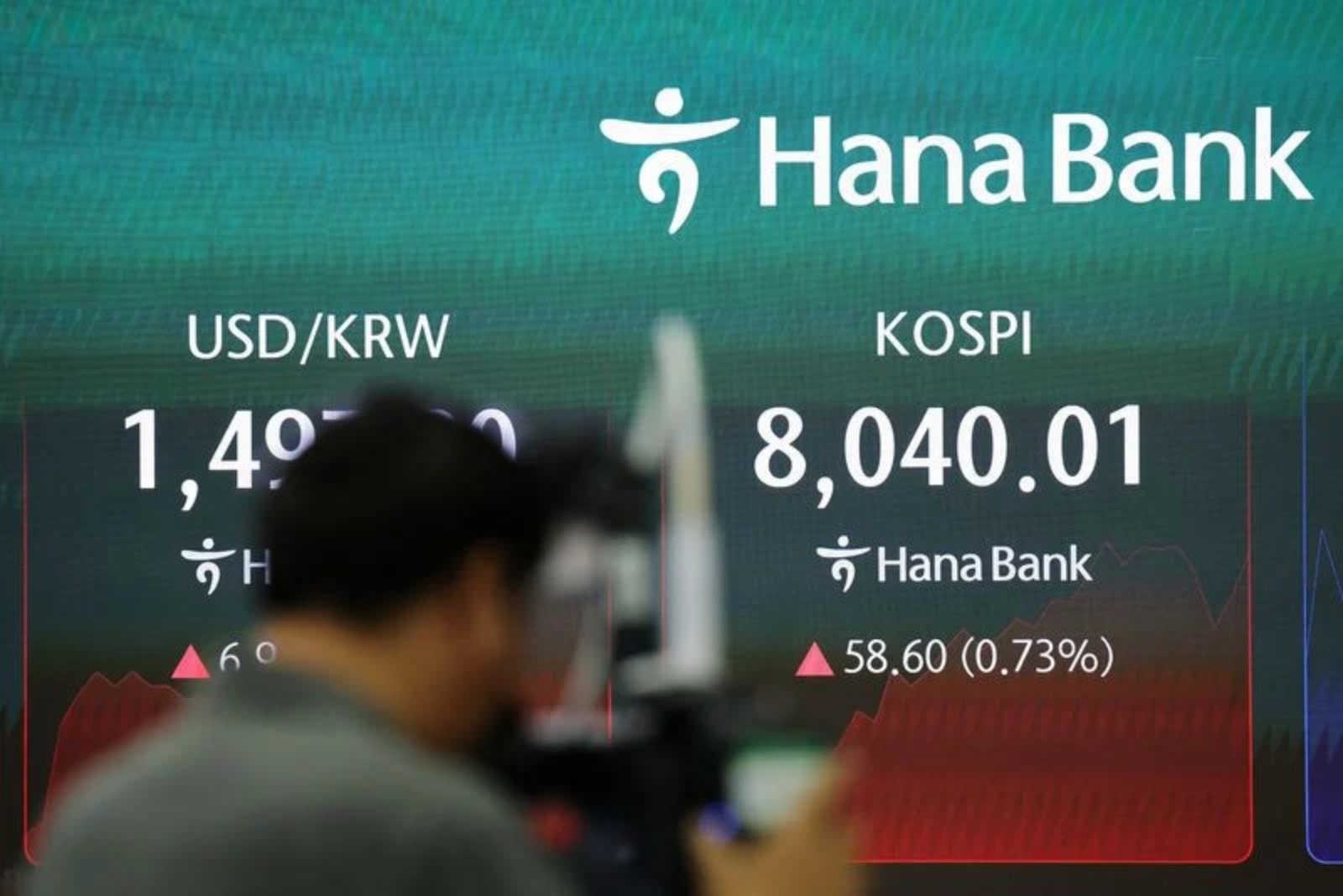
South Korea’s stock market experienced a severe downshift on Monday, with the KOSPI dropping as much as 8.8% in early trading as global rate expectations shifted higher following robust U.S. payrolls data. The sharp decline forced the activation of circuit breakers and prompted an immediate additional trading curb - a sidecar - when trading resumed.
Leading the slump were domestic semiconductor champions. Samsung Electronics and SK Hynix each recorded declines exceeding 10% at the session low, hitting the stocks that have been the primary engines of the index’s exceptional run. Both companies have seen their market capitalisations surge this year - by more than 150% for one and over 200% for the other - together representing over half the index and propelling them into the $1 trillion market-cap tier.
Circuit breakers were triggered at 0003 GMT, pausing trading for 20 minutes - the first such halt in three months, the third instance so far this year and the ninth time in the market’s history that this mechanism has been used. Once trading resumed, a sidecar curb was activated and the KOSPI’s peak losses were trimmed to 5.9% as of 0448 GMT.
Currency markets moved alongside equities. The Korean won strengthened 0.7% to 1,548.9 per dollar, a rebound from Friday’s session when the currency weakened to 1,615.0 - its weakest level since March 2009. Authorities held an emergency meeting and vowed decisive action to counter speculative trading, and foreign exchange officials reiterated warnings to market participants. Traders noted what they believe to be dollar-selling intervention by authorities to limit further depreciation of the won. "However, we will have to see if the 1,550 level will be defended," one trader said.
The selloff in Seoul followed heavy losses in U.S. markets on Friday. The Nasdaq Composite fell 4.2% after the U.S. payrolls surprise reduced hopes for near-term interest rate cuts. The Philadelphia Semiconductor Index recorded a roughly 10% decline, and the iShares MSCI South Korea ETF plunged about 14% during the session.
Market analysts pointed to the U.S. employment surprise as the catalyst that pushed bond yields higher and provided the trigger for a correction in an already overheated technology segment, particularly semiconductors. One market analyst noted that the semiconductor rally had accumulated pressure and that the employment numbers offered an immediate reason for profit-taking. At the same time, the analyst said that despite the heightened volatility, a prolonged rout was unlikely given that valuation pressure on the KOSPI had been partly relieved by recent corrections and earnings momentum for semiconductor companies remained solid.
Not all large-cap names moved in the same direction. SK Hynix pared some losses to trade down 3.8% after comments from Nvidia’s CEO during a visit to South Korea that the U.S. AI chipmaker considers SK Hynix its "biggest partner" while announcing new deals. E-commerce heavyweight Naver bucked the decline, jumping 14.1% on a deal with Nvidia.
Foreign investors were net sellers of Korean equities on the day, offloading 1.2 trillion won in local shares - equivalent to about $773.89 million - and extending a streak of consecutive net outflows to 21 sessions.
Despite the steep losses recorded on Monday, the KOSPI remains materially higher year-to-date. The index is up 83% so far this year. In 2025, it rose 76% - the biggest annual increase since 1999 and the top performance among major markets last year.
Exchange rate reference: $1 = 1,552.1000 won.
Context and market implications
The rapid reversal in sentiment highlights how dependent the KOSPI’s recent gains have been on a narrow set of technology leaders, and how sensitive that concentration is to shifts in global interest rate expectations. The combination of outsized market-cap weighting by a few semiconductor firms and continuing foreign selling has amplified the market’s reaction to external macroeconomic data.