
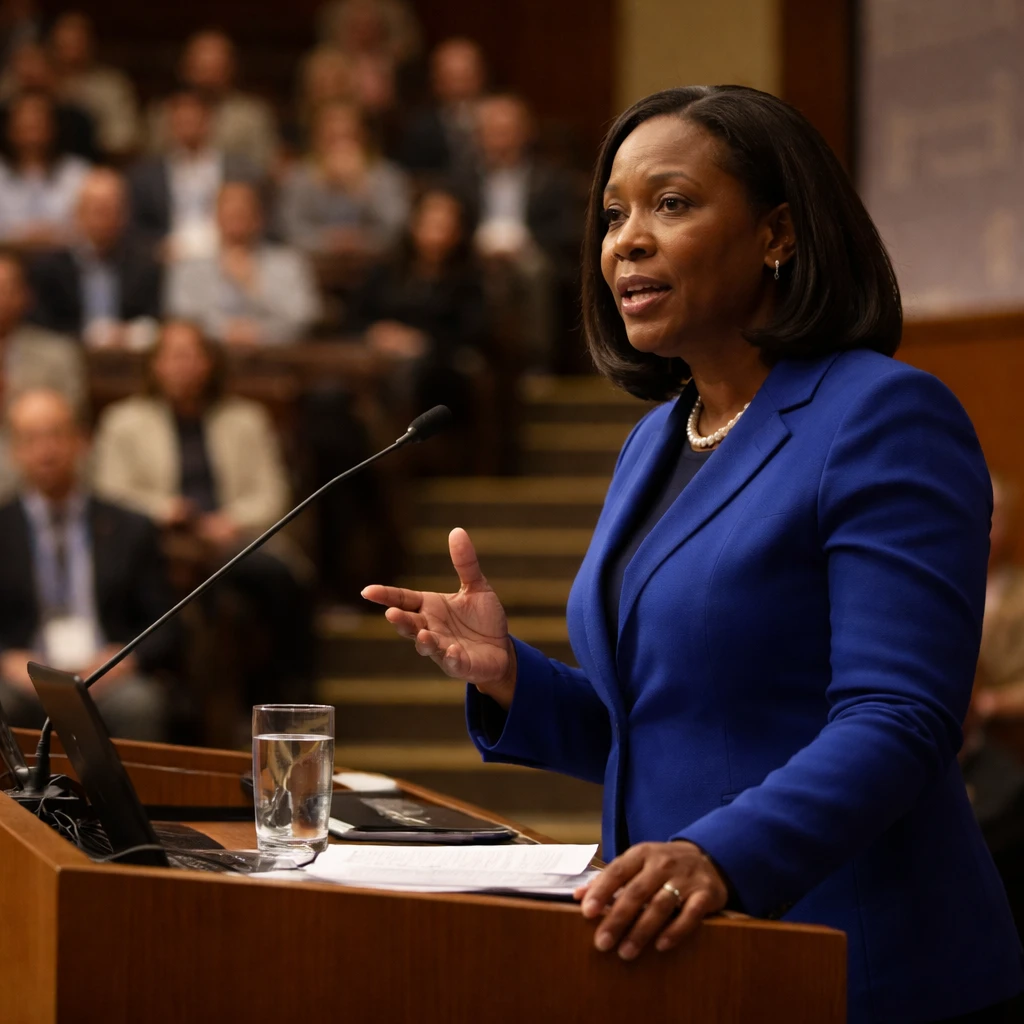
Federal Reserve Governor Lisa Cook said policymakers should hold short-term interest rates steady for the time being, while keeping open the option of raising them if inflation fails to slow as expected.
Speaking at a policy forum on artificial intelligence hosted by Stanford's Institute for Economic Policy Research, Cook framed the current stance as a risk-management choice. She said the balance of risks tied to the Fed's dual mandate - price stability and maximum employment - argues for patience in policy for now, but that the risks are not one-sided.
Cook described recent inflation developments as moving "in the wrong direction," attributing upward pressure to a combination of factors identified at the forum. She pointed to tariffs enacted last year, an increase in oil prices since the Iran war began on February 28, and stronger demand for semiconductors and software. Cook also highlighted that construction wages are under upward pressure as investment in AI data centers accelerates.
While Cook said she currently expects inflation to fall in coming months without further rate increases, she cautioned that a prolonged period of inflation above the Fed's 2% target could become embedded in price- and wage-setting behavior. "The risks remain tilted toward higher inflation," she said. "I am prepared to raise rates, if the expected disinflation does not appear in a timely manner."
Cook's recent comments come after she joined the majority at last month's Federal Open Market Committee vote to leave the policy rate unchanged in a 3.50%-3.75% target range. The governor's readiness to consider a rate increase introduces a potential complication for the new Fed chair, Kevin Warsh, whom the president appointed with expectations tied to eventual easing once the Iran war ends and energy prices retreat. Several other Fed officials have similarly signaled that another hike could be necessary under certain conditions.
At the Stanford event, Cook expressed optimism about the potential for rapid corporate adoption of artificial intelligence to lift productivity and economic growth. At the same time, she warned that AI-driven transitions could produce near-term job losses before new roles materialize, creating downside risk for an otherwise steady labor market.
Cook said she expects the labor market to remain stable without cuts to interest rates, but she also left open the option of lowering rates should employment conditions weaken. The unemployment rate was 4.3% in April.
Cook's remarks underline the Fed's current approach of cautious monitoring: keeping policy unchanged while reserving the flexibility to respond to persistent inflation or a notable weakening in labor market conditions. The governor tied specific inflationary forces to trade policy, energy-market developments linked to geopolitical events, and technology-driven demand pressures associated with AI investment.