
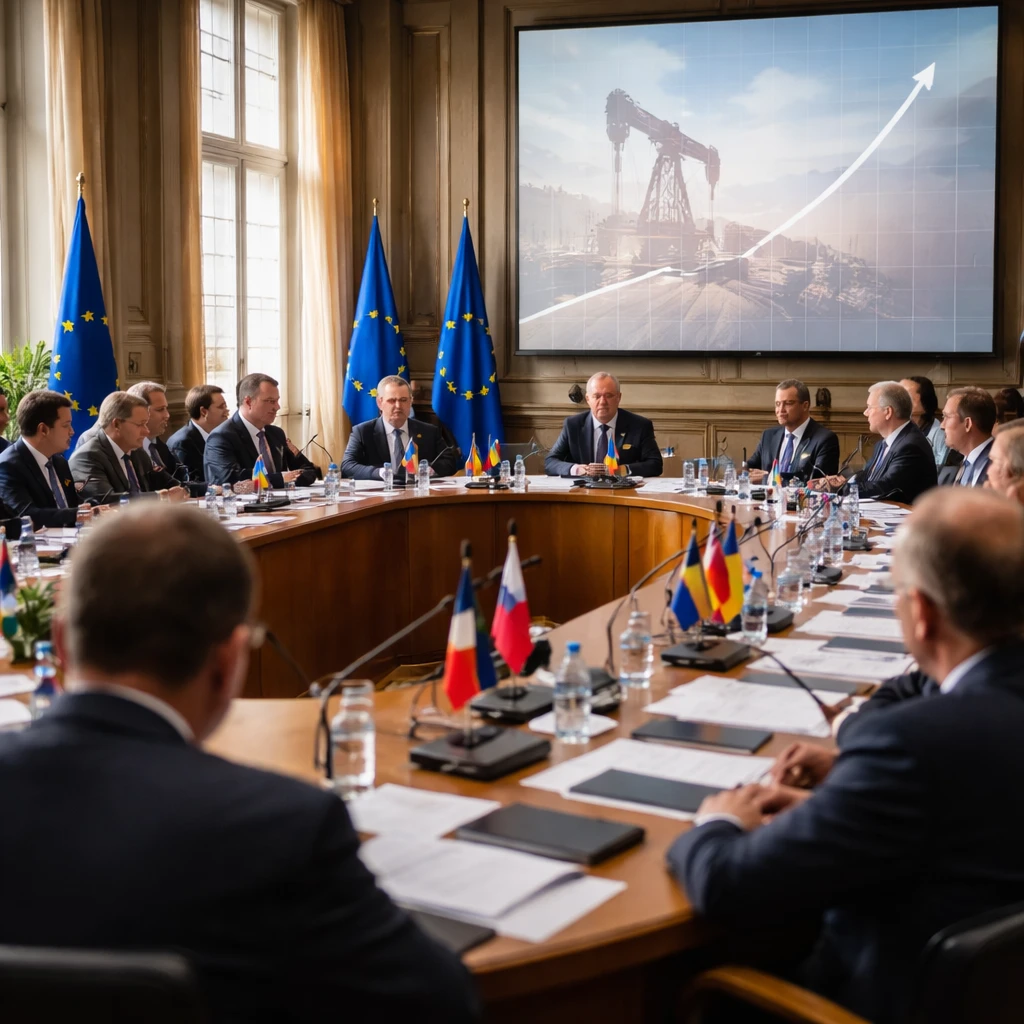
European finance ministers gathered informally in Nicosia voiced concern that a sharp rise in energy prices linked to the Iran war has pushed the bloc into a stagflationary trend, while urging governments to avoid measures that would provoke a fiscal crisis.
The European Commission on Thursday set out a dour near-term outlook for the euro zone, projecting growth to slow to 0.9% in 2026 from 1.3% in 2025 and forecasting inflation to accelerate to 3.0% from 1.9% - a level clearly above the European Central Bank's 2.0% target.
Before entering the informal talks in Nicosia, the chairman of euro zone finance ministers, Kyriakos Pierrakakis, said: "There is stagflationary pressure, but Europe is resilient." The commission noted the fallout from the Middle East war could prove worse the longer it endures.
Officials and markets have been closely watching the implications of the conflict. The Commission highlighted that investors are increasingly concerned a war in Iran might deliver a persistent inflationary shock; government bond yields have responded by rising to levels not seen in a decade, exacerbating pressure on public finances.
Pierrakakis described how ministers were balancing competing priorities: "We have seen the instability in the bond markets and we are trying to balance on the one hand the need to support our citizens ... and on the other we should not allow this energy crisis to metastasize into a fiscal crisis."
Policy guidance and fiscal limits
The Commission urged national governments to confine support to measures that are both targeted and temporary, focusing assistance on the most vulnerable. Despite that advice, several countries have already implemented broad measures such as cuts to excise taxes on petrol, which apply across the population rather than being narrowly targeted.
European Economic Commissioner Valdis Dombrovskis stressed the preferred approach to fiscal relief: "In terms of policy response we recommend to stick to temporary and targeted measures, not to sustain and drive up demand for fossil fuels in view of the limited fiscal space." Pierrakakis added a similar emphasis on precision: "What we need to be is surgical (with the support measures)."
Budgetary outlook and political debates
The Commission's projections imply growing strain on public finances. It forecasts the aggregated euro zone budget deficit will rise to 3.5% of GDP next year from 2.9% in 2025, a level above the EU's 3.0% ceiling. Public debt is also expected to climb to 91.2% of GDP in 2027 from 88.7% in 2025.
Some governments, notably Italy, have pushed for the Commission to treat fiscal support for fuel prices in a similar way to defence spending - effectively excluding it from deficit calculations. However, the Commission and most finance ministers have been reluctant to adopt that approach.
Belgian Finance Minister Vincent van Peteghem told reporters that opening a broad escape clause would be problematic, arguing: "I know some countries are proposing this, but opening a general escape clause is difficult because this is a supply crisis, rather than a demand one."
Ministers therefore face a narrow path: provide relief to households and firms facing higher energy costs while avoiding policies that could deepen fiscal imbalances, sustain fossil fuel demand, or amplify inflationary pressures. The coming months will test how governments balance these competing imperatives amid elevated bond yields and an uncertain conflict trajectory.