
Economy May 29, 2026 04:38 AM

ECB Plans Prompt, Calibrated Response to Prevent Energy Shock Becoming Enduring Inflation

Fabio Panetta signals possible policy 'recalibration' ahead of June governing council meeting as energy costs fuel price pressures

By Priya Menon

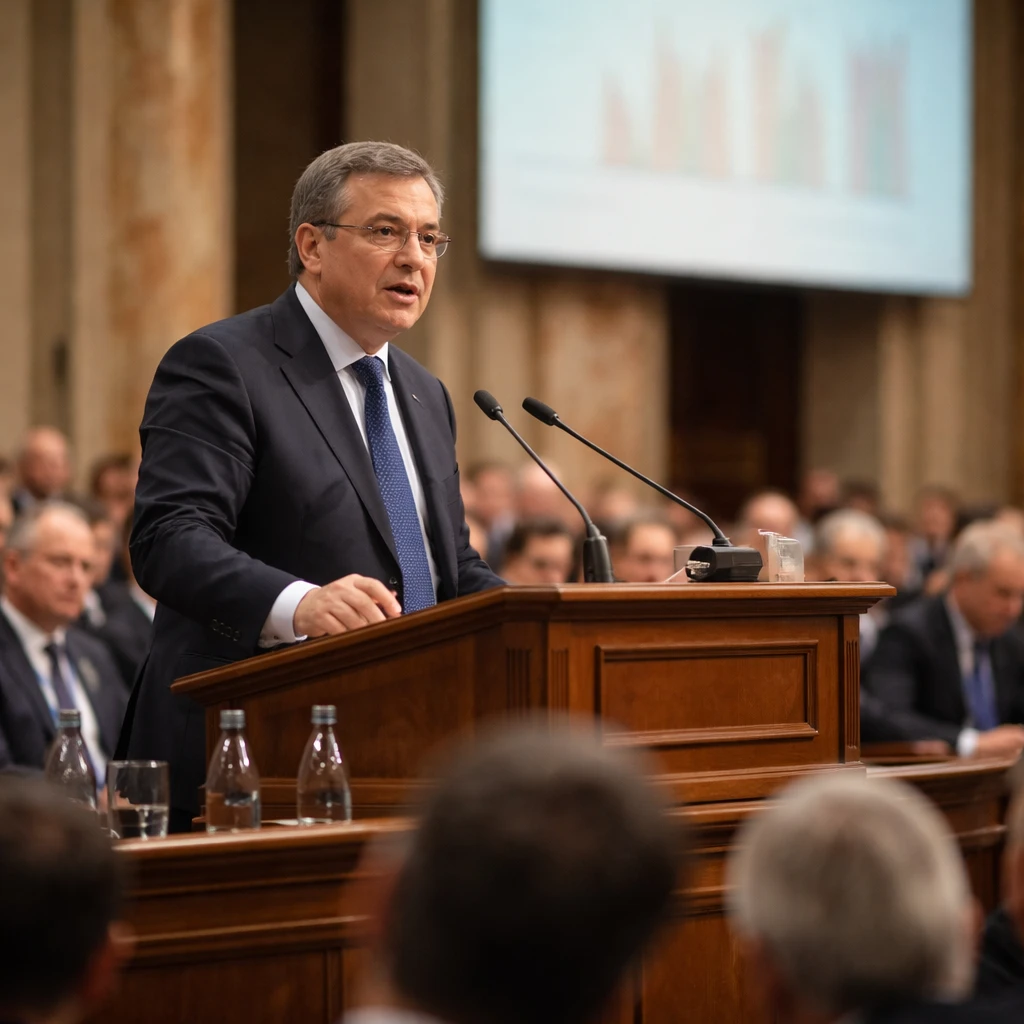
Fabio Panetta, a member of the European Central Bank's governing council and governor of the Bank of Italy, said the ECB will act in a "timely and measured manner" to prevent the current energy shock from becoming persistent inflation. Speaking at the Bank of Italy's annual assembly in Rome, Panetta called for a "recalibration" of monetary policy and said the June 10-11 meeting will need to assess the pass-through from higher energy prices. He warned that oil and gas prices are unlikely to normalize quickly even if the Iran war is rapidly resolved, and noted rising consumer inflation expectations and firms' plans for price increases, while medium-term market expectations remain anchored to the ECB's 2% goal.

ECB Plans Prompt, Calibrated Response to Prevent Energy Shock Becoming Enduring Inflation

Key Points

  • ECB to act in a "timely and measured manner" to prevent the current energy shock from becoming persistent inflation - impacts monetary policy decisions.
  • Bank is expected to raise rates at the June 10-11 governing council meeting; assessing pass-through from higher energy prices will be central - affects fixed income and borrowing costs.
  • Oil and gas prices are unlikely to normalize quickly even if the Iran war is rapidly resolved; consumers' inflation expectations are rising and firms are planning price increases - implications for energy, consumer goods, and corporate pricing strategies.

Fabio Panetta, a member of the European Central Bank's governing council and the governor of the Bank of Italy, told attendees at the Italian central bank's annual assembly in Rome that the ECB will move in a "timely and measured manner" to stop the current energy shock from evolving into sustained inflation.

Addressing the assembly, Panetta said the outlook for inflation ahead calls for what he described as a "recalibration" of monetary policy by the ECB. He underlined that policymakers are watching developments closely as they prepare for the next governing council meeting, scheduled for June 10-11, where the bank is widely expected to raise interest rates.

Panetta said it will be particularly important at the June meeting to evaluate how much of the recent increase in energy costs is being passed through into broader prices. He noted that numerous policymakers have signaled a need for action, and that assessing the extent of pass-through from higher energy prices will be a central consideration in determining the bank's response.

On the outlook for energy markets, the Bank of Italy chief warned that oil and gas prices are unlikely to normalize quickly even if the Iran war is rapidly resolved. That prospect, he suggested, increases the risk that short-term energy shocks could spill over into more persistent price pressures unless addressed by policy measures.

Panetta also pointed to signs that inflation expectations among households are rising and that companies have already begun planning to raise prices. Those developments, he implied, increase the urgency of a measured policy response to prevent temporary shocks from becoming entrenched.

At the same time, he observed that medium-term inflation expectations priced into financial markets remain firmly anchored to the ECB's 2% target. That anchoring provides some reassurance about longer-run price stability even as near-term risks intensify.


Panetta's remarks frame the immediate policy challenge for the ECB: calibrating a response that counters the risk of inflation becoming persistent while taking account of the uncertain path of energy prices and the degree to which those costs transmit to consumers and businesses.

Risks

  • Unclear extent of pass-through from higher energy prices into broader inflation - creates uncertainty for central bank policy and financial markets, particularly fixed income and bank lending.
  • Oil and gas costs may remain elevated even if the Iran war is rapidly resolved - sustained pressure on energy sector costs and downstream producers.
  • Rising consumer inflation expectations and firms planning price hikes could make temporary shocks harder to reverse, increasing the risk of entrenched inflation for households and businesses.

More from Economy

Australian house price momentum to slow to four-year low as borrowing costs bite Jun 4, 2026 Kevin O’Leary Scales Back Utah Data Center Plan Amid Lawmaker Concerns Jun 4, 2026 Fed's Daly Says AI Could Exert Downward Pressure on Prices Over Several Years Jun 4, 2026 Putin Says Moscow Willing to Make Concessions if Kyiv Reciprocates Jun 4, 2026 Putin Says Moscow and Beijing Near New Energy Deals, Offers Few Details Jun 4, 2026