
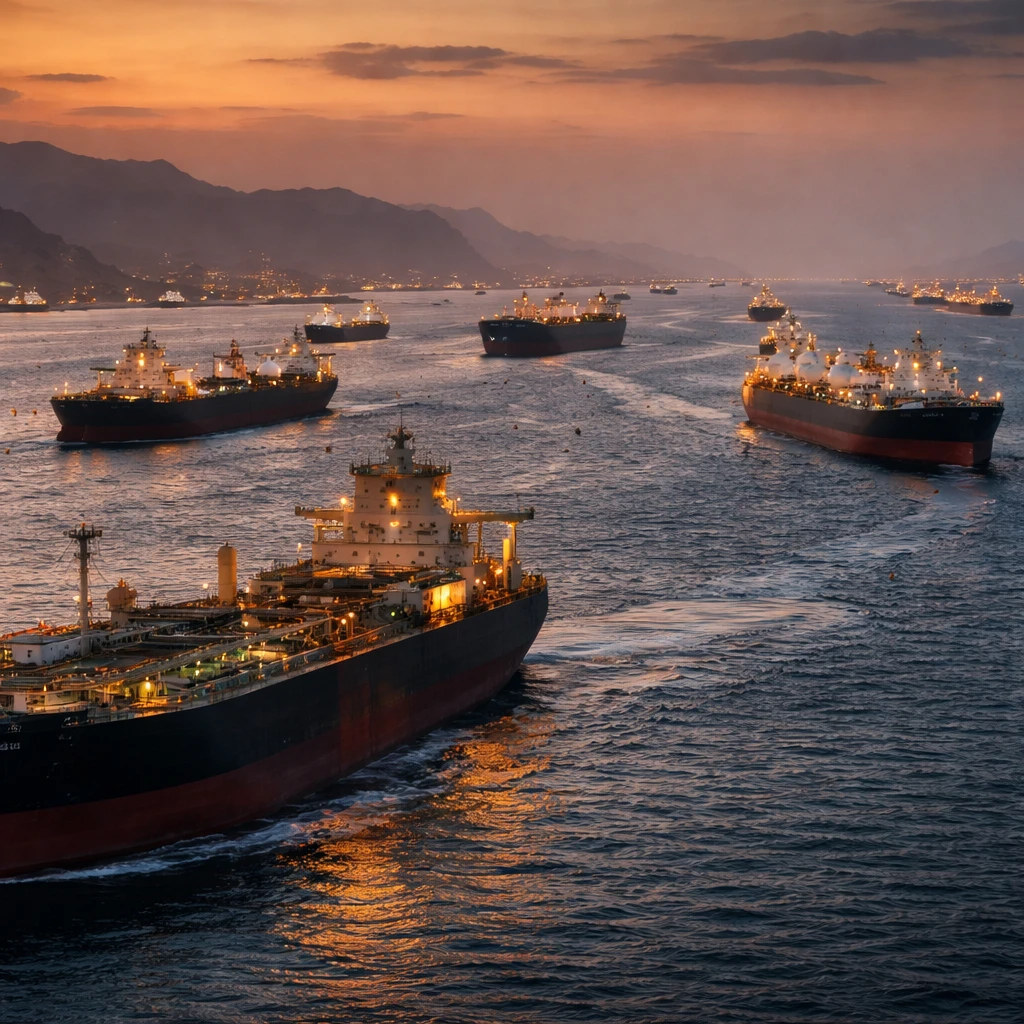
Dallas Federal Reserve President Lorie Logan said on Wednesday that a prolonged closure of the Strait of Hormuz could compel a reduction in global oil and natural gas consumption if shipping does not soon return to prewar levels.
Logan, speaking from prepared remarks for delivery at a Bank of Japan conference, said Iran has restricted shipping through the strait during the three-month conflict between the United States and Israel on Iran. That disruption has contributed to higher prices for energy, food and fertilizer, she said, noting that roughly one-fifth of the world's oil and liquefied natural gas transited the narrow waterway before the conflict began.
"With supplies highly constrained, if shipping through the strait does not soon return to prewar levels, world oil and natural gas consumption could need to fall more meaningfully than it has so far," Logan said.
Logan emphasized that the economic effects depend on how end users respond. If consumers and industries can switch to alternative energy sources or adopt more efficient energy use, those adjustments could mitigate the need to curtail broader economic activity. If such adaptations are not feasible at sufficient scale, however, the alternative could be a direct reduction in economic output as energy consumption is cut back.
In presenting the dynamics of supply and demand, Logan pointed to data from a recent Dallas Fed survey of U.S. oil executives. Those respondents expect U.S. oil production to increase by about 250,000 barrels per day this year and by about 500,000 barrels per day next year. By contrast, Logan noted a much larger shrinkage in global oil supply tied to the conflict - a decline of about 13 million barrels per day since the start of the Iran war - a shortfall that has been largely bridged so far by drawing down inventories.
"One way or another, I expect energy markets to come into rough balance before too long," she said. "If the molecules aren't available, the world can't consume them."
Logan was one of three Federal Reserve policymakers who dissented at last month's interest-rate decision, arguing that the central bank should signal that a rate increase is as likely as a rate cut given rising energy and other prices. In her prepared remarks at the closed-press conference on Wednesday, Logan did not provide near-term economic forecasts or comment on monetary policy.
Key takeaways
- Prolonged disruption of shipping through the Strait of Hormuz could force a material reduction in global oil and natural gas consumption.
- The shortfall in global oil supply since the Iran war - roughly 13 million barrels per day - has been mainly offset so far by inventory drawdowns; U.S. production is expected to rise modestly by 250,000 b/d this year and 500,000 b/d next year, according to a Dallas Fed survey.
- The ultimate economic impact will hinge on end users' ability to switch fuels or improve energy efficiency versus having to curtail economic activity.
Risks and uncertainties
- Duration of the strait disruption - Continued restrictions on shipping could deepen supply constraints and require steeper consumption cuts, affecting energy and related sectors such as fertilizer and food.
- Ability to substitute fuels or boost efficiency - If end users cannot switch energy sources or significantly reduce intensity, broader economic activity could be curtailed.
- Reliance on inventories - The current bridging of the supply gap has depended on drawing down inventories; if inventories are depleted before flows recover, market balance could be more difficult to restore.
The comments underscore the interconnected risks between geopolitics, energy markets and the broader economy. Logan framed the issue in operational terms: if the physical supply of hydrocarbons is constrained, demand must ultimately adjust.