
Economy June 2, 2026 06:20 AM

Canada's trade minister to meet U.S. trade chief after being left out of Mexico talks

Dominic LeBlanc to sit down with U.S. Trade Representative Jamieson Greer as Ottawa remains outside initial U.S.-Mexico negotiating round on USMCA revisions

By Priya Menon

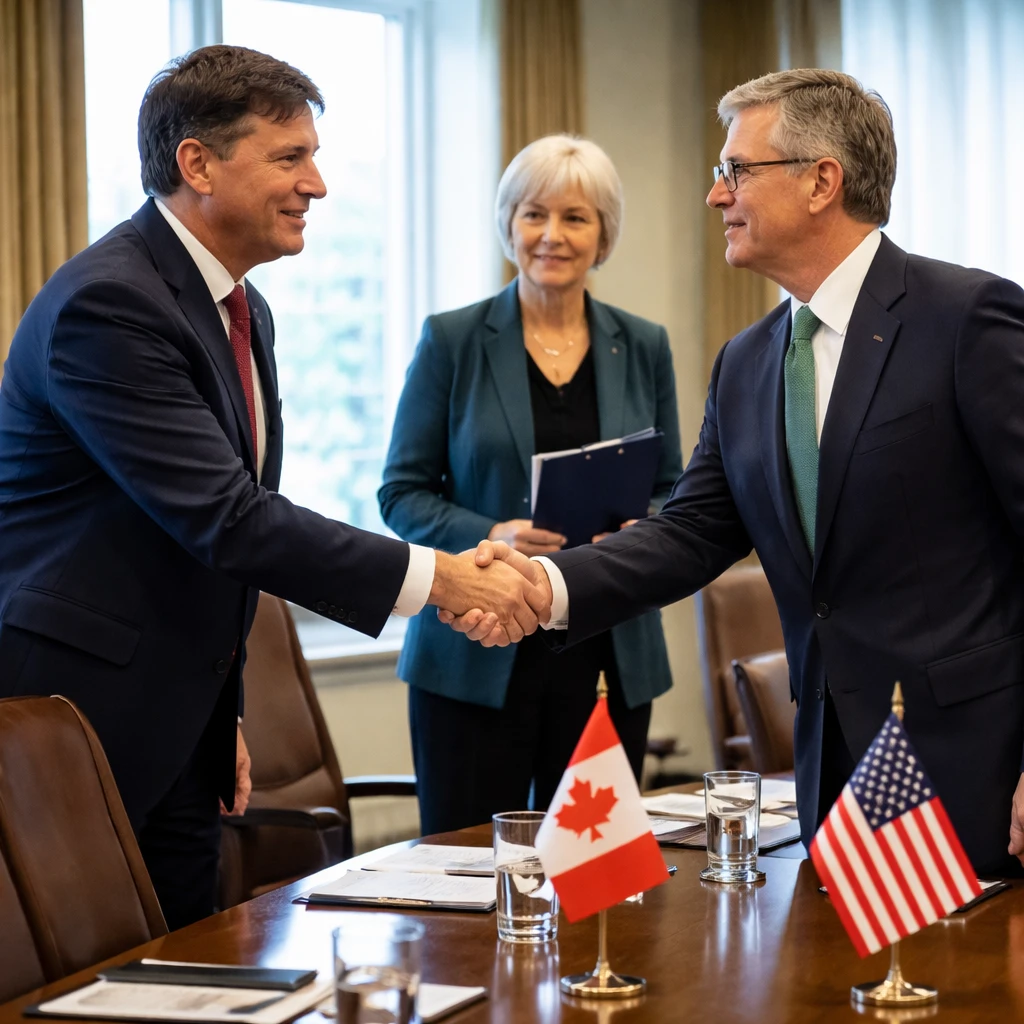
Canada's minister in charge of Canada-U.S. trade, Dominic LeBlanc, will meet U.S. Trade Representative Jamieson Greer on Tuesday, with Chief Trade Negotiator to the United States Janice Charette attending. The meeting comes after Canada was excluded from the first bilateral talks between the United States and Mexico on revisions to the United States-Mexico-Canada Agreement (USMCA). The U.S.-Mexico discussions addressed automotive rules of origin, steel and aluminum trade, and economic security. Canada has not yet opened formal negotiations and faces a July 1 review deadline for the pact.

Canada's trade minister to meet U.S. trade chief after being left out of Mexico talks

Key Points

  • Dominic LeBlanc will meet U.S. Trade Representative Jamieson Greer on Tuesday, accompanied by Janice Charette.
  • The meeting comes after Canada was excluded from the first round of bilateral U.S.-Mexico talks on USMCA revisions, which covered automotive rules of origin, steel and aluminum trade, and economic security.
  • Canada has not yet begun formal negotiations on the USMCA, which must be reviewed by July 1; failing agreement to extend would shift the pact to annual reviews through 2036.

Canada's minister with responsibility for Canada-U.S. trade, Dominic LeBlanc, is scheduled to meet U.S. Trade Representative Jamieson Greer on Tuesday, the minister's office said on Monday. Janice Charette, Canada's Chief Trade Negotiator to the United States, will accompany LeBlanc to the meeting.

The announcement follows Canada's exclusion from last week's bilateral talks between the United States and Mexico on revising the United States-Mexico-Canada Agreement (USMCA). LeBlanc's office did not provide details on the agenda for Tuesday's discussions.

Officials from the United States and Mexico concluded their first round of bilateral negotiations on Friday. According to the U.S. Trade Representative's office, those talks dealt with automotive rules of origin, steel and aluminum trade, and economic security.

Canada has not yet begun formal negotiations on revisions to the three-party trade pact. The agreement is subject to a required review by July 1. If the three parties do not agree to extend the existing terms, the accord would shift to annual reviews through 2036.

U.S. Trade Representative Jamieson Greer has signaled that Canada may need to accept some form of tariffs in order to participate in discussions with the United States over the agreement's revision. Greer has also stated that a revised USMCA should include tighter automotive rules of origin and should increase access for U.S. businesses to Canadian markets, citing dairy as one example.

Details on how Tuesday's meeting might affect the timeline for Canada's formal entry into talks, or whether it will resolve the questions raised by the U.S.-Mexico bilateral session, were not provided in the statement from LeBlanc's office.


Context and next steps

  • Canada's participation status: Ottawa has not started formal negotiations on USMCA revisions.
  • Key issues in earlier talks: automotive rules of origin, steel and aluminum trade, and economic security were discussed by the U.S. and Mexico.
  • Timeline pressure: the pact must be reviewed by July 1, or it will move to annual reviews until 2036 if no extension is agreed.

No additional information was released about the objectives for Tuesday's meeting between LeBlanc, Charette, and Greer.

Risks

  • Uncertainty over Canada's role in USMCA revisions - Canada's exclusion from the initial U.S.-Mexico talks creates ambiguity around its negotiating position and timeline, affecting trade-sensitive sectors such as automotive and agriculture.
  • Potential for tariff demands - U.S. statements indicating Canada may have to accept some form of tariffs to engage could pose downside risk for cross-border trade in steel, aluminum, and other exposed industries.
  • Deadline-driven negotiation pressure - the July 1 review deadline introduces timing risk; failure to agree on an extension would move the agreement to annual reviews until 2036, creating ongoing regulatory uncertainty for market participants.

More from Economy

Market Resilience Amidst Sector Shifts: Dow and Russell 2000 Reach New Heights Jun 4, 2026 Australian house price momentum to slow to four-year low as borrowing costs bite Jun 4, 2026 Kevin O’Leary Scales Back Utah Data Center Plan Amid Lawmaker Concerns Jun 4, 2026 Fed's Daly Says AI Could Exert Downward Pressure on Prices Over Several Years Jun 4, 2026 Putin Says Moscow Willing to Make Concessions if Kyiv Reciprocates Jun 4, 2026