
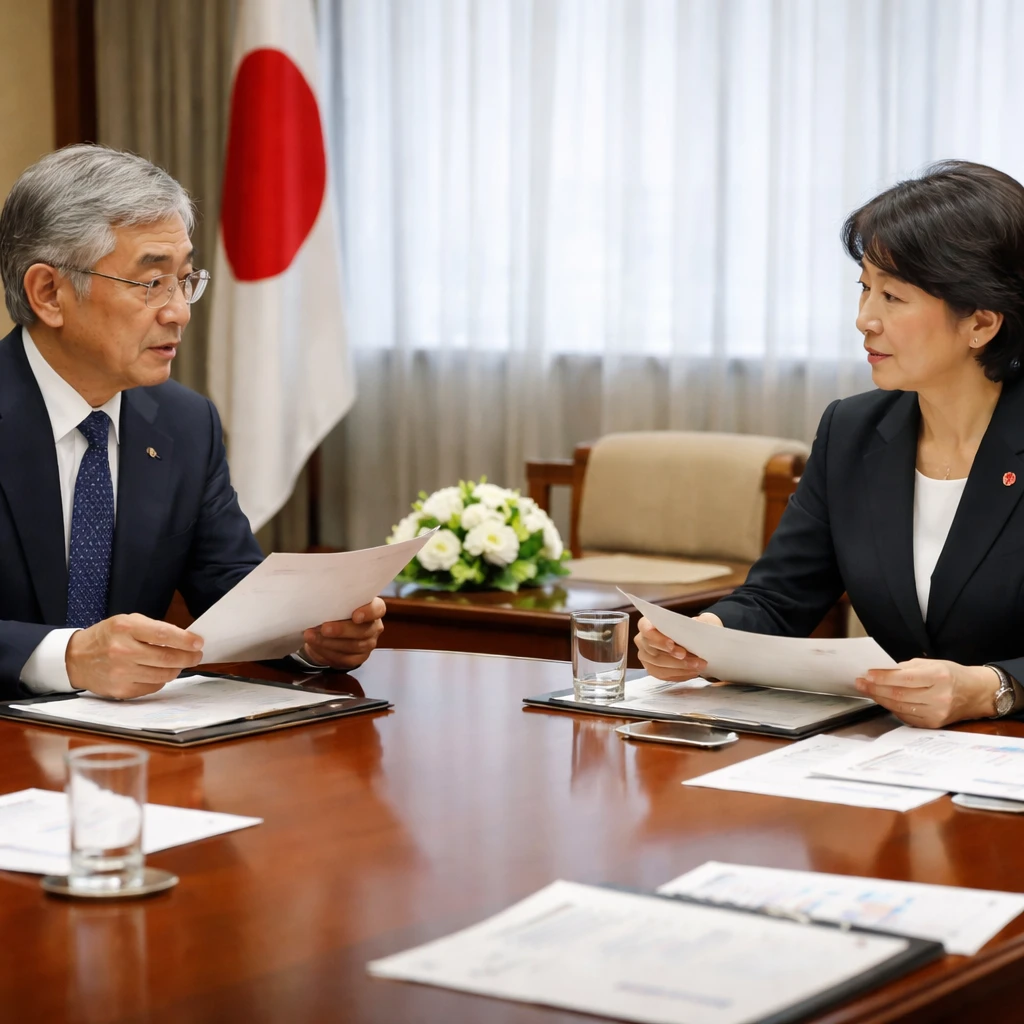
Bank of Japan Governor Kazuo Ueda held a meeting with Prime Minister Sanae Takaichi on Friday to set out the central bank's approach to monetary policy and to discuss recent economic and market dynamics.
When questioned by reporters about rising market expectations for a rate increase in June, Ueda said there was no specific conversation on that topic during the meeting. He declined to engage with the market speculation, noting only that the timing of any potential move was not part of the discussions held with the prime minister.
Both officials agreed to keep close coordination between the central bank and the government, Ueda said. According to his account, Takaichi conveyed a desire for the BOJ to implement appropriate monetary policy consistent with their mutual understanding, while also taking into account government measures intended to offset the effects of higher inflation.
Ueda described the session as useful, saying the pair exchanged views on a range of issues. Topics he listed included economic conditions, developments in prices and movements in financial markets. He also confirmed that the conflict in the Middle East was raised as part of the discussion.
Asked whether the prime minister had accepted the BOJ's stance on monetary policy, Ueda characterized the exchange as positive across multiple fronts. He did not offer additional detail about any specific agreements beyond the mutual commitment to continue close coordination.
Key points
- Ueda and Takaichi agreed to maintain close coordination between the Bank of Japan and the government.
- No specific discussion took place on market expectations of a June interest rate increase.
- Meeting topics included economic conditions, price developments, market movements and the Middle East conflict.
Sectors affected: Financial markets and policymaking bodies are directly referenced in the discussion of market movements and monetary policy; price developments relate to inflation-sensitive sectors.
Risks and uncertainties
- Ongoing market speculation about a June rate increase remains unresolved, creating uncertainty for financial markets.
- Rising inflation and the need for government measures to cushion its effects introduce policy uncertainty for inflation-sensitive sectors.
- Geopolitical tensions in the Middle East were discussed, representing a potential source of market volatility.