
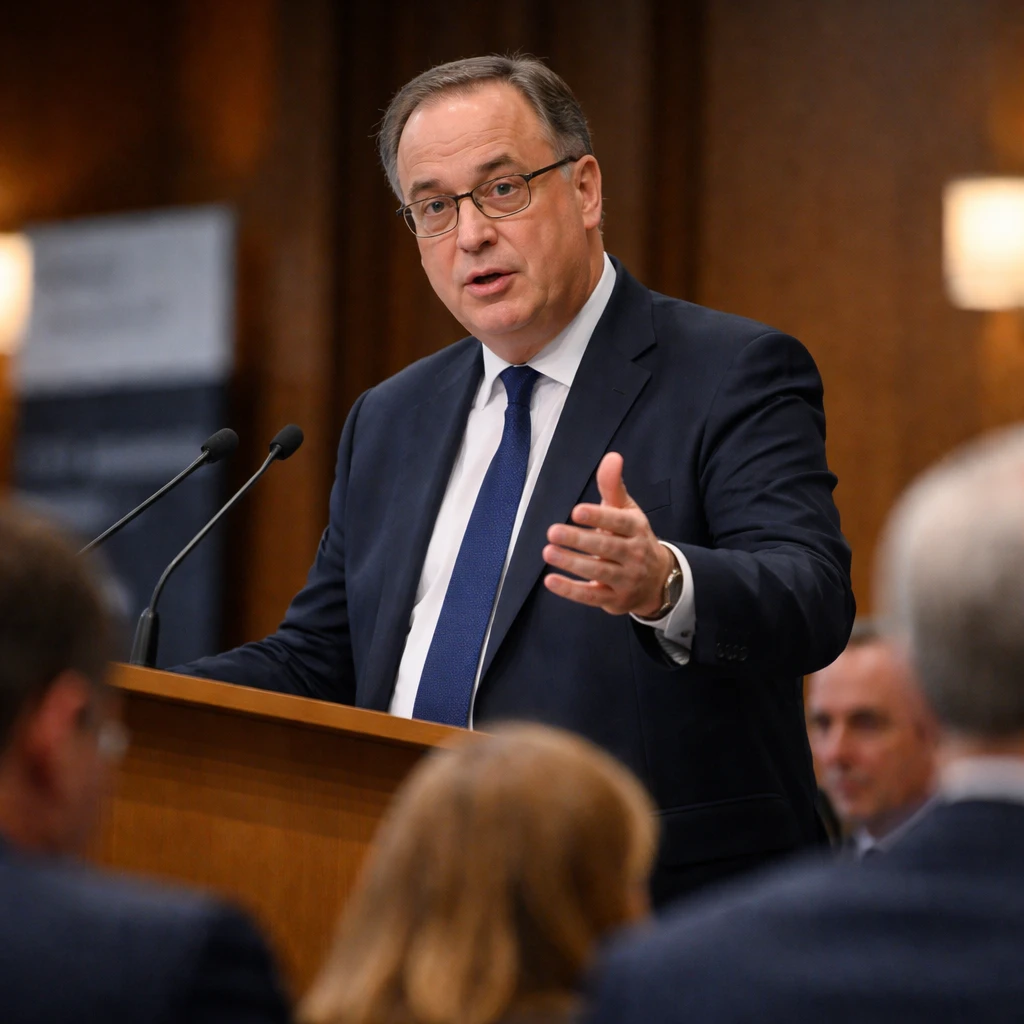
Bank of England Governor Andrew Bailey said he welcomed markets dialing back expectations for future interest-rate rises but said the outlook would hinge on how the conflict in the Middle East evolves. He defended the central bank's willingness to allow inflation to run above its 2% target as a temporary measure to cushion a weakening economy, while drawing a firm line on longer-lasting inflation pressures.
Speaking in a question-and-answer session after delivering a speech at a conference in Reykjavík organised by Iceland's central bank, Bailey said he hoped the markets' reassessment would continue. "I hope it goes on. I think that will depend on events in the Middle East," he said.
Financial market pricing has shifted markedly since March. Markets are now fully pricing a single quarter-point rate rise over the remainder of 2026, expected in November, with only about a one-in-three chance priced for a second move. That stands in contrast to expectations from earlier in the year, when investors were pricing in more than three hikes.
Bailey argued that tolerating inflation above the Bank's 2% target is justified under current conditions given two key uncertainties explicitly cited by policymakers: the economic impact of the Iran war and the economy's sluggish pace of growth. At the same time, he was careful to limit that tolerance if evidence of persistent, broader inflationary pressures emerges. "But that tolerance would weaken if signs of second-round effects begin to emerge," he said, referring to effects that could feed through to longer-term inflation.
The governor reiterated that monetary policy has been tightened in part by removing the prospect of rate cuts, a stance he said is already having effects across the economy. "We have to monitor the situation in the Middle East and how it affects the UK economy and inflation very closely and adjust policy as required," Bailey added, emphasizing that policymakers are watching the interaction between external shocks and domestic conditions.
The Monetary Policy Committee left interest rates unchanged at its April 30 meeting while it evaluated the economic consequences of the Iran war. The central bank simultaneously said it expected inflation to rise as a result of the energy price shock linked to the conflict. Bailey and most of his MPC colleagues have signalled they are not in a hurry to raise borrowing costs.
That posture contrasts with signals from the European Central Bank, which indicated a likely rate increase in June after having cut rates by a greater amount than the BOE before the conflict began.
As the MPC approaches its next meeting on June 18, the economy appears to be losing momentum. Consumers are spending less, businesses are pulling back on investment, building inventories and cutting jobs amid higher energy costs. A softer-than-expected April inflation print has strengthened the case for those within the MPC who prefer keeping rates on hold for now.
Bailey warned that the Iran conflict has pushed the United Kingdom toward a second cost-of-living shock in under five years because of the country's substantial dependence on imported energy. He said the "legacy of four years ago," when inflation jumped into double digits after Russia's invasion of Ukraine, remains a relevant consideration for current policy deliberations.
On the persistence of indirect effects from energy shocks, Bailey cautioned that they can take time to materialise and can make arguments for ignoring them weaker. "Because they take longer to come through, the argument for looking through the indirect effects is weaker, and protracted indirect effects could keep inflation above target for too long unless monetary policy responds," he said.
With markets revising their expectations for rate rises and with headline inflation and economic momentum both in flux, the BOE faces a balancing act: tolerating some overshoot of the inflation target to support a fragile economy while remaining prepared to act if inflationary dynamics broaden and persist.