
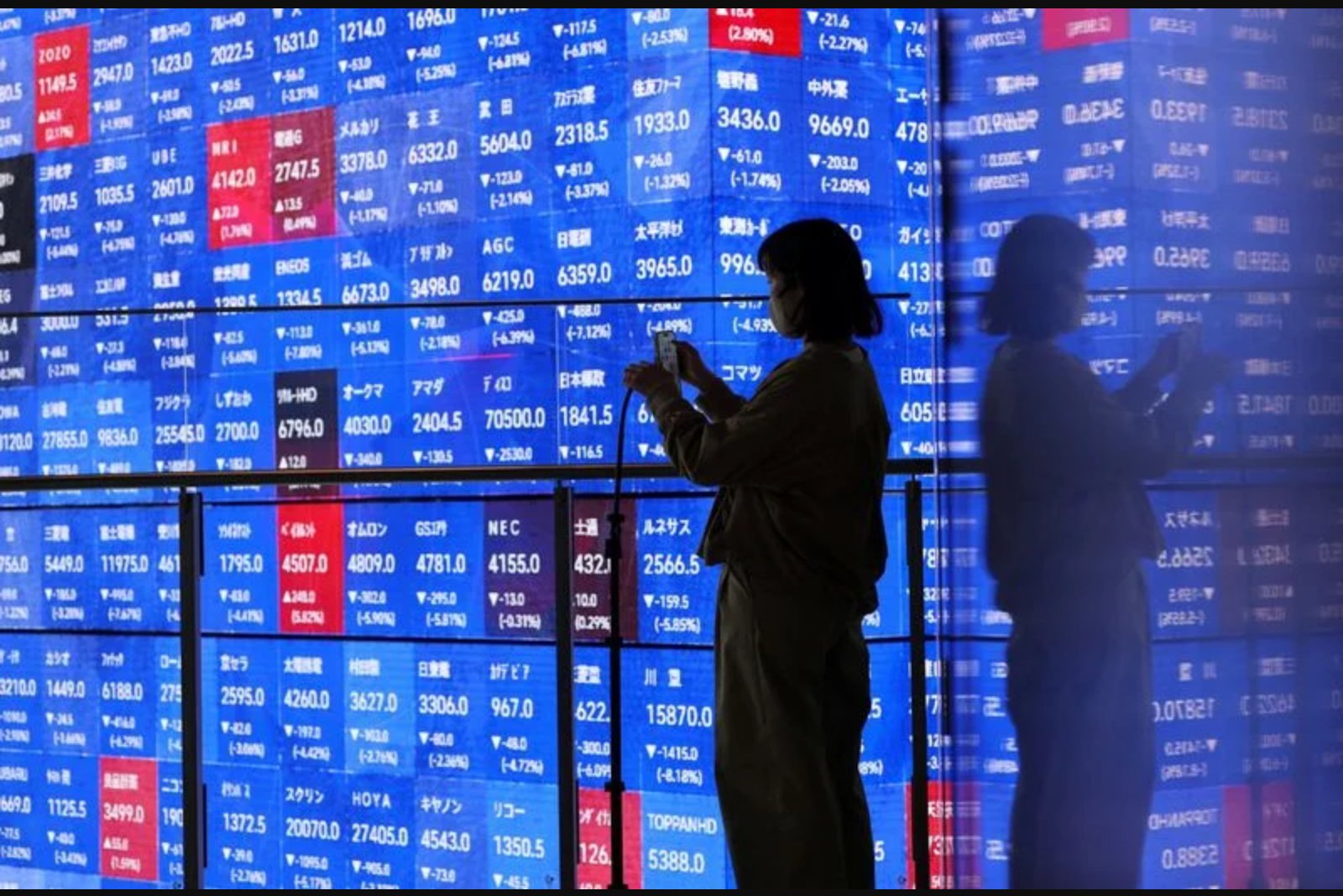
Equity markets across the Asia-Pacific region experienced a general decline on Monday, driven by a convergence of geopolitical risks and mounting expectations for tighter monetary policy. The S&P 500 futures contract decreased by 0.5%, while Nasdaq futures fell 0.7%, indicating a cautious sentiment among investors. In European markets, EUROSTOXX 50 futures dropped 0.5%, DAX futures declined 0.3%, and FTSE futures dipped 0.1%. Within Asia, the MSCI broadest index of Asia-Pacific shares outside Japan eased by 0.4%. Japan’s Nikkei index managed a slight advance of 0.7%, recovering from a robust 8% surge the previous week that had lifted it to all-time highs. Conversely, South Korea’s market retreated by 0.9%, a pullback from its impressive 11% gain the prior week, which had been fueled by demand for semiconductor stocks.
Geopolitical friction played a central role in market movements, particularly concerning developments in the Middle East. Oil prices climbed as doubts persisted about the peace process in the region. Brent crude futures increased by 1.1% to settle at $81.43 a barrel. Although this level remains significantly below its May peak of $126.41, it highlights ongoing volatility. U.S. crude futures rose more sharply, gaining 2.7% to $78.70 a barrel, yet they remain well above the $67 level recorded before the onset of regional conflicts. The upward pressure on oil was exacerbated by reports that Iran had closed the Strait of Hormuz again. Tracking data indicated a reduction in vessel traffic, with only 32 ships passing through on Friday and 26 on Saturday. These threats from Tehran were sufficient to drive the increase in Brent crude prices.
Simultaneously, political instability in the United Kingdom introduced additional uncertainty. Sterling weakened as reports emerged that Prime Minister Keir Starmer was evaluating his political future. This development followed a decisive election victory for rival Andy Burnham to parliament, which encouraged other ministers within the governing Labour Party to call for Starmer’s resignation. U.S. President Donald Trump publicly stated that Starmer was expected to resign and also threatened new attacks on Iran. This occurred while Vice President JD Vance engaged in the first talks with Iranian officials under an interim peace deal, underscoring the complex diplomatic landscape.
Financial markets were also heavily influenced by expectations regarding U.S. interest rates. Treasury bonds faced pressure following a hawkish stance adopted by the Federal Reserve last week. This shift in tone led markets to price in a 75% probability of a rate hike as early as September. Futures markets currently imply 38 basis points of tightening by the end of the year. The yield on 2-year Treasury notes increased by 4 basis points, reaching 4.2276%, the highest level observed since early 2025.
Analysts are closely monitoring these developments for implications on asset allocation. Fabio Bassi, head of cross-asset strategy at JPMorgan, stated that their baseline expectation is for patience and a first rate hike in the second half of 2027. However, he emphasized that the margin for error and tolerance for further inflation is limited, presenting genuine risks of earlier hikes. Bassi noted that improving labor markets would likely keep rates higher for longer, supporting a narrow leadership in Quality Growth, Large Cap, and Tech sectors. He added upside risks for the S&P target, potentially tilting towards 8,000. The Fed’s preferred gauge of core inflation is scheduled for release on Thursday and is forecast to rise slightly to 3.4% in May, further underlining the risk of tighter policy. Central bank speakers, including Governor Christopher Waller and Federal Reserve Bank of New York President John Williams, are expected to provide additional insights.
Currency markets reflected these macroeconomic pressures. The Fed’s hawkish outlook kept the dollar supported at 161.44 yen. The currency only avoided testing resistance at 161.96, a high from mid-2024, due to the potential threat of Japanese intervention. The euro weakened to $1.1462, after hitting a three-month low on Friday at $1.1418. Political uncertainty in the UK nudged sterling down 0.2% to $1.3210. Skye Masters, head of market research at NAB, commented that amid the uncertainty around a potential challenge against the UK PM and its implications for the fiscal outlook, gilts are likely to remain under selling pressure to start the week.
In commodity markets, higher bond yields exerted downward pressure on non-interest-paying gold, which slipped 0.1% to $4,154 an ounce. The interplay between geopolitical tensions, political shifts in the UK, and monetary policy expectations continues to shape investor behavior across equities, currencies, and commodities.