
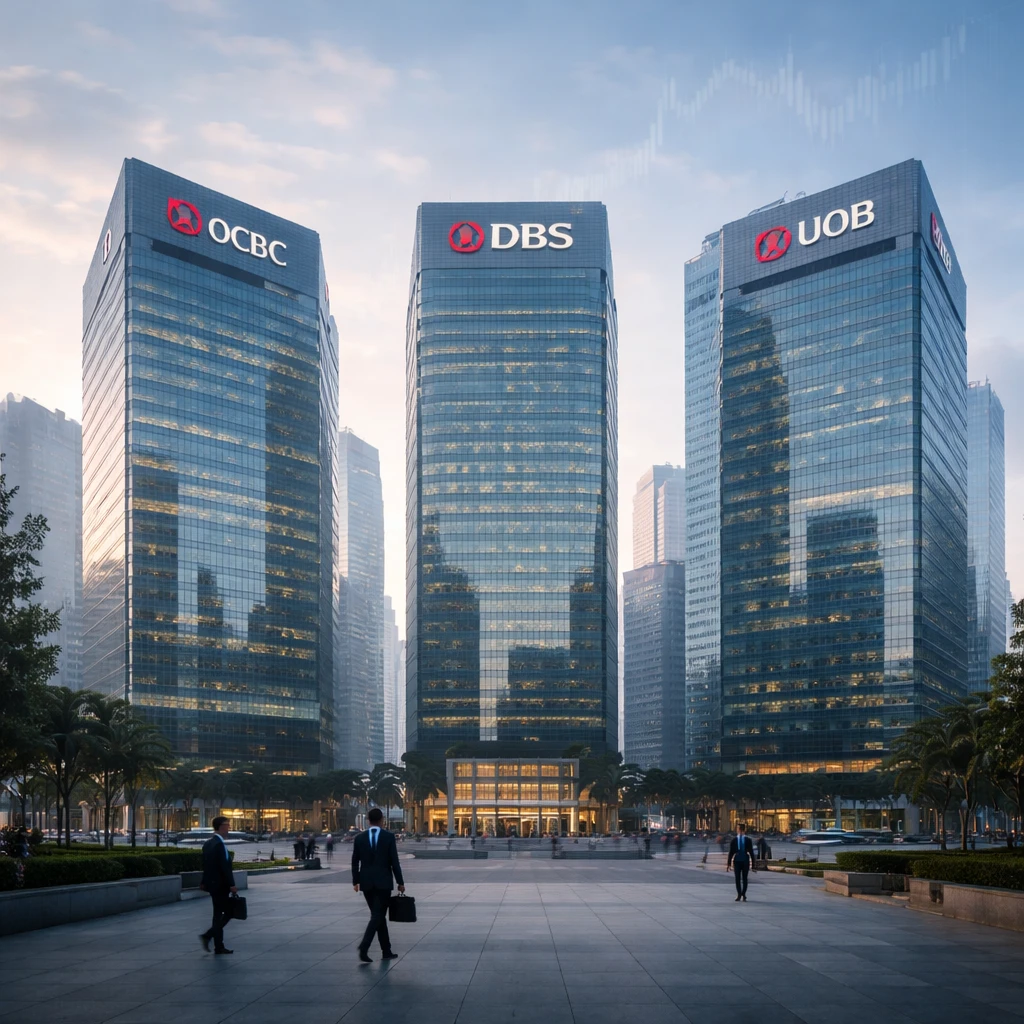
Singapore's three largest banks each present durable franchises and attractive yields, yet investors face materially different risk-reward profiles. All three pay dividend yields north of 4% when compared across the group, but the disparity in fair-value upside is telling: OCBC leads with a +15.2% uplift, UOB follows at +12.2%, and DBS shows the smallest headroom at +7.2% while trading close to its 52-week high. Quality is priced into DBS, whereas OCBC appears to offer the best blend of value and defensive characteristics given current market levels.
Key metrics at a glance
| Metric | DBS (DBSM) | OCBC (OCBC) | UOB (UOBH) |
|---|---|---|---|
| Price (SGD) | SGD73.55 | SGD28.63 | SGD43.06 |
| Market Cap | SGD209B | SGD129B | SGD71B |
| P/E (LTM) | 19.1x | 17.3x | 15.7x |
| P/E (Fwd) | 18.7x | 16.7x | 12.9x |
| Price/Book | 3.0x | 2.1x | 1.5x |
| Div. Yield | 4.2% | 3.5% | 4.2% |
| ROE | 15.9% | 12.2% | 9.5% |
| Net Inc. Margin | 49.2% | 53.2% | 39.8% |
| Beta (5Y) | 0.29 | 0.20 | 0.38 |
| Fair Value Upside | +7.2% | +15.2% | +12.2% |
| Analyst Target Upside | -2.7% | -1.9% | -1.1% |
| Take | Premium, fully priced | Best value/quality blend | Cheap but earnings slipping |
DBS - the high-quality name priced accordingly
DBS stands out as the region's most sophisticated banking franchise, with a return on equity of 15.9% that exceeds its peers. Over the last five years, group revenue compounded from SGD14.1 billion to SGD22.1 billion, underscoring solid top-line growth. The bank has also raised dividends for four consecutive years and maintains a 27-year payment streak, signalling a consistent distribution policy.
That quality carries a valuation premium: DBS trades at a price-to-book of 3.0x and is trading near its 52-week high. The market-implied fair-value upside is modest at +7.2%, the smallest of the three banks. Analyst targets included in the metrics point to a -2.7% downside from current levels. Given those inputs, DBS functions as a hold for investors seeking proven franchise strength rather than an opportunistic buy at current prices.
OCBC - the most attractive value-quality combination
OCBC presents the most compelling mix of valuation and defensive characteristics in this set. It posts the highest net income margin at 53.2%, indicating that the bank converts revenue to profit more efficiently than both DBS and UOB. OCBC's price-to-book of 2.1x offers a meaningful discount to DBS's 3.0x despite only modestly lower returns.
Additional defensive attributes include the lowest beta at 0.20, suggesting lower share-price volatility, and a 35-year unbroken dividend track record. Revenue and net income have remained relatively stable, with the latest year at SGD13.95 billion and SGD7.34 billion respectively, compared with peers that experienced sharper earnings swings. The fair-value upside of +15.2% is more than double DBS's implied headroom. The primary trade-off is a dividend yield of 3.5%, which is lower than DBS and UOB at 4.2% each.
UOB - cheap on multiples, but earnings need watching
UOB is the cheapest across common valuation measures: price-to-book at 1.5x and a forward price-to-earnings of 12.9x. That discount is tangible, yet the latest fiscal year raised concerns. Net income declined to SGD4.59 billion from SGD5.95 billion, and revenue dropped from SGD13.37 billion to SGD11.77 billion. A return on equity of 9.5% signals lower capital efficiency relative to peers.
While UOB's fair-value upside is still a healthy +12.2%, the weaker earnings trajectory suggests investors should seek confirmation of stabilization before concluding that the stock is an unmistakable bargain. The metrics also flag poor free-cash-flow yield, which adds an additional element of caution.
Conclusion
When weighing value and quality, OCBC appears best-positioned among the three Singapore banks based on the data presented: it offers the largest fair-value upside, the strongest margins, the lowest share volatility, and a long dividend history while trading at a modest P/B discount to DBS. UOB is evidently the cheapest on paper but requires earnings stabilization to demonstrate that it is value rather than value-at-risk. DBS remains the benchmark for quality but comes with limited upside given its premium valuation.
Summary
- OCBC shows the most attractive risk-adjusted opportunity with a +15.2% fair-value upside and the highest net income margin.
- DBS is the quality leader but is priced for that strength, leaving only +7.2% fair-value upside and analyst targets slightly below current levels.
- UOB offers the deepest discounts on multiples, but recent declines in revenue and net income counsel caution until earnings stabilize.
Key points
- All three banks yield around 4% or higher, but OCBC combines yield with stronger margin conversion and lower volatility.
- Valuation spreads - particularly price-to-book and forward P/E - separate a premium-priced DBS from more attractively valued OCBC and UOB.
- Bank earnings, valuation, and dividend durability are central to investor decisions in Singapore's financial sector.
Risks and uncertainties
- UOB's recent deterioration in revenue and net income introduces execution and earnings-risk for the banking sector.
- DBS’s premium valuation implies limited upside and raises the risk of underperformance if growth slows or expectations slip.
- OCBC’s lower dividend yield relative to peers may deter yield-focused investors despite its quality and valuation merits.