
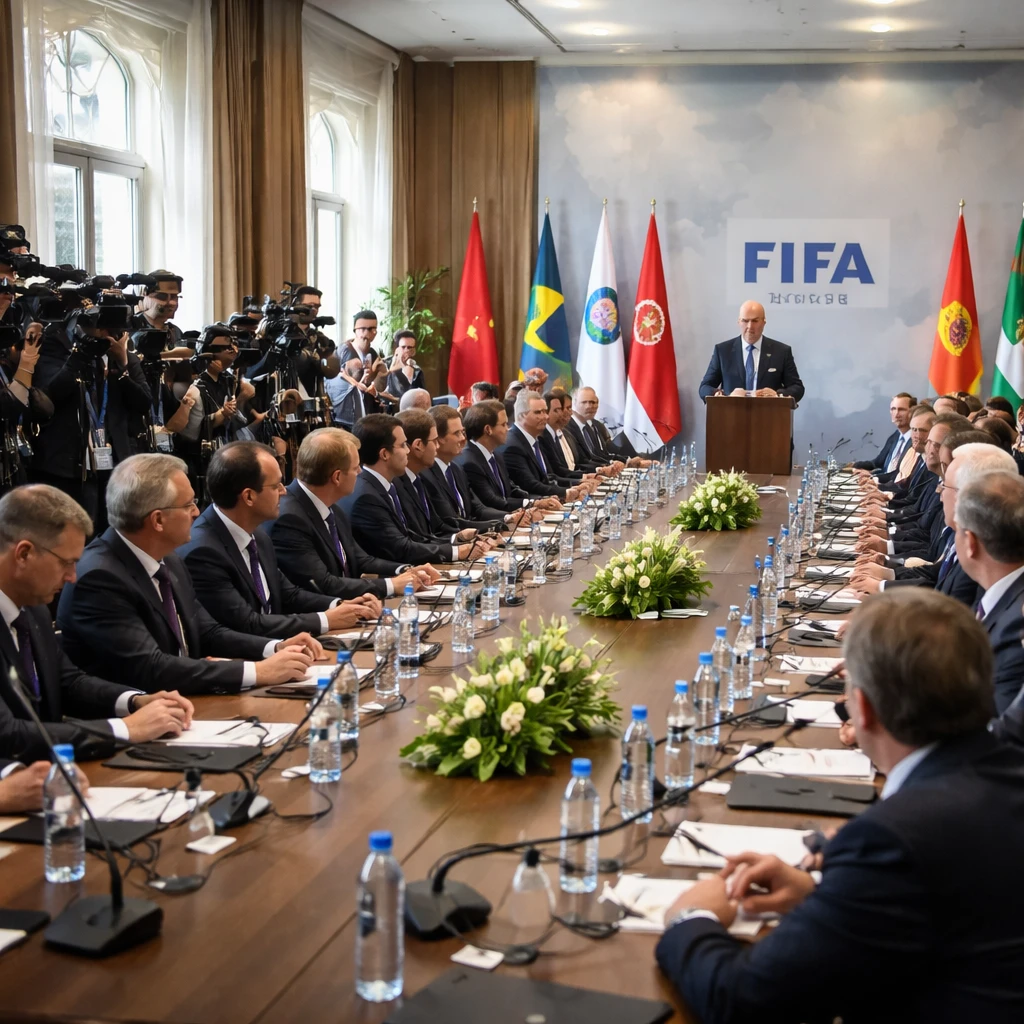
FIFA has apologised to its member associations for mistakes made in the handling of a now-abandoned proposal to sell a portion of the World Cup's commercial rights, and its senior management said they continue to back President Gianni Infantino following a crisis meeting held in Rabat, Morocco.
The contested proposal would have involved selling a 20% stake in a newly created commercial-rights entity to private investors, a transaction that FIFA estimated would have generated about $4.2 billion. The plan provoked significant blowback and was formally withdrawn last Friday.
In an official statement issued after Wednesday's meeting, FIFA said: "Following a meeting in Rabat, Morocco, the FIFA Secretary General and members of the FIFA management board in attendance reaffirmed their full support for FIFA President Gianni Infantino." The statement added that the president, in turn, "reiterated his full support for the FIFA Secretary General and the FIFA administration for their necessary and outstanding work in the delivery of his vision."
Senior figures within FIFA acknowledged the proposal had been mishandled. Secretary General Mattias Grafstrom circulated an internal memo this week expressing regret over what he described as a "sad and reproachable series of events" that culminated in the project being "permanently abandoned." That memo, which did not name the president directly, warned that "individuals, unstable moments and unfortunate episodes come and go" but stressed that FIFA's work would continue.
The organisation's Chief Operating Officer, Kevin Lamour, had earlier told staff they felt "deceived" about the plan and described it as the project of one person.
The statement from the meeting also emphasised a governance point: Infantino, who has served as FIFA president since 2016, is "the only official elected by the 211 FIFA member associations." FIFA said a separate letter had been dispatched to FIFA Council members and to the wider membership apologising for the mistakes and promising a review of the way the proposal was managed.
"It was agreed that it was not the intention for the FIFA Council and FIFA member associations to feel excluded from the process and that the process should have been handled differently," the statement said.
With the commercial-rights sale now off the table, FIFA also warned it would "no longer tolerate any attacks on its integrity, good governance and due process."
The plan attracted intense criticism from a broad set of stakeholders. Concerns were heightened by the involvement of a company with family links to U.S. President Donald Trump, and European football's governing body UEFA was among the harshest critics. Several European federations have withdrawn their support for Infantino, and UEFA publicly said it had lost confidence in his leadership. CONCACAF expressed a similar lack of confidence.
The Asian Football Confederation was also strongly critical of how the proposal was presented - saying it had been treated as a fait accompli with inadequate prior consultation. Public figures added to the pressure: former Portugal player Luis Figo said Infantino should resign over the affair, while UEFA Vice President Laura McAllister told reporters the controversy had brought the president's leadership to a crisis point.
European Leagues, representing more than 1,300 clubs, warned that FIFA should not be allowed to "continue taking unilaterally disruptive decisions" that affect clubs, players and fans. The leagues body also criticised the "impractically short assessment timeline" of four weeks that FIFA gave stakeholders to study a separate plan to expand the World Cup from 48 to 64 teams for the 2030 edition.
Under FIFA rules, an Extraordinary Congress may be convened if at least 43 member associations submit a formal written request for one.
Despite the backlash in parts of Europe and Asia, Infantino retains substantial support in other regions. Senior African administrators have issued messages of backing as he seeks the continent's 54 votes. The African confederation has not adopted a formal position to date.
The executive committee of Oceania, the smallest and least wealthy regional confederation, planned to meet next Wednesday to decide its stance. Several national associations have already declared loyalty to the president: Qatar, which hosted the 2022 World Cup, along with Kuwait, Lebanon, Sri Lanka, Indonesia and the Philippines, have publicly expressed their support despite criticism from the Asian confederation.
FIFA's electoral rules mean that each member association's vote carries equal weight - for example, the vote of San Marino, whose men's national team sits at the bottom of the world rankings, counts the same as that of World Cup winners. That parity is a practical advantage for an incumbent who can marshal support from many smaller or less wealthy associations.
As the March presidential election approaches, no clearly identified challenger has yet emerged to oppose the 56-year-old Swiss Italian seeking to remain in office until 2031. That absence of an obvious competitor further strengthens Infantino's position.
One of the first national associations to publicly reaffirm support for Infantino after the withdrawal of the commercial-rights proposal was Morocco. Morocco will co-host the 2030 World Cup with Portugal and Spain and is hoping to stage the tournament final.
A FIFA spokesperson addressed media reports suggesting the president had offered promises linked to the staging of the 2030 final in exchange for support. The spokesperson said: "It is false and misleading to claim the FIFA president has made any promise in relation to hosting the FIFA World Cup 2030 final. A decision will be made by FIFA in due course."
The episode leaves FIFA confronting multiple immediate challenges: managing a promised review into decision-making processes, repairing relationships with confederations and federations that felt excluded, and containing reputational damage while continuing regular operations and preparations for future tournaments.
How those internal governance reviews unfold, and whether they prompt calls for more formal accountability mechanisms or procedural changes, will shape the organisation's standing with stakeholders and its ability to pursue future commercial or sporting initiatives.