
Overview
The Houthi movement, which originated in north Yemen in the late 1990s as a Zaydi Shi'ite revivalist group connected to the Houthi family, has transformed from a localized militant band into a force with regional reach. Its expansion has been driven by a succession of domestic conflicts, the collapse of Yemen’s central authority during the 2011 Arab Spring, and the development of ties with Iran and Lebanon’s Hezbollah. That trajectory culminated in a rapid coastal advance that has put the Bab el-Mandeb Strait - the 12-mile-wide (19-km-wide) choke point linking the Red Sea to the Gulf of Aden - under their effective control.
Origins and political consolidation
The movement fought six wars against the Yemeni government through the early 2000s, building a hardened local militia in northern highlands. When state institutions fragmented around 2011, the Houthis expanded their territorial control and forged closer relationships with external backers. In 2014 they seized the capital, Sanaa, removing the internationally recognised government from the seat of power and stalling a Gulf-supported political transition.
The Saudi-led military intervention that followed aimed to restore the government and quickly led to years of pitched conflict. That fighting eventually settled into a stalemate and produced a ceasefire in 2022. During the period of hostilities and later, the Houthis employed missiles and drones beyond Yemen’s borders, including at sea.
Recent military developments and territorial gains
In recent weeks the 2022 ceasefire has collapsed and conventional fighting has resumed along several long-standing front lines. Hostilities are reported in northern governorates such as Marib and Jawf, in Taiz city in the southern highlands, in Dhale in central Yemen and across the Red Sea coastal plain known as the Tihama.
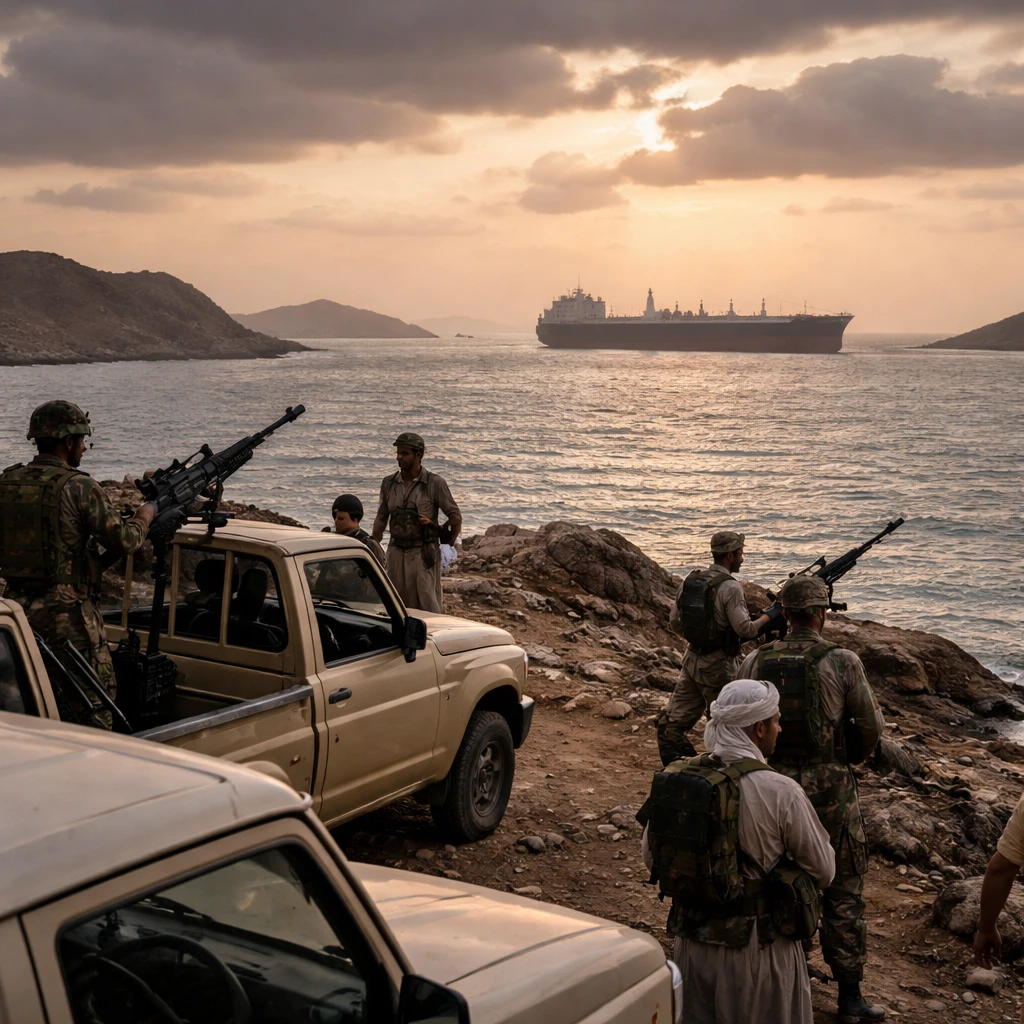
Most notably, Houthi forces advanced rapidly into the southern Tihama last week. They first captured the port city of Mocha and then consolidated control over the remainder of the Red Sea coastline and the nearby islands. By positioning armed forces along the full length of the shore that borders the Bab el-Mandeb Strait, the movement has gained a practical capability to impede traffic through a route used for Saudi oil exports to Asia and other commerce. These coastal positions also create a potential staging ground for future ground operations toward Aden, while Saudi Arabia has responded with airstrikes in support of forces aligned with the ousted government.
Longer-range strike capabilities
One of the changes that has elevated the Houthis' strategic relevance is their capacity to conduct long-range, increasingly accurate strikes. Houthi ballistic missiles have reportedly reached Israel, at distances exceeding 1,000 miles (1,800 km). One such strike hit the perimeter of Israel’s main airport in 2025. The group has also launched frequent missile attacks inside Saudi Arabia, targeting cities and infrastructure, and has fired on commercial vessels in the Red Sea, producing interruptions in maritime traffic.
Unmanned aerial systems have become a major component of Houthi operations. Drones have struck Saudi targets repeatedly and are now used extensively in battlefield roles - a marked operational shift from the conflict phase prior to the 2022 ceasefire.
Observed weapons and field equipment
Since early September the group has circulated video material purporting to show its current arsenal and actions. Footage includes drones releasing a variety of mortar rounds and other bombs onto vehicles and enemy combatants, the launch of a rocket or missile, and high-resolution drone footage of precise hits on structures and convoy vehicles at what appears to be a camp.
Ground footage depicts fighters in pick-up trucks - some trucks fitted with weapon mounts - as well as foot troops. Many combatants are shown wearing traditional Arab robes and carrying assault rifles; a smaller number appear in camouflage uniforms. Weapons observed in the videos include light and heavy machine guns and scoped rifles. Separately, the clips show the display of hardware attributed to captures from Saudi-backed forces in the Tihama: armoured and combat vehicles, a tank, an artillery piece, a satellite dish, small arms and a device described as a drone jamming unit. The videos do not, however, typically show the seized equipment operating in combat.
Supply chains and domestic arms production
International monitoring has documented both indigenous systems and external assistance contributing to Houthi capabilities. A United Nations panel of experts reported in 2025 that the movement had advanced missile and drone technologies through a combination of technical assistance and domestic manufacturing. The same report described extensive arms smuggling in breach of a U.N. arms embargo, citing overland shipments across the Omani border as well as seaborne consignments. Seized materiel included drone control systems, kit to receive ships’ navigational data, drone engines and missile components.
Earlier United Nations reporting in 2023 recorded seizures of whole drones, ballistic missile components such as chemical precursors, and Iranian-made anti-tank missiles. Iranian sources have claimed that Tehran provided weapons and expert support to the Houthis, while Iran has formally denied violating the U.N. embargo by arming the group. External analysis from a 2025 assessment by the International Institute for Strategic Studies concluded that, despite meaningful improvements in local arms production, the Houthis continue to rely on Iran for critical technologies and advanced capabilities.
Doctrine, force size and external training
The U.N. panel characterised Houthi tactics as focused on infiltration, drone strikes, and shelling along established front lines, combined with the deployment of mines and other explosive devices. The panel also assessed the movement’s fighter strength at approximately 350,000 personnel, a figure that the report linked in part to recruitment that included fighters under 18.
Analysts attribute a large part of the transformation from a ragged militia into a more organised military actor to training provided by Iran and Hezbollah. One analyst quoted in monitoring reports noted that such instruction began soon after the Arab Spring and contributed to changes in structure and operational movement. U.N. experts reported the presence of Hezbollah missile and drone operatives with Houthi units in 2025 and said that Iranian Qods Force general Abdolreza Shahlaei had spent time in Yemen working with Houthi forces.
Implications
The combination of territorial control over the Bab el-Mandeb coastline, an expanded set of missile and drone capabilities, and evidence of improved domestic production alongside external technical assistance has elevated the Houthis from a primarily local militia to an actor with the capacity to affect regional maritime routes and energy infrastructure. The group’s recent posture has included strikes on international shipping and on energy targets inside Saudi Arabia, conduct it says is in solidarity with Palestinians during the wider Israel-Gaza conflict of 2023-25. With Iran described as being under attack by the United States since February 28, Houthi operations have again included attacks on Red Sea shipping and on energy facilities in Saudi Arabia.
What remains uncertain
Certain aspects of the movement’s operational capabilities and long-term sustainability are difficult to assess solely from publicly released footage and monitoring reports. While imagery and seizures document both indigenous production and smuggling, the degree to which each channel contributes to sustained capability growth is described in monitoring reports rather than definitively quantified. Likewise, while external training and presence of foreign operatives are reported, the specific logistic and command structures tying these elements together are outlined by expert assessments rather than exhaustively detailed in public reports.