
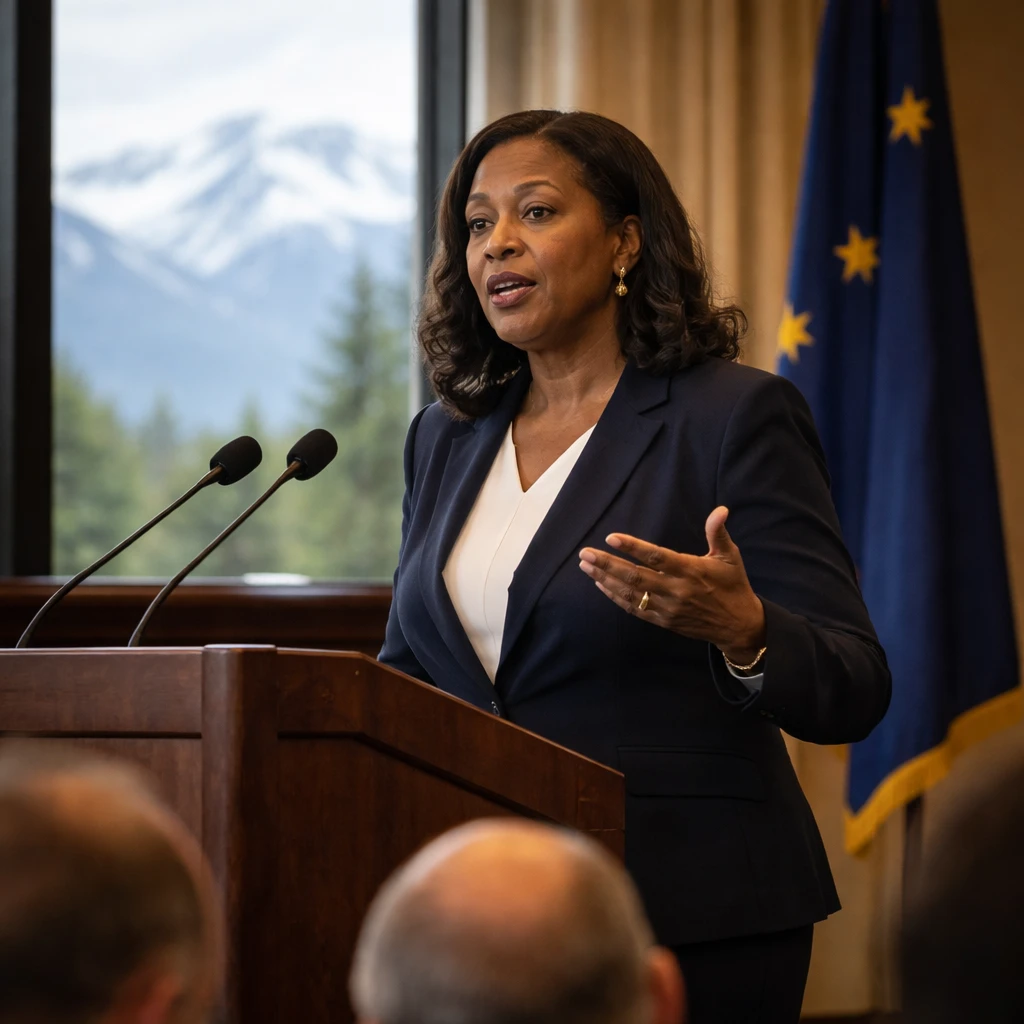
Federal Reserve Governor Lisa Cook said she stands ready to lift the central bank's short-term interest rate target should inflation fail to cool, placing greater weight on the risk of persistent price pressures than on the job market, according to prepared remarks delivered before the 2026 Economic Luncheon of the Anchorage Economic Development Corporation in Anchorage, Alaska.
"If inflation doesn't start to cool off, I am prepared to act by raising rates, if necessary," Cook said in the text of her speech. She framed the decision to consider higher policy rates as one she would weigh carefully against effects on the broader economy, adding that she would support an increase "if it becomes necessary, to bring inflation down. It may not."
FOMC context and recent voting
Cook was among the Fed officials who backed the central bank's recent decision to keep the federal funds target range unchanged at 3.5% to 3.75%, despite inflation running well above the Fed's 2% objective. That pause produced three dissenting votes from policymakers who argued a rate rise was warranted at that meeting to help tamp down price pressures.
Her remarks come amid a stream of recent commentary from other Fed officials. New York Fed President John Williams and Philadelphia Fed leader Anna Paulson have signaled they, too, would be open to raising rates if conditions require it. By contrast, Chairman Kevin Warsh has declined to offer guidance on the future path of interest rate policy and has offered little public insight into his decision-making process.
Inflation risks and policy constraints
Cook warned that the Fed has progressively less room to allow inflation to remain above target given how long it has exceeded the central bank's 2% goal. She cautioned that inflation could become embedded in price- and wage-setting behavior, creating a persistence that would be more difficult to reverse.
"Inflation may become entrenched in price- and wage-setting behavior, leading to persistence that would be much harder for us to attack," she said, and added that "while we might be able to afford to wait for longer in a different environment, we do not have that luxury in this one."
Drivers to watch and wider concerns
Cook noted several factors that have influenced price pressures and could ease, helping to bring inflation down. She cited tariffs, the war in the Middle East, and investment related to the artificial intelligence sector as potential drivers that might abate and thus reduce overall inflationary forces.
She also addressed the tone of consumer sentiment, saying its souring is connected to a range of factors, including inflation. On the topic of labor market disruption tied to technology, she observed that the most dire predictions about job losses from artificial intelligence have not materialized so far, but she acknowledged that risks remain.
Conclusion
Cook framed her position as one of conditional readiness: prepared to act with higher policy rates if the trajectory of inflation warrants it, but also mindful of the economic trade-offs such action would entail. Her comments underscore the Fed's current balancing act between limiting persistent inflation and assessing how emerging drivers and geopolitical developments will influence price trends.