
Investigations of footage circulating on Russian social media indicate a new method being used to strike Ukrainian power infrastructure: small First Person View (FPV) drones operated through thin fibre-optic cables. The Centre for Information Resilience (CIR), an open-source investigative group based in London, verified the videos, and the reporting has been independently confirmed.
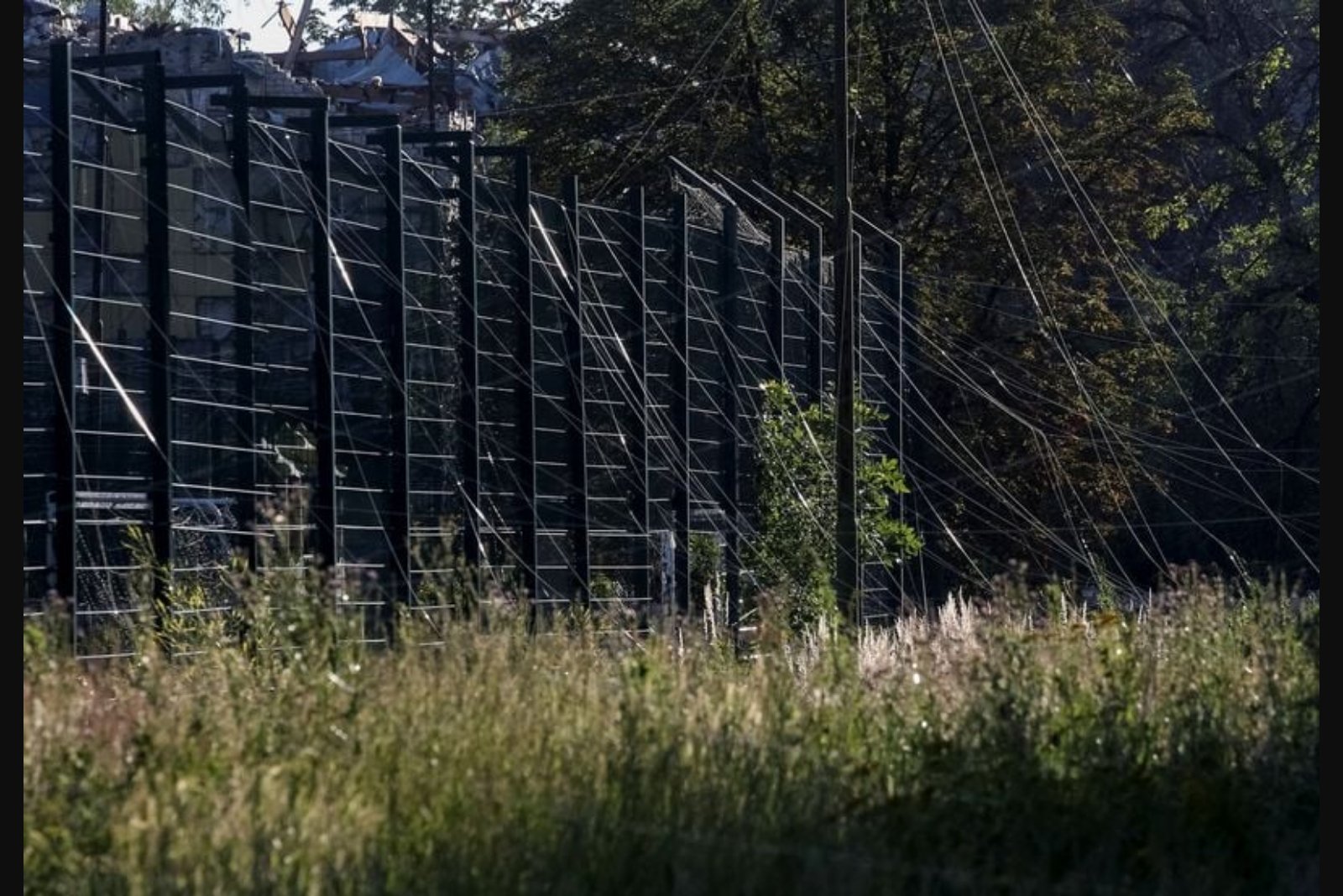
Ukrainian energy facilities have been a frequent target throughout the conflict. To protect key equipment, authorities have covered large high-voltage transformers with reinforced concrete enclosures colloquially called sarcophagi, and have deployed anti-drone nets. Frontline provinces are also saturated with electronic warfare systems intended to jam the radio controls of remotely piloted aircraft.
Those protections are ineffective against tethered FPV drones so long as the translucent fibre-optic cable remains intact. The cable carries control and video signals via a physical line rather than radio transmission, rendering the drone immune to signal jamming and other electronic countermeasures.
Investigators describe a two-stage technique. Joshua Scriven, an investigator at CIR, said attackers use an initial drone to break through anti-drone netting and create an opening. A second, more maneuverable drone then slips through the gap and navigates around the external sarcophagus to find ventilation openings leading to internal components.
Since May, CIR has verified four strikes on large, seemingly well-defended 330 kilovolt (kV) substations and at least four additional strikes on smaller 110 kV substations. Mapping produced by Deepstate, an independent online battlefield map producer, places the strikes on 330 kV infrastructure between 16 and 26 km (10-16 miles) from the active frontline, demonstrating an extended operational range for these small fibre-optic systems.
The target appears to be the autotransformer located within the substation. Oleksandr Kharchenko, head of the Energy Research Centre in Kyiv, said that in a 330 kV substation the autotransformer is valued at about $3.5 million, and that its destruction can collapse the entire transformer unit.
Analysts at CIR and others working with open-source footage say the shift to tethered FPV drones is driven by the increasing use of protective sarcophagi. "I think why they’ve started using them is because of these protective sarcophagi. They protect against missiles and Shaheds (heavy-duty drones)," Scriven said. He added that a fibre-optic FPV drone can cost as little as $2,000, and observed that "the cost-benefit analysis there is staggering."
Scriven and CIR interpret the attacks as part of a broader approach to separate regions from Ukraine's national grid and subsequently produce blackouts by striking local generation or distribution points.
The Sumy region, where these strikes have been documented, has endured heavy bombardment since summer 2024. That period followed a Ukrainian offensive that penetrated Russian territory from the province, after which Ukrainian forces were pushed out and Russian counter-attacks intensified in Sumy.
Ukrainian Defence Minister Mykhailo Fedorov commented on the security situation, saying it deteriorated in June and writing that "Russia’s goal is to terrorise people and make life in the border regions unbearable."
There is also an ongoing legal and accountability context: the International Criminal Court has issued arrest warrants against senior Russian military commanders over strikes on Ukraine’s power grid between 2022 and 2023. Moscow denies deliberately targeting civilians and asserts that its operations have military objectives.
Verification and open-source evidence
The strikes were documented on Russian social platforms, then verified by CIR and corroborated through independent reporting. CIR’s analysis covers patterns of attack, techniques used to defeat defensive measures, and repeated targeting of specific substation components.
Implications for infrastructure defence
These incidents highlight a vulnerability in physical and electronic countermeasures when adversaries employ tethered systems that bypass radio-frequency jamming. The combination of low equipment cost and the ability to reach protected components inside sarcophagi complicates defensive planning for grid operators.
Whoever assesses and responds to these threats will need to weigh the relative resilience of local distribution assets and consider adaptations to both passive and active protective measures, based on the verified attack profiles.