
Opening anecdote
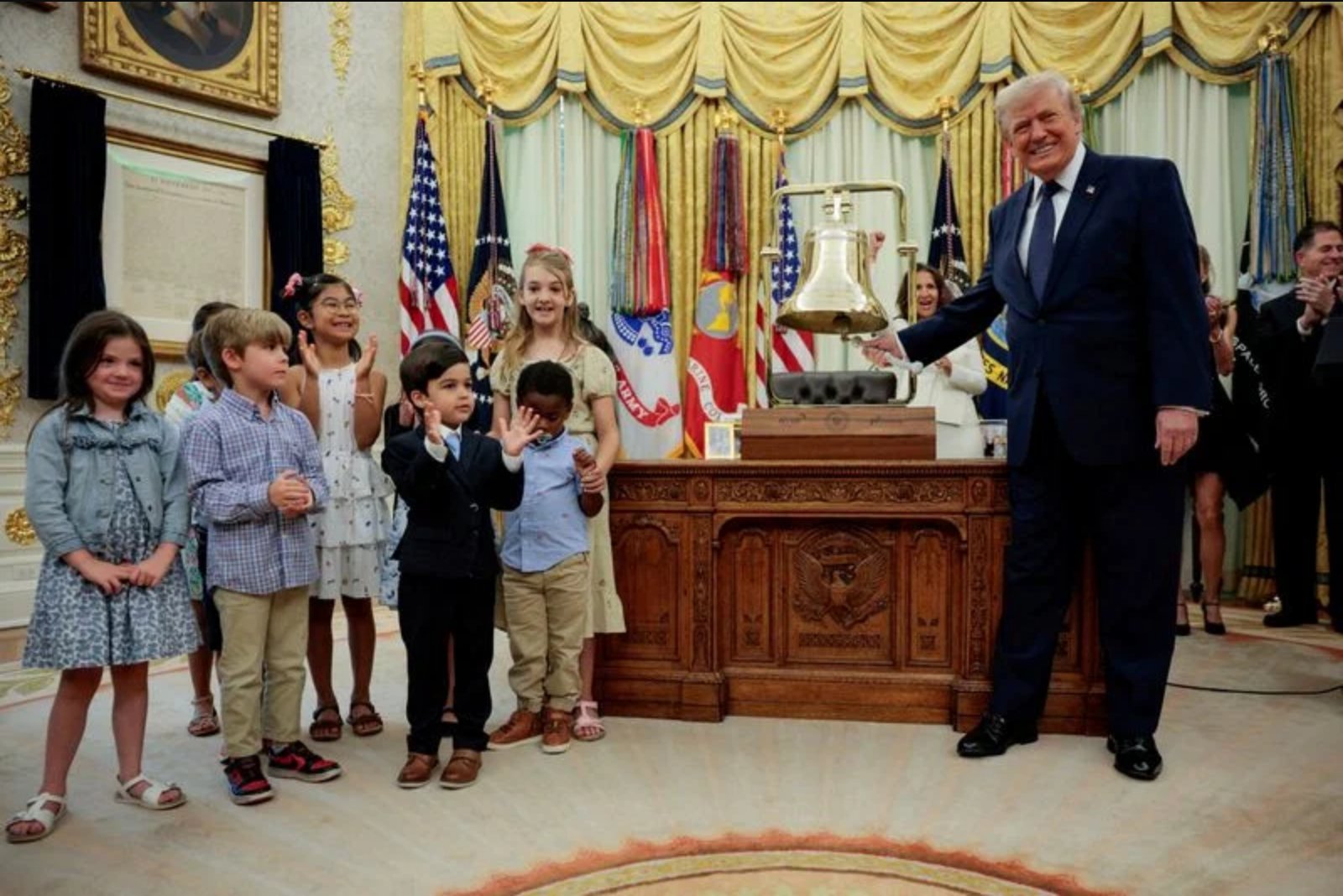
At the start of this week the president marked an unusual first for his second term by ringing the stock market's opening bell from the Oval Office. The gesture encapsulates how closely the administration now ties equity values to its record in office. Record stock prices are presented repeatedly by the president as evidence that his agenda is working, even as many Americans face rising living costs and a significant share of households own no stock at all.
Policy moves and public framing
The White House has pursued a set of measures that tie the federal government more directly to capital markets and private firms while encouraging broader household participation. Republicans’ $4.1 trillion proposal created government-seeded investment accounts for newborns, called “Trump accounts.” In February the administration announced plans to match up to $1,000 in 401(k) contributions for workers who enroll in so-called “Trump IRA” accounts. Officials describe these steps as part of a legacy effort to increase participation in capital markets and to give more Americans a stake in the nation's economic performance.
At the same time, the federal government has entered into arrangements with several large corporations. The administration has taken an equity stake in Intel and a so-called "golden share" in U.S. Steel. It has also signed revenue-sharing agreements with Nvidia and AMD. The White House highlights the performance of these firms as indicators of an expanding economy, framing their market successes as validation of administration policy rather than the result of heightened federal market intervention.
Market gains and concentration
Since the president returned to office, the U.S. stock market has increased in value by roughly $15 trillion, an advance the article describes as about a 25% rise. Equities now make up roughly one-third of total household wealth. Yet those gains are not broadly distributed. Polling cited in the reporting finds that about four in 10 Americans do not own any stock, and the wealthiest 1% hold more than half of the country's capital market investments.
Those statistics support what economists have described as a "K-shaped" economic pattern in which wealthy households, whose spending is buoyed by rising asset prices, help sustain markets while middle- and lower-income households tighten spending. For many in the bottom half of the wealth distribution, assets are more likely to be concentrated in real estate and durable goods. That composition means rising equities have limited short-term impact on their personal finances.
Political use of the market signal
The president routinely invokes stock market performance across public settings - in meetings with foreign leaders, at campaign-style rallies, and even during military ceremonies. The administration frames rising equity prices and higher 401(k) values as signs of national strength. In June, before awarding three servicemembers the Medal of Honor, the president said, "The stock market just hit a new all-time high, the 401(k)s are at a new all-time high, and oil is dropping like a rock."
Administration officials say the focus is part of a broader effort to expand household ownership of stocks. Supporters on Wall Street have praised the emphasis, arguing it signals that the White House is attentive to the economy’s pulse and that it can serve as protection against unexpected shocks.
Critics and caveats
Economists and advocates caution that stock market levels are an imperfect measure of the nation's economic health and that reliance on that metric can obscure the economic reality for a large share of Americans. ‘‘It’s not a perfect correlation. There are other measures of how businesses are doing,’’ said Stephen Moore, a conservative economist who periodically advises the president and White House officials. ‘‘But a valuation of their stock is an important indication.’’
Others point to the risk that policies change in response to market moves. Critics say the president has at times reversed or altered major initiatives after declines in equity prices, including scaling back elements of his trade strategy following market drops after its announcement. Observers also believe that market reactions have affected how the administration has discussed the war with Iran, in which officials have noted that the president appears sensitive to signals from equities.
"This is the way that people can get his attention or society can get his attention," said Alex Jacquez, chief of policy and advocacy at the liberal think tank Groundwork Collaborative. He added that the approach is dangerous if it mainly activates when corporate or financial interests are implicated and that it leaves out demographics - young people, women, and many minority groups - who are underrepresented in capital markets. Measuring economic performance by stock values does not capture the health of small businesses or privately held firms, he noted.
Economic indicators and consumer sentiment
The domestic economy is described as largely on steady footing with what the reporting terms healthy growth and low unemployment. Still, recent inflation - which the article comments has been influenced in part by the war with Iran - has dampened some consumers' outlook. Among commonly used macro indicators, U.S. gross domestic product rose by 2.1% in 2025 and average hourly wages advanced by 3.5%. Those wage gains gave workers higher pay but did not fully keep pace with recent inflation, the reporting states.
Personal exposure and market activity
The president is also personally heavily exposed to market fluctuations. In the first three months of 2026, his financial disclosures show investment accounts completed 3,600 stock trades with a total value reported as between $212 million and $695 million. The president has drawn a direct line between his own financial results and the broader market, saying last week, "You know why I’m profiting? Because the stock market’s going up, everybody’s profiting."
Supporters argue the president’s attention to markets helps prevent surprise, large-scale shocks, sometimes called "black swan events." Dan Ives, global head of tech research at Wedbush Securities, said, "Having President Trump always focused on the market helps investors sleep well at night. It almost creates some natural guardrails." Some on Wall Street remain skeptical, however, that any single administration can permanently shield markets from downturns.
What is left out by a market-focused metric
The reporting emphasizes that using stock prices as a primary yardstick leaves several important elements of the economy unmeasured. Young households, and many women and minority groups, have limited stock exposure and may not benefit directly from rising equities. Small businesses and privately held firms - which employ a large share of the U.S. workforce - do not have their value captured by public market indices. As a result, many economists prefer broader measures such as GDP and wage growth when assessing overall economic health.
Conclusion
The White House has made the stock market a central element of its narrative about the economy, pairing that theme with policies aimed at expanding market participation and with direct financial relationships with major corporations. The approach has been welcomed by investors who say the president’s focus stabilizes expectations, but it has prompted criticism from those who argue that market benchmarks fail to capture the economic experience of a large share of Americans.