
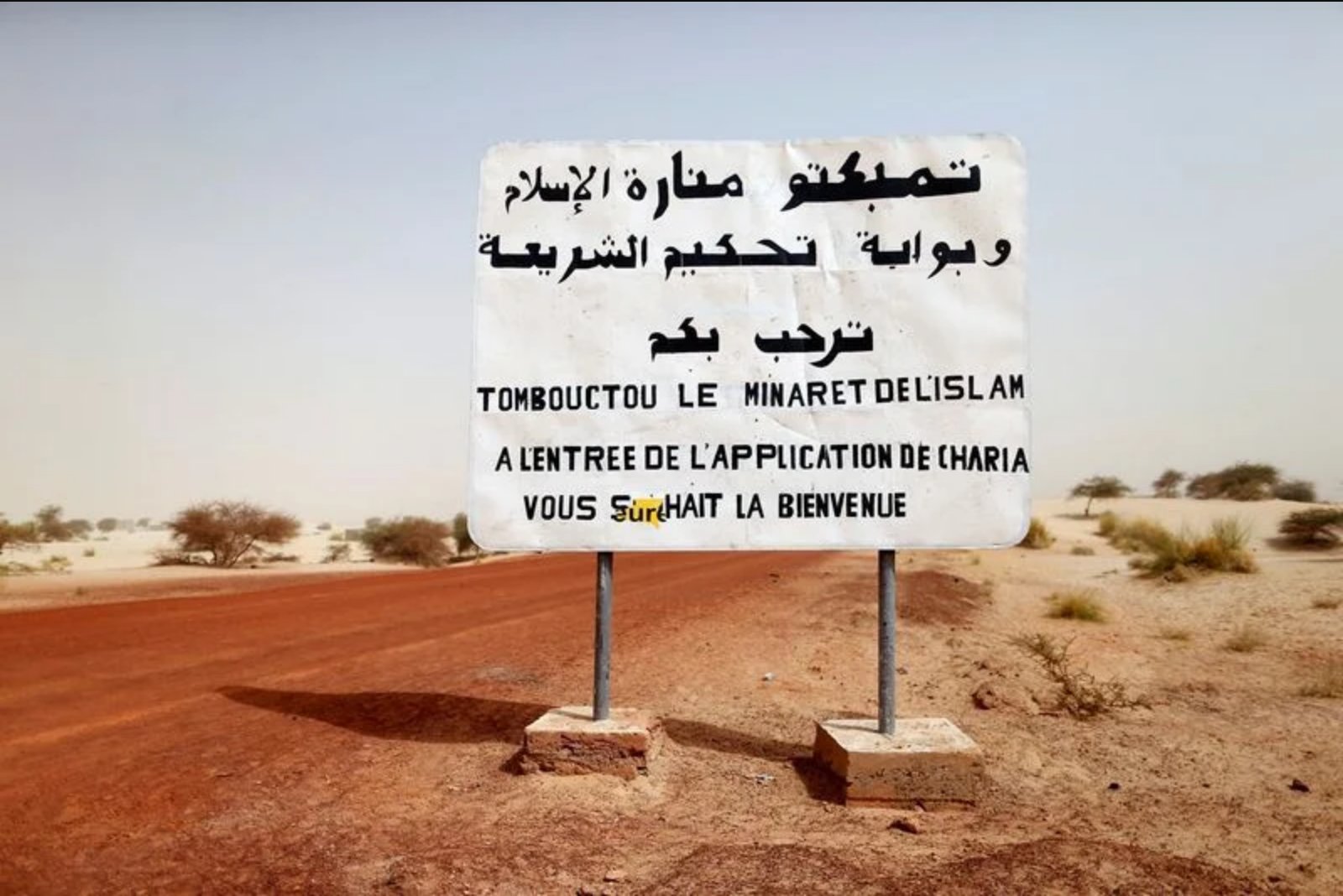
Across several villages in central Mali, meetings called by jihadists aligned with al Qaeda have become a recurring feature of rural life. Men gather at a mud-brick mosque where fighters collect levies on crops and cattle, and later oversee distributions of food, medicine and livestock to the most vulnerable households. Longstanding fears have not entirely vanished, but villagers say the tone of control has changed from open threat to religious persuasion and administrative order.
Residents who have lived under the group known as Jama’at Nusrat al-Islam wal Muslimin, or JNIM, say the militants have eased the overt brutality that marked earlier years of their control. One herder from the riverside village of Poutchi, speaking under conditions intended to protect his identity, recalled a time when militants threatened to slit the throat of anyone - including the local imam - who questioned their interpretation of Islam. He described how the rhetoric has since softened, with fighters focusing more on religious messaging and less on direct threats.
"Now, they don’t talk like that," the herder said. "The dynamic has really changed."
JNIM pledged allegiance to al Qaeda when it formed in 2017 and has spent much of the last decade expanding its presence across the Sahel. The group gained space and influence as foreign military footprints changed after 2020, notably following the expulsion of large numbers of French and U.N. personnel and the subsequent employment of private Russian security partners by Malian authorities. In the months that followed, JNIM demonstrated increased operational capability with a series of high-profile attacks in April, including strikes on the capital's airport, the killing of the defence minister, and the seizure of several army bases in the north in coordination with Tuareg-led separatists.
Those military gains have not only showcased JNIM's battlefield reach; they also coincide with what residents describe as a deliberate pivot toward governance where the group holds sway. According to seven people who live under JNIM rule in central Mali and spoke on the condition of anonymity or with only first names used, militants are increasingly resolving local disputes between herders and farmers, permitting humanitarian organisations to operate in some areas, and allowing certain government employees to return to villages to spend holidays with relatives.
Experts and local separatist leaders interviewed about the phenomenon describe a combination of coercion and persuasion underpinning the group's local authority. For many villagers, who have been born, married and raised under JNIM's presence, accommodation often feels like a survival strategy as much as acquiescence.
"The stronger they have become, the less brutal they have to be," said a Sahel specialist with long experience studying jihadist growth in Mali, noting that governance and coercion can coexist as mechanisms of control.
JNIM's evolution echoes patterns that analysts point to across areas where the group has consolidated influence. Where fighters are entrenched, they appear to be taking on roles typically associated with administration rather than solely acting as an insurgent force. The group has encouraged informal reconciliation mechanisms for land and resource disputes and in some cases permitted the flow of aid. Villagers report that JNIM's rule is often experienced as more predictable and less corrupt than interactions with the state's security forces.
"Since JNIM has controlled the area, we are safe," said a resident from Birga-Peul in the Mopti region, which JNIM took control of in 2017. "Even though their rule is difficult to respect, we have gotten used to it. We are not killed." She described a change in profile from foreign fighters who once led the movement to personnel more embedded in local communities, adding that militants now tolerate activities such as football and the use of mobile phones.
At the same time, the group continues to be linked to episodes of extreme violence. In January, fighters attacked a fuel convoy and killed 12 people, with some victims subjected to throat slitting. In May, two villages in central Mali were attacked in raids that killed around 50 people. These incidents underline JNIM's continued capacity for severe brutality, particularly where resistance is encountered.
Outside areas under firm JNIM control, the group's tactics can be far harsher in terms of restricting movement and access to essentials. In one Mopti village, residents reported a blockade that has been in place for more than a year and that they say led to the deaths of children and elderly residents due to lack of food and medicine. According to a villager's account, restrictions prevented people from travelling even short distances to fish or collect firewood, sharply curtailing local livelihoods. Reuters was unable to independently verify the casualty figures provided to journalists, and JNIM did not respond to requests for comment on these claims.
Even where governance has become steadier under JNIM, limits on personal freedoms remain. Early restrictions included bans on shaving for men and on women participating in certain trades, with severe punishments such as public whippings recorded in earlier years. Several residents recounted that while punishments still occur, the rhetoric has softened and now often takes the form of religious sermons that call for unity and social cohesion, accompanied by warnings before punitive measures.
The changing posture of JNIM has drawn attention from other armed actors in Mali's fractured theatre. Tuareg-led separatists who have at times allied with the jihadists report noticing shifts in the group's messaging and operations. A leader of one such separatist movement, now calling themselves the Azawad Liberation Front or FLA, said discussions with JNIM indicated a willingness to debate local interpretations of Islam and to talk about a more inclusive political future for the region. He also said his group has encouraged JNIM fighters to cut ties with al Qaeda and concentrate on domestic issues.
"They were open to discussing peace and stability in this region, to discuss important factors for us about their view of the future, to talk with everyone, to have peace," the separatist leader said by phone from northern Mali.
JNIM's stated immediate objectives include pressuring foreign forces, notably Russian troops, to leave Mali, and ousting the army officers who seized power after coups in 2020 and 2021. After the April attacks, the group issued a rare statement in French urging Malians to join them in overthrowing the government and in constructing a new state based on Islamic law. It has also increasingly produced media in local languages, including videos of Malian fighters speaking Bambara, a language widely used in southern Mali, indicating an effort to broaden its appeal beyond traditional jihadi strongholds.
Despite these efforts to present itself as a political actor able to govern and to communicate in local vernaculars, JNIM does not currently hold major cities and for now does not appear intent on seizing the capital. One video released after the April offensives recorded fighters in Tessit processing captured Malian troops for release; observers note that Islamist insurgents in past conflicts have at times executed captured soldiers after victories.
Authorities in Bamako have been unequivocal about their stance toward the armed groups. In public statements, the government has rejected any intention to negotiate with fighters it calls terrorists. The Foreign Minister announced that the administration would not engage in dialogue with the armed groups deemed responsible for ongoing violence and instability. Russia's defence ministry did not respond to a request for comment, and journalists were unable to reach JNIM for comment.
The wider context of shifting control and the reported moderation in behavior by some fighters is complicated by allegations of abuse by Mali's security forces and their allies. Multiple residents reported abuses by the army or allied militias, and some observers note that such actions have driven young men from villages to join JNIM. Data from conflict monitoring organisations cited by observers indicate that Malian soldiers and their Russian partners have been responsible for a larger number of civilian deaths than jihadist groups over recent years; the Malian government denies these accusations, asserting that its forces have targeted terrorists.
Residents who fled or who still live under JNIM control frequently described the decision to accept the group's presence as pragmatic. One villager summed up the local calculus by saying that people had developed more trust in the group because it provided a kind of order and, in some cases, basic services that had been absent or arbitrary under other authorities. "People have more faith in them, and it's a good relationship," he said.
The picture that emerges from central Mali is one of a group that is simultaneously consolidating military gains and attempting to craft a less visibly brutal mode of rule where it is entrenched. For villagers, that can mean increased predictability and occasional access to services, but it also entails curbed freedoms, the threat of reprisals, and sometimes lethal enforcement of control. For the Malian state and for external actors, the phenomenon raises the question of how to respond to a group that mixes governance with violence and seeks to shape political narratives while remaining capable of harsh attacks.
The residents who provided these accounts did so under the condition of anonymity due to fear of retribution. The combination of forced compliance, persuasion and embedded social ties complicates any straightforward assessment of popular acceptance. Analysts observing the Sahel say JNIM's efforts to demonstrate governability are significant because they seek to translate battlefield success into political legitimacy; whether that strategy will yield durable influence across a region long beset by conflict and competing armed factions remains an open question.
What is clear to those living amid the shifting dynamics is that daily life has been reshaped. Farmers and herders contend with collections of levies and new local dispute mechanisms. Aid organisations sometimes regain limited access. Certain government employees may visit their communities intermittently. And across villages, a cautious equilibrium has settled in many places - one in which the visible threat of immediate execution has declined in favor of a disciplined, religiously framed order enforced by a group that retains the capacity for brutal violence when it deems it necessary.