
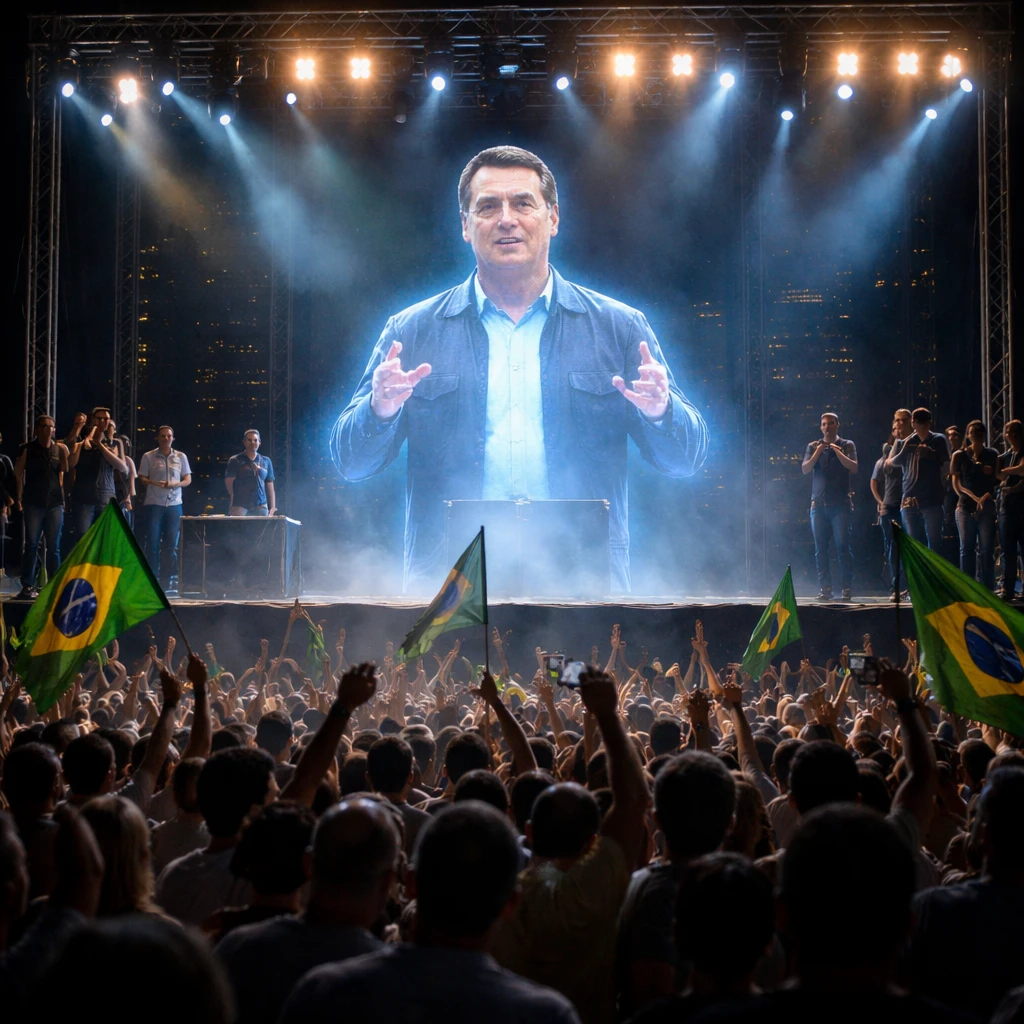
Former Brazilian President Jair Bolsonaro, currently confined to house arrest and legally prohibited from addressing the public, made an unexpected virtual appearance at the launch of his son Senator Flavio Bolsonaro’s presidential bid when an AI-generated avatar delivered a message at the rally.
The avatar, which informed attendees it had been produced using artificial intelligence, declared: "No prison will silence the feeling of hope we have stirred." It went on to ask supporters to "welcome with open arms the person I chose to replace me," framing the synthetic message as a direct intervention in the campaign launch.
Leftist and center-left parties immediately filed a petition challenging the use of the video in court, arguing the stunt could run afoul of electoral rules that aim to curb synthetic content capable of reproducing real people for the purpose of influencing voter intent. The complaint underscores a central dilemma for Senator Flavio Bolsonaro’s effort to compete with President Luiz Inacio Lula da Silva, who is campaigning for a fourth non-consecutive term: how to draw on the former president’s enduring popularity among conservative voters while respecting the judicial restrictions that bar Bolsonaro from public communications.
Legal authorities and experts weigh in
Marco Aurelio Mello, a former justice who once led Brazil’s Superior Electoral Court (TSE), stressed the difficulty regulators face when dealing with artificial intelligence. "The challenge with artificial intelligence is that it is virtually impossible to control," he said, reflecting the practical limits of enforcing rules against rapidly evolving technologies.
The president of Brazil’s Supreme Court, Justice Kassio Nunes Marques, who previously led the court that oversees electoral rules, commented on the broader question of AI use in campaigns, saying that "Using AI for campaigning is permissible, but what is forbidden is using it to harm someone." He also indicated he could not discuss the specific case until it has been formally reviewed by the court. He did not respond to requests for comment.
The Superior Electoral Court has adopted an AI rule that bars fabricated or manipulated content in electoral advertising when such content spreads false or misleading information that could undermine the fairness of an election or the integrity of the electoral process. How that rule applies to an avatar that openly admits to being synthetic remains a point of contention.
Arguments and defenses
A coalition of leftist and center-left parties, in its petition, cited the persuasive and manipulative potential of synthetic media and argued the rules prohibit creating a replica of a real person in order to influence voter intent. The petition framed the AI avatar as the sort of synthetic content regulators intended to limit.
Legal scholars, however, note ambiguities. Ivar Hartmann, an associate law professor at Insper in Sao Paulo, said Jair Bolsonaro is unlikely to face direct penalties because the former president could maintain he neither recorded nor authorized the AI-generated message. Hartmann added that the more difficult legal question is whether the video violated the electoral court’s AI restrictions. He pointed out the possible defense that the prohibitions are aimed specifically at deceptive content that harms electoral fairness or electoral integrity - an interpretation that aligns with Justice Nunes Marques’ comments.
Senator Flavio Bolsonaro’s campaign did not provide a comment on the video. Local reporting indicated Jair Bolsonaro had not been told in advance that the AI-generated clip would be played at the event, and that the campaign judged disclosing the synthetic nature of the footage to be a sufficient legal rationale for its use.
Political and technological implications
The incident highlights a growing intersection between technology and electoral politics: while public debate has often centered on deepfakes as vectors for misinformation, this episode tests whether synthetic avatars can function as political surrogates for figures who are legally constrained from communicating directly with voters. It remains unclear whether the avatar’s appearance at the campaign launch was a singular publicity tactic or the beginning of a more sustained role for virtual representations in the run-up to the October presidential contest.
As the courts consider the petitions, the case will help clarify how Brazil’s electoral framework treats synthetic media that is disclosed as artificial but nevertheless leverages the persona of a barred political leader.