
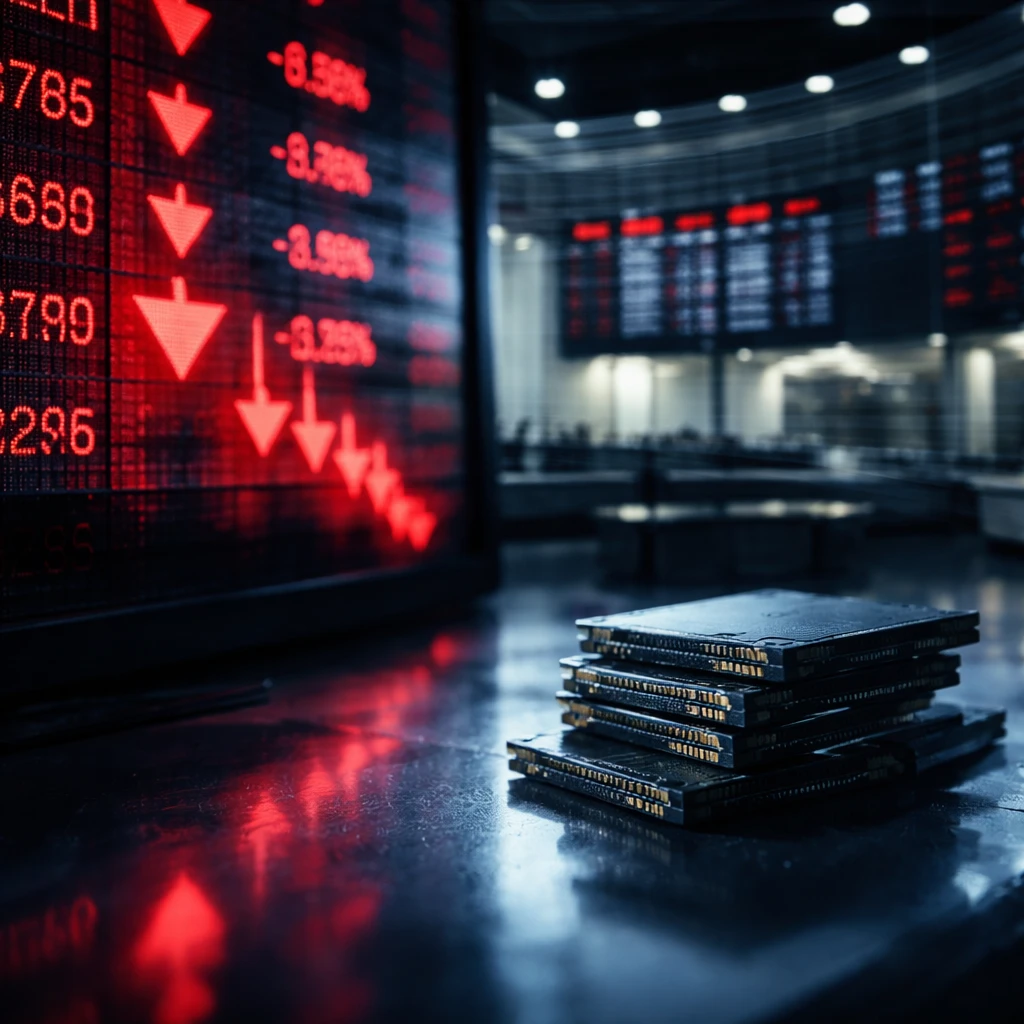
Tokyo - Kioxia's shares fell sharply, dropping 18.3% to trade at ¥44,550 and ending the day at the Tokyo Stock Exchange's daily limit-down price as selling pressure swept through semiconductor equities.
Investors moved to exit positions across memory chipmakers after reports surfaced that Nvidia may be providing backstop financing amounting to hundreds of billions of dollars for a major AI customer, a funding structure described in coverage as potentially "circular." That development undermined confidence in the financing underpinning parts of the AI investment wave and cascaded through the AI supply chain.
The immediate catalyst for Kioxia's decline was a sharp fall in its U.S. peer SanDisk during the prior American trading session. SanDisk plunged by more than 11%, provoking sympathy selling that hit Kioxia at the Tokyo open. At the same time, market participants reacted to reports that Chinese state-backed enterprises have started producing domestic immersion DUV lithography equipment, prompting concerns about faster-than-expected competition in the NAND memory market and the potential for margin pressure on established manufacturers.
Regional equity markets compounded the pressure on chip stocks. Japan's Nikkei 225 declined roughly 4% on the day, at one point losing more than 3,000 points intraday to reach its lowest level since late May - a roughly two-month low. South Korea's Kospi fell sharply enough to trigger a 20-minute exchange-wide circuit breaker, and memory-focused large caps including Samsung Electronics and SK Hynix experienced heavy losses. Taiwan's Taiex also dropped by more than 4%, illustrating the cross-border nature of the selloff affecting semiconductor names.
Within this confluence of negative signals - AI financing concerns, a direct sympathy shock from SanDisk, the emergence of a potential new domestic competitor in lithography, and a collapsing regional market backdrop - Kioxia became the worst-performing stock on the Tokyo Stock Exchange Prime Market for the session. The stock finished at its limit-down threshold on unusually large trading volume, reversing course from an all-time high of ¥112,700 recorded just weeks earlier.
This episode highlights how financing narratives and shifts in supply-chain dynamics can rapidly alter investor sentiment in capital-intensive technology sectors. For companies and market participants focused on memory production, the twin pressures of funding-related worries and evolving competitive risk profiles have translated into immediate share-price volatility across the region.
Market snapshot and context
- Kioxia - share price fell 18.3% to ¥44,550, closing at daily limit-down.
- SanDisk - dropped more than 11% in the prior U.S. session, triggering sympathy selling.
- Reports of Chinese state-backed production of immersion DUV lithography equipment raised competition concerns for NAND memory suppliers.
- Regional indices - Nikkei 225 down roughly 4%; Kospi triggered a 20-minute circuit breaker; Taiex fell over 4%.
Trading note - The magnitude and breadth of the declines produced extraordinary volume in affected names and left Kioxia as the session's worst performer on the Prime Market.