
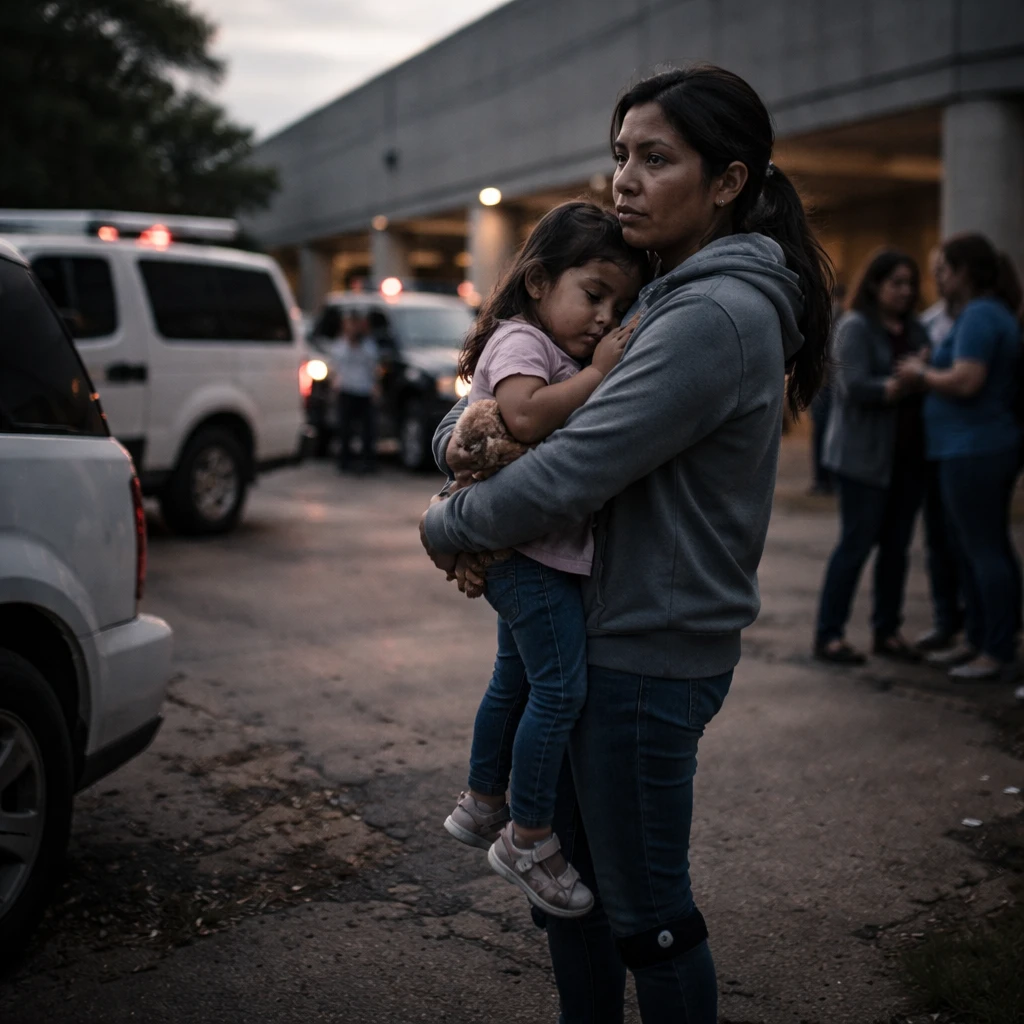
Newly reviewed internal government data and interviews with migrant families, legal advocates and former officials reveal a dramatic shift in how information gathered by the Office of Refugee Resettlement - the federal agency charged with caring for unaccompanied migrant children - has been used by immigration enforcement authorities. Records show ORR supplied ICE with a very large volume of information during President Donald Trump’s second term, a change that has coincided with thousands of arrests of sponsors, children and other household members.
One parent whose experience is detailed in the records is Aurora, 24, whose 6-year-old daughter arrived at the U.S. border alone and was placed in a child migrant shelter. Aurora, who entered the United States without authorization two years earlier and worked as a house cleaner in Mississippi, undertook the lengthy vetting process ORR now requires to secure her daughter's release. After months of providing documentation, including a DNA test, the two were reunited in late March, an occasion Aurora described as joy: "We were overjoyed." Within days of that reunion, however, both mother and daughter were detained by Immigration and Customs Enforcement and transferred to a family detention center in Dilley, Texas, according to case records.
Aurora's detention ended after three weeks, but her circumstances changed considerably. She was released with an ankle monitor and ordered to attend regular check-ins while her immigration case proceeded. During a detention hearing DHS records say Aurora admitted to having been "illegally smuggled across the border." In the interim, her landlord in Mississippi evicted her and disposed of her belongings, forcing her to relocate to California with a friend. Aurora said she fears imminent deportation and that her daughter frequently wakes up crying, believing she is still detained.
The cases of Aurora and other families in the records occur against the backdrop of a substantial increase in data sharing between ORR and ICE. According to the internal data, since January 2025 ORR provided more than 460,000 "leads" to ICE concerning unaccompanied children, their sponsors - commonly parents or other relatives - and additional household members. Those leads have resulted in more than 12,000 arrests by immigration authorities during the same period.
ORR was established in 1980 to resettle refugees. Since the early 2000s the agency has also been responsible for housing unaccompanied migrant children who arrive at the U.S.-Mexico border. Historically, the care of these children and the process of placing them with sponsors has been separated from immigration enforcement, a policy reflected in a 2008 law intended to ensure children are placed quickly in the least restrictive setting regardless of a sponsor's immigration status. That framework allowed sponsors to come forward to reunite with children without immediate fear of being targeted by enforcement.
Advocates and former officials say the policy has changed substantially. Jen Smyers, who served as deputy director of ORR during the Biden administration, said long-standing safeguards that limited ORR's sharing of information with ICE have been "completely reversed." Smyers added, "They are weaponizing a child welfare program for the purposes of more deportations."
In statements responding to questions about the agency's role, ORR said it "plays no role in the apprehension of children," and referred detailed questions about immigration enforcement to the Department of Homeland Security. DHS acknowledged that during Trump’s second term "ORR has provided ICE Homeland Security Investigations with potential investigative leads" in an effort to locate unaccompanied children who had been placed with what DHS described as "unvetted sponsors," including some with criminal records. DHS framed the information sharing as part of efforts to find children placed in homes that may threaten their safety.
Legal advocates and service providers see the effect differently, describing a process in which information required for child protection and placement has been used to locate and detain sponsors and other household members. The material shared with ICE reportedly includes identifying data collected during the increasingly rigorous vetting process, which now encompasses fingerprinting of all household members and additional checks that were not previously standard practice. ORR has said the enhanced screening is designed to protect children, but advocates argue the outcome has been to make both sponsors and children more vulnerable to immigration enforcement.
The operational consequences of the new vetting regime are visible in ORR’s reported custody durations. The agency's own figures indicate that the average length of time unaccompanied children spend in ORR custody rose sharply - from an average of 30 days in fiscal year 2024 to 194 days as of June 2026. The extended stays reflect the added steps in sponsor screening that aim to reduce risk to children, but they also prolong separation from family members while information is processed and, in many cases, while enforcement activity follows.
For many families, providing the sensitive information ORR requests is a matter of necessity; without it, children cannot be released from shelter care. Aurora and others complied, sharing DNA results, tax records, fingerprints and other material. That cooperation, however, has sometimes exposed relatives to enforcement action.
Marleny, another parent whose story appears in the records, fled violence in Guatemala with her youngest son in 2023 and settled in Texas, where she worked cleaning construction sites. Her older son, Victor, remained in Guatemala but later made the journey north after his uncle was killed. On turning himself in to U.S. border authorities, Victor went into ORR custody and was held for four months before being released on the night before his 18th birthday, according to public records.
To secure Victor's release, Marleny said she and her partner provided extensive documentation to ORR, including tax documents and fingerprints. Confident they had no criminal records, Marleny said she felt safe sharing the information. Two months after Victor's release, ICE agents arrested Marleny and her partner at gunpoint as they were getting into a car to go to work. DHS told officials that ICE executed a criminal search warrant on Marleny's "roommate," an apparent reference to her partner. DHS did not provide further details about the nature of the underlying allegation or how agents located the individual.
The sight of armed officers was deeply traumatic for the family, Marleny said, evoking the violence they had fled. A neighbor who witnessed the arrest alerted Victor, who was at home with his 6-year-old brother. In the chaos, Victor called a legal assistant at the Galveston-Houston Immigrant Representation Project for help. Victor is now the primary caregiver for his younger brother and is himself contending with immigration court proceedings after failing to appear for a scheduled hearing in the turmoil following his mother's arrest. Facing a deportation order, Victor said he is trying to find legal representation in hopes of reopening his case.
Legal service providers report that collateral arrests of sponsors and household members have become a recurring feature of enforcement after ORR-originated leads were shared. Alexa Sendukas, a managing attorney with the Galveston-Houston Immigrant Representation Project, said, "We've seen so many sponsors arrested and collateral arrests with them." The effect, she added, leaves minors to shoulder new responsibilities and increases pressure on community legal services that assist families.
The data reviewed show ORR supplied more than 460,000 leads to ICE since January 2025, and that information-sharing has been linked to over 12,000 arrests. ORR, which traces its origins to 1980 and since the early 2000s has managed care for unaccompanied children, says enhanced vetting steps are intended to protect children from harm. Advocates and former officials counter that these same safeguards have eroded the firewall between child welfare placement and immigration enforcement established under prior policy and reinforced by a 2008 law aimed at expediting release of children to the least restrictive, safe setting regardless of a sponsor's immigration status.
For families like Aurora's and Marleny's, the consequences have been immediate and personal: extended separations, detention and the loss of homes and possessions. For communities and legal service providers, the changes have increased demand for assistance and raised questions about how child welfare information is used when enforcement priorities shift. For sponsors, the choice between providing information needed to secure a child's release and the risk that that information will be used for enforcement is now a central dilemma.
Officials at ORR and DHS have offered differing characterizations of the data sharing. ORR emphasizes it does not apprehend children and points to child safety as its rationale for heightened screening. DHS notes ORR has provided potential investigative leads to ICE in cases involving placements it describes as unvetted or potentially risky. Advocates and some former ORR officials argue the policy change has been sweeping and that safeguards once in place to protect families and rapid reunification have been reversed.
The records and the families' accounts do not resolve broader policy debates over how to balance child protection with immigration enforcement. They do, however, document a shift in practice with clear human consequences: repeated detentions, longer stays in shelter care, and what legal advocates call collateral enforcement actions that ripple across households and communities. Families interviewed described fear, disruption and ongoing legal uncertainty as they navigate immigration proceedings prompted in part by information originally provided to secure the safety and placement of unaccompanied children.
As these cases play out in immigration courts and community legal clinics, the practical implications extend to sectors that employ large numbers of migrant workers, including construction, cleaning services and other service industries, all of which may face labor disruptions if sponsors and workers are detained. Legal aid organizations and community groups that support immigrant families are experiencing increased caseloads and strain. The longer average custody times for children also have implications for shelters and social services tasked with extended care and case management.
The records underline a striking operational reality: information collected as part of a child welfare and placement process can, under current practice, lead directly to enforcement actions that reverberate through families, alter caregiving arrangements and impose new burdens on community support systems. Whether the balance between child safety screening and protection from immigration enforcement will be recalibrated remains an open question, one that is being addressed in courts, administrative offices and community meetings nationwide.
For the families at the center of the records, the stakes are immediate. Aurora continues to await the result of her immigration case while caring for her daughter in California, fearing deportation and grappling with trauma after detention and eviction. Victor is coping with new responsibilities caring for his younger brother as he seeks legal help to contest a deportation order. Marleny remains separated from her children following her arrest. These experiences illustrate how a change in the handling of information at a child welfare agency can translate into far-reaching consequences for thousands of people already living with legal uncertainty.