
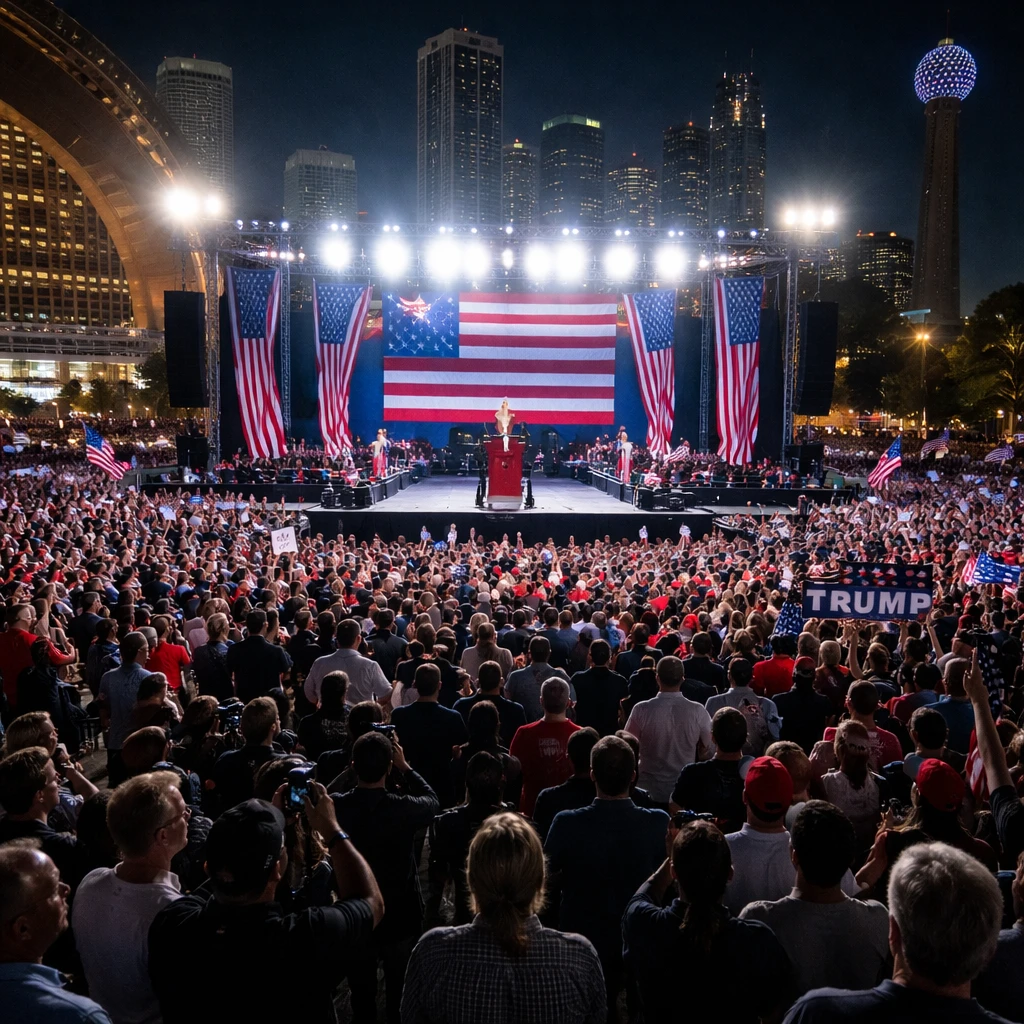
DALLAS, Sept 9 - Republican leaders and activists gathered in Dallas for the party's inaugural midterm convention, betting that President Donald Trump can activate loyal supporters and blunt Democratic momentum even as polls indicate he remains broadly unpopular. The two-day meeting is being presented as a high-profile showcase of the GOP's campaign priorities ahead of the November 3 midterm elections.
Organizers have designed the program around a heavy Trump presence. The president is scheduled to deliver the chief address on Wednesday night and to return to the stage on Thursday after Vice President JD Vance to close the event. Republican National Committee officials expect a full house at the 20,000-seat American Airlines Center, according to party statements announcing arrangements for officials, donors, activists and members of the public. Entry to the event was opened to the public through a free ticket lottery, a step taken after internal concern that turnout could be lower than hoped.
The convention contains no formal party business on its agenda and is being staged more like a campaign rally than a traditional party convention usually held in the run-up to a presidential election. That distinction underscores how closely the party is tying its midterm fortunes to Trump, a strategy reflected in an informal nickname used internally by one senior party official - a play on a major music festival that highlights the president's centrality to the gathering.
Yet the convention is not without controversy inside Republican ranks. Several House and Senate candidates running in competitive races are electing not to participate, illustrating concern that Trump's appeal to core supporters may not be sufficient to overcome wider voter dissatisfaction stemming from inflation and the war on Iran. Public polling included in pre-convention analysis suggests Democrats are more motivated to vote, creating the risk Republicans could lose control of at least one chamber of Congress.
Sergio Arellano, chair of the Republican Party of Arizona, framed the effort as an attempt to counter prevailing narratives of decline. "A lot of people are feeding into the narrative that things are worse off than they ever have been," he said in an interview. "It’s important that we reconnect, refresh and reenergize." The comment captures a central aim of the Dallas gathering: to shore up the Republican base and turn out voters who may be less enthusiastic than their Democratic counterparts.
Some party strategists and candidates have signaled wariness about the event's tone. With no official business on the schedule and a program heavy on national figures, a number of Republicans view the convention as more of a celebration of the president than an opportunity explicitly tailored to boost individual House and Senate campaigns. Matthew Wilson, a political science professor at Southern Methodist University, suggested that such concerns reflect an enduring pattern in which Trump prioritizes his personal brand. "Trump has always cared more about brand Trump than about the Republican Party," Wilson said. "I think that’s why there’s some wariness from their standpoint about being a visible presence at this event."
While the Republican National Committee's published speaker list includes at least 16 candidates in competitive House and Senate contests, other high-profile Republicans are notable by their absence. Representative Tom Barrett of Michigan and Senator Susan Collins of Maine are among those not scheduled to speak. Senate Majority Leader John Thune does not appear on the publicly released roster of speakers, though he is expected to attend and will meet with donors and candidates, a person familiar with the matter said.
The program interweaves campaign themes designed to paint Democratic opponents as too far left while highlighting aspects of the Trump administration's domestic agenda. Speakers are slated to emphasize immigration restrictions, efforts to lower drug prices and a 2025 tax-and-spending package that, according to the party outline, eliminated taxes on tips and Social Security benefits.
Members of the president's cabinet will also appear. Treasury Secretary Scott Bessent is among those scheduled to address the gathering; his remarks are anticipated to draw attention from observers given concurrent concerns about rising U.S. debt levels and persistently high living costs.
Democrats are mounting a counter-programming effort. House Minority Leader Hakeem Jeffries has dispatched four Democratic lawmakers to Dallas to offer an alternative message. In a statement, Jeffries accused Republicans of neglecting cost-of-living concerns and criticized the convention as an event for wealthy backers. "Americans are drowning in the failed Republican economy," he said. "Rather than taking a single step to lower costs, MAGA extremists are partying with their super-rich donors in Dallas."
The choice of Texas as host state also spotlights a key battleground Senate race. The midterms will feature a closely watched contest in Texas between Attorney General Ken Paxton and Democratic state Representative James Talarico, an example of the localized prize fights that the national party is seeking to influence with the Dallas gathering.
Competition for viewers could dilute the convention's reach. The opening night coincides with the start of the NFL season, including a game that matches the New England Patriots and the Seattle Seahawks in a Super Bowl rematch, while Thursday's schedule overlaps with a matchup between the San Francisco 49ers and the Los Angeles Rams. Those sporting events present a potential ratings obstacle for Republican organizers trying to maximize exposure.
Despite the questions about turnout and messaging, party officials are using the event to press their preferred narratives on affordability, immigration and healthcare while rallying donors and activists. Organizers are relying on the president's continued popularity among core voters to stamp the party's identity on the final stretch of the midterm campaign, even as several competitive candidates weigh the political calculus of formal participation.
Key points
- Republicans are staging their first midterm convention in Dallas with a program heavily centered on President Trump, aiming to energize base voters before the November 3 elections.
- Several competitive candidates are not participating, reflecting internal concern that Trump's appeal may not be sufficient to overcome voter dissatisfaction on inflation and the war on Iran; at least 16 competitive House and Senate candidates are scheduled to speak.
- Policy themes on the agenda - immigration limits, drug-price reductions and a 2025 tax-and-spending package that eliminated taxes on tips and Social Security benefits - touch on sectors such as healthcare, consumer spending, and fiscal markets.
Risks and uncertainties
- Voter enthusiasm gap - Pre-convention polling indicates Democrats may be more motivated to vote, increasing the risk Republicans could lose control of at least one chamber of Congress; this has implications for market-sensitive policy outcomes.
- Internal GOP divisions - The decision by some candidates to skip the convention highlights uncertainty about whether a Trump-centric event will translate into broader electoral gains, potentially affecting campaign resource allocation in key races.
- Audience reach - The convention's television and streaming audience may be reduced by competing high-profile NFL games, limiting the event's capacity to sway undecided or less-engaged voters.
Disclosure