
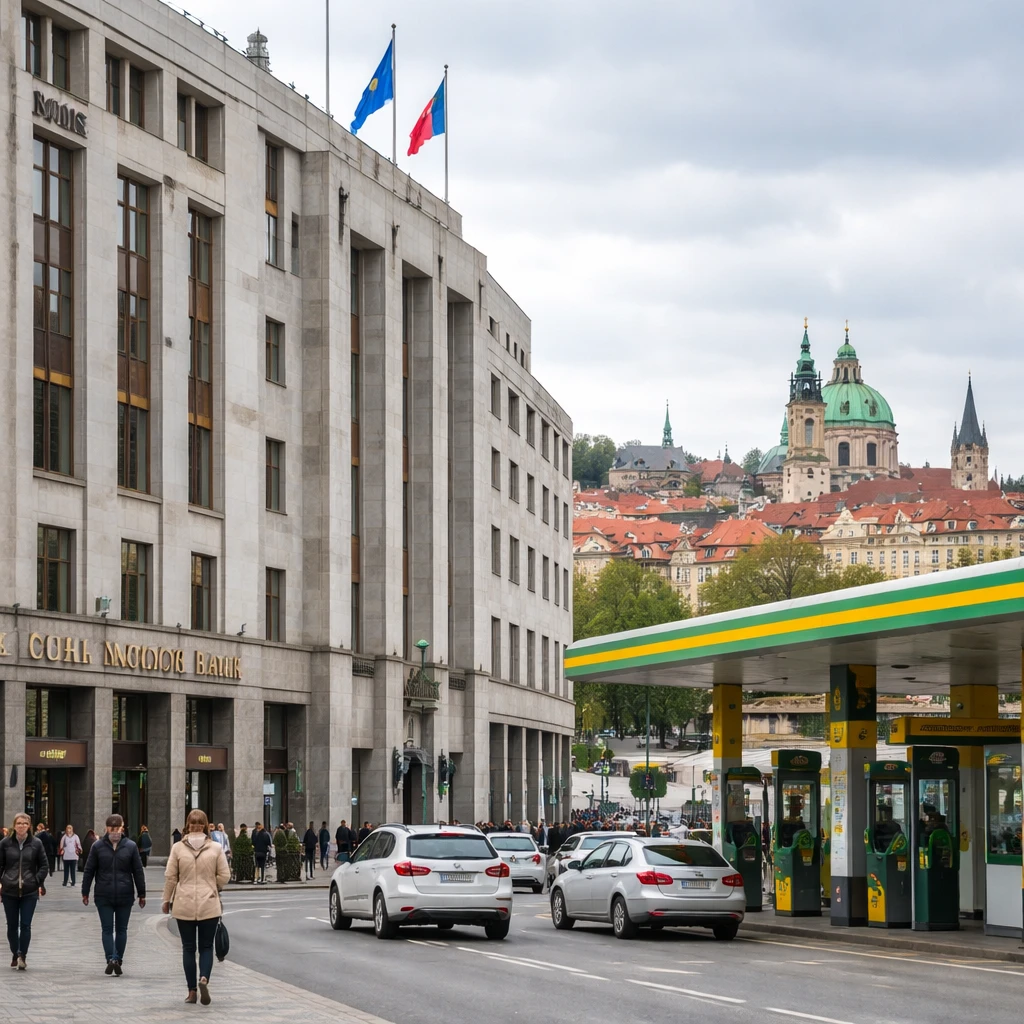
The Czech National Bank said monetary policy is still on a restrictive footing despite a renewed uptick in inflation in April 2026, with fuel prices cited as the main driver of the increase in headline consumer price growth.
Headline consumer inflation accelerated to 2.5% year on year in April, up from 1.9% in March, the Prague-based central bank said in a statement accompanying the April 2026 inflation data. The bank highlighted that fuels have become markedly more expensive - adding almost 30% over the past two months - and that development underpinned much of the monthly rise.
Policymakers opted to keep interest rates unchanged at 3.5% this month as they balance the upward pressure from energy costs against potential negative effects on economic growth stemming from restrictive monetary settings.
On core measures, the CNB reported that core inflation remained steady at 2.9% year on year in April. Services inflation stayed elevated at 4.5% year on year, while goods inflation measured a 0.6% year-on-year increase. The cost measure for owner-occupied housing accelerated to 5.5% year on year in April, representing the highest reading in three years.
Not all categories moved higher: food and non-alcoholic beverage prices continued to fall, with their annual rate deepening to -1.3% in April. Fuel prices registered a 27.1% year-on-year increase in April, slightly above the central bank's projection of 25.8%.
"The level of core inflation and the increase in the inflation outlook driven by global cost pressures and the risk of spillovers into other price categories are reasons for increased caution," said Petr Sklenář, Executive Director of the Monetary Department.
Looking ahead, the CNB expects headline inflation to remain between 2% and 3% for the remainder of the year as a result of impacts stemming from the Middle East conflict. The bank's statement frames recent energy price developments as a key factor shaping its cautious stance.
Summary
- April headline inflation rose to 2.5% year on year from 1.9% in March, largely due to a surge in fuel prices following the Iran war.
- The CNB held its policy rate at 3.5% while noting risks from global cost pressures and potential spillovers into other price categories.
- Core inflation was unchanged at 2.9% year on year; services inflation was 4.5% and owner-occupied housing costs hit 5.5% year on year.