
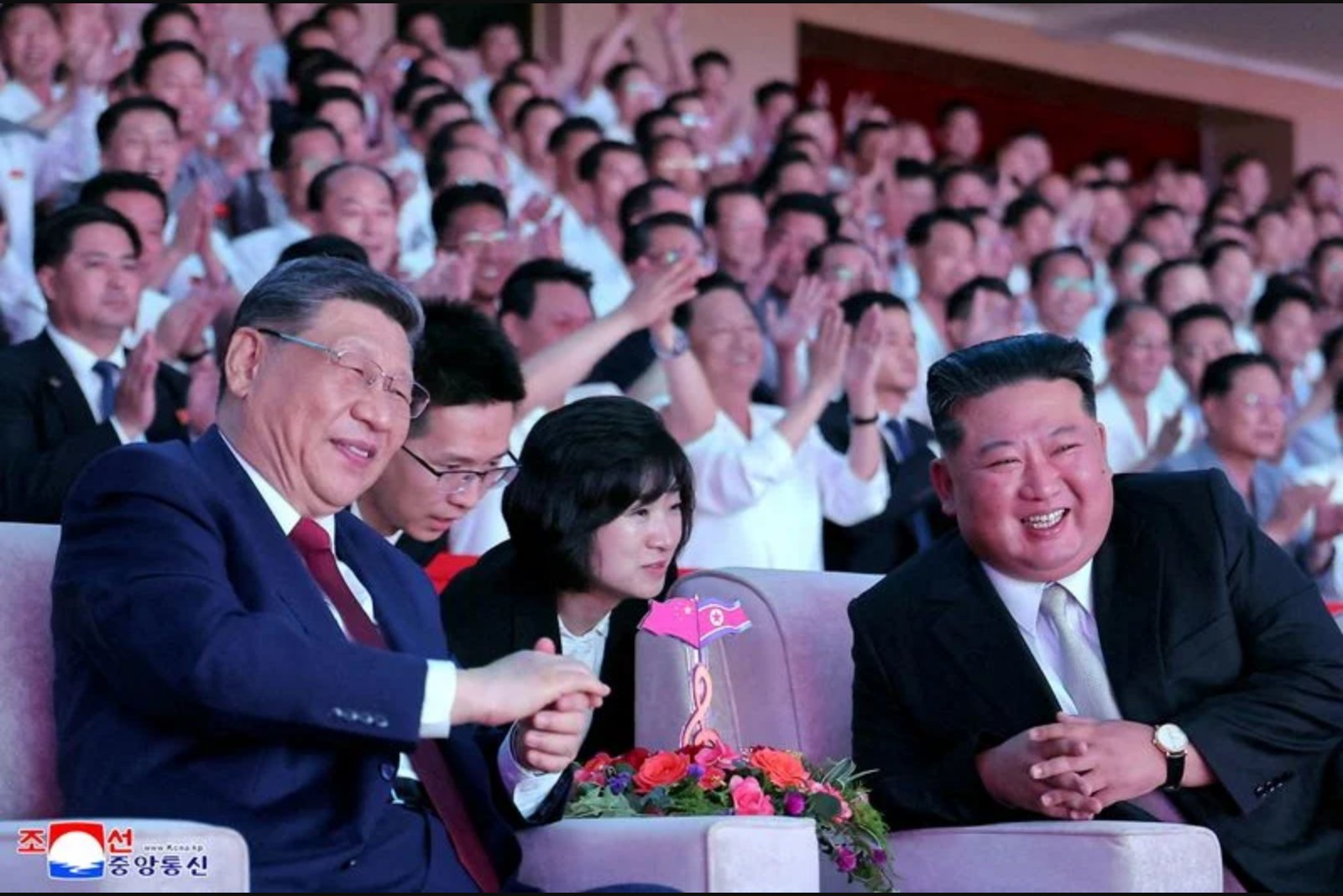
Chinese President Xi Jinping ended a visit to North Korea on June 9, marking his first trip to Pyongyang in seven years, and told hosts at a departure luncheon that the meeting had produced a "deeper and more comprehensive" mutual understanding and clarified the direction for future ties, according to China’s official Xinhua news agency.
North Korean state media, KCNA, said Xi and North Korean leader Kim Jong Un agreed to widen cooperation in politics, the economy and culture, calling the summit the start of a new chapter in the relationship between the two neighbours. KCNA reported both leaders pledged to pursue closer strategic communication through visits by high-level officials.
Footage carried by China’s state broadcaster CCTV showed Kim waving both hands as Xi’s plane taxied on the tarmac, following an energetic send-off in which Pyongyang residents lined the road to the airport waving flags and chanting friendship slogans. Earlier in the visit the two leaders jointly planted a fir tree on the grounds of a political training school for party cadres - an act described by Xinhua as a symbol of "ever-renewing friendship." Xinhua also said Xi visited the Sino-Korean Friendship Tower, which commemorates Chinese soldiers who died in the Korean War.
KCNA and Xinhua each framed the visit in distinct ways. While Xinhua outlined proposals that included intensified high-level exchanges, trade and agriculture initiatives and the restoration of transport links, KCNA emphasised the summit as an affirmation of equality and the two countries' "special relationship." Analysts said the contrasting official narratives reflect differing priorities.
Lim Eul-chul, a professor at South Korea’s Kyungnam University, observed that Pyongyang stressed regime dignity and the unique relationship between the neighbours. Hong Min, a senior research fellow at the Korea Institute for National Unification, said Pyongyang had removed elements that might suggest a subordinate or dependent position and had recast the relationship as one between equals, while amplifying messages of solidarity, including anti-U.S. and Taiwan-related signals, and erasing indications of dependence.
China, meanwhile, continues to be North Korea’s largest trading partner. Analysts have suggested that Xi’s visit could be geared toward practical economic engagement, including trade and tourism, and potentially the restoration of transportation links that have been disrupted. A Beijing resident who gave her name only as Zhu, a 43-year-old doctor, commented that the countries can appear friendly outwardly while still having many unresolved issues beneath the surface.
At a banquet hosted by Kim marking the 65th anniversary of the neighbours’ friendship treaty, Xi said that China-North Korea relations had reached a "new historical starting point," according to KCNA. Xinhua reported Xi pledged that Beijing would not waver in protecting shared interests. KCNA said Xi and his wife Peng Liyuan, accompanied by Kim and Ri Sol Ju, attended a performance of Chinese and North Korean songs that KCNA said showcased "the value and closeness of DPRK-China friendship." DPRK is the abbreviation used by the North for the Democratic People’s Republic of Korea.
KCNA reported Kim told Xi he would fully support the "One China principle," a position Beijing describes as meaning both sides of the Taiwan Strait belong to one country regardless of changes in the international environment. Xinhua and KCNA coverage reiterated that Beijing views democratically governed Taiwan as its own territory and has never renounced the use of force to bring the island under its control, while Taipei rejects those sovereignty claims.
Notably, North Korean media did not report on whether Pyongyang’s nuclear weapons programme or relations with the United States were discussed during the talks. Ja Ian Chong, a political science professor at the National University of Singapore, said that such an omission suggests Beijing would prefer the visit to be framed as a neighbourhood, rather than a strategic security, engagement.
The summit also drew commentary about its potential to influence broader diplomacy. While former U.S. president Donald Trump met Kim three times during his first term before efforts collapsed over U.S. demands for denuclearisation, analysts cited in coverage expressed skepticism that Xi’s trip would necessarily catalyse talks between Washington and Pyongyang. Leif-Eric Easley, a professor of international studies at Ewha Womans University in Seoul, said it is doubtful Xi will serve as such a catalyst.
Implications for trade and transport
Both state agencies mentioned trade-related initiatives. Xinhua’s description of proposals touching on trade, agriculture and restoration of transport links points to potential practical cooperation that could affect cross-border flow of goods, tourism and logistics operations. For a country that counts China as its largest trading partner, steps toward restoring transport connections could have direct implications for freight movements, transport infrastructure and regional commerce.
Public symbolism and political messaging
Public displays - from the planting of a fir tree to performances featuring national songs and the airport send-off - reinforced the ceremonial and propagandistic elements of the visit. KCNA’s stress on parity and dignity suggests Pyongyang prioritised messages of sovereignty and mutual respect in the official narrative.
This report is based on statements and coverage published by Chinese and North Korean official media, and on comments by named analysts and individuals referenced in that coverage. Where official media did not provide details, this article reflects those reporting omissions rather than introducing additional claims.