
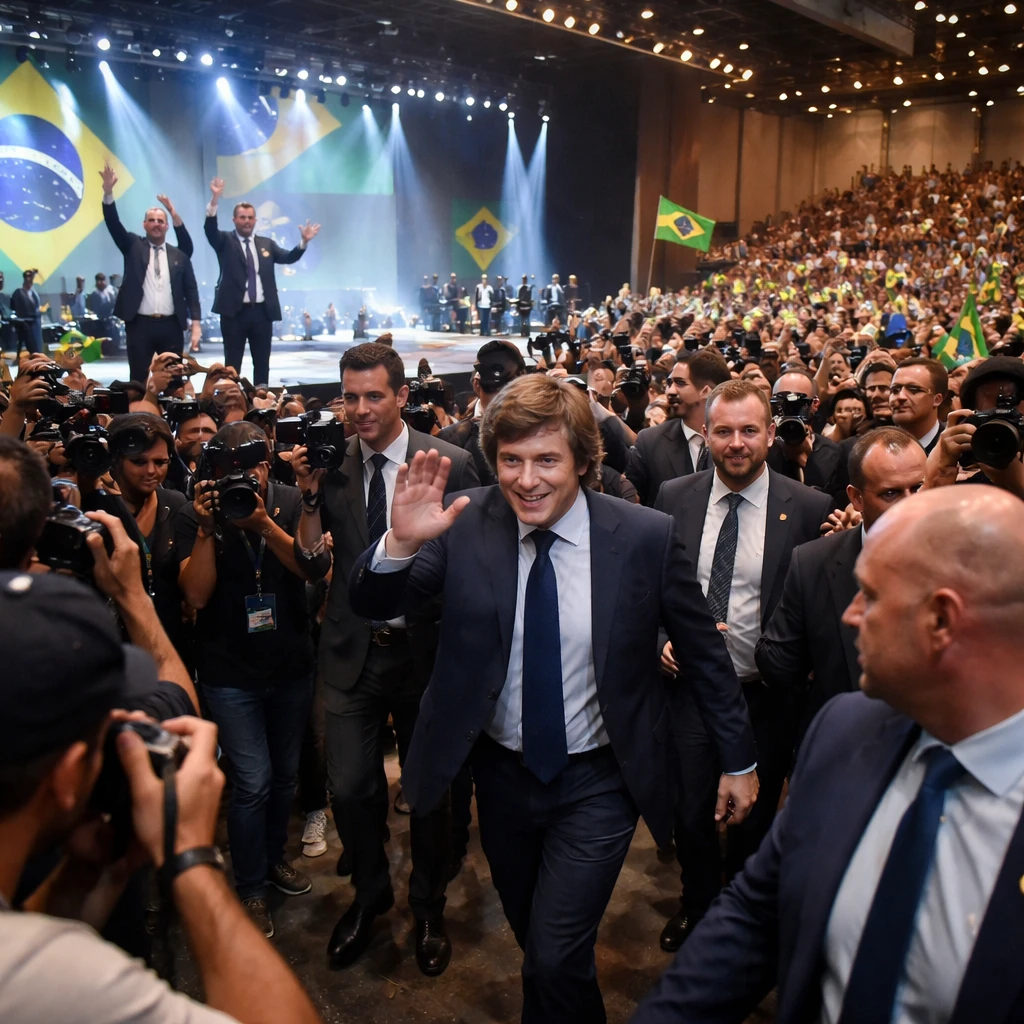
Argentine President Javier Milei arrived in Brazil on Friday to endorse Senator Flavio Bolsonaro at his party’s nominating convention, a rare show of direct support from a foreign head of state during a domestic political event. The public backing is intended to inject momentum into Bolsonaro’s bid for the presidency as he seeks to broaden support ahead of a possible runoff against incumbent President Luiz Inacio Lula da Silva.
The visit stands out both for its symbolism and for its timing. Political operatives and outside observers see Milei’s presence as a potential catalyst for the senator, whose campaign has been buffeted by months of controversy and internal disputes. The endorsement from another regional conservative leader is also framed by commentators as part of a broader wave of right-leaning electoral successes across parts of Latin America.
Political context and campaign headwinds
Flavio Bolsonaro has slipped in opinion polls and now trails President Lula in potential head-to-head matchups, according to survey data reported by pollster Quaest. The polling shift marks a reversal from April, when he held a technical lead, and has heightened scrutiny of his campaign’s capacity to unite conservative voters.
Several specific difficulties have depleted campaign momentum. In May, the senator confirmed that a banker who has since been jailed in a major fraud and bribery probe provided funding to produce a film about his father’s political career. This disclosure was followed by federal police authorization to investigate the financing, adding fresh legal and reputational pressure on the campaign.
Domestically, a public dispute with his stepmother has threatened Bolsonaro’s appeal among women voters. At the same time, the ongoing political role of his father, who remains under house arrest serving a sentence tied to a failed coup plot, complicates efforts by the senator to present himself as the uncontested heir to the Bolsonaro political brand. Analysts describe this dynamic as weakening Flavio’s natural claim to that mantle.
Endorsement dynamics and regional alignment
Observers suggest Milei’s endorsement could help mobilize the more ideologically driven elements of Bolsonaro’s base. Silvio Cascione, who heads Brazil coverage at Eurasia Group, noted that Milei’s appearance at the convention is likely to energize and mobilize the party’s ideological core, and linked the gesture to the string of conservative victories in recent elections across the region.
The Argentine leader’s outreach is not limited to Brazil. He is scheduled to attend the July 28 inauguration of Keiko Fujimori in Peru, to hold talks in Ecuador with conservative President Daniel Noboa, and to travel to Colombia for the August 7 inauguration of right-winger Abelardo de la Espriella. Those movements tie Milei to a set of leaders and victories that analysts see as forming a regional right-leaning current.
Policy alignment and campaign messaging
Flavio Bolsonaro’s platform echoes common themes among the recent conservative winners: a strong emphasis on law-and-order measures and market-oriented economic changes. On public security, he has proposed lowering the age of criminal responsibility from 18 to 16 and constructing new maximum-security prisons, citing models such as that of El Salvador’s president.
On economic policy, the senator has promised tax reductions and privatizations aimed at creating a smaller government footprint. He has also criticized President Lula for food inflation trends that have eroded some of the incumbent’s popularity.
Strategy, positioning, and the path forward
One central strategic question for Bolsonaro’s campaign is how to retain his father’s fervent supporters while expanding reach to Brazilians fatigued by a decade of intense polarization. After receiving explicit backing from his father last December, which helped sideline other potential conservative contenders, the senator has sought to burnish an image of moderation. He has described himself as a more centered version of the Bolsonaro political brand and has pursued diplomatic and relationship-building trips abroad to underscore a willingness to engage internationally.
Yet campaign missteps and unresolved internal divisions have kept some conservative allies and potential partners on the sidelines, while other right-leaning candidates remain in the field, polling at low single digits. Political analysts and pundits continue to expect a competitive runoff between Lula and Bolsonaro in October, but for now the momentum appears to favor the incumbent, barring an unforeseen reversal in public sentiment.
Economic and market implications
Recent developments have brought economic issues into sharper relief for Bolsonaro’s campaign. New U.S. tariffs on Brazilian goods have intensified focus on trade relations and the family’s track record in cultivating ties with external actors, including overtures to U.S. political figures. Meanwhile, criticism of Lula over inflation in food prices has been a central plank of Bolsonaro’s messaging toward voters concerned about household budgets and purchasing power.
Market actors and investors watching the race will likely monitor how political shifts and policy proposals could affect trade, tariff exposure, privatization prospects, and broader investor confidence. For now, the contest remains fluid, with a clear need for Bolsonaro to consolidate his base and broaden appeal if he hopes to overcome the current polling deficit.
As of late Thursday, a press officer for Senator Flavio Bolsonaro had not responded to a request for comment.