
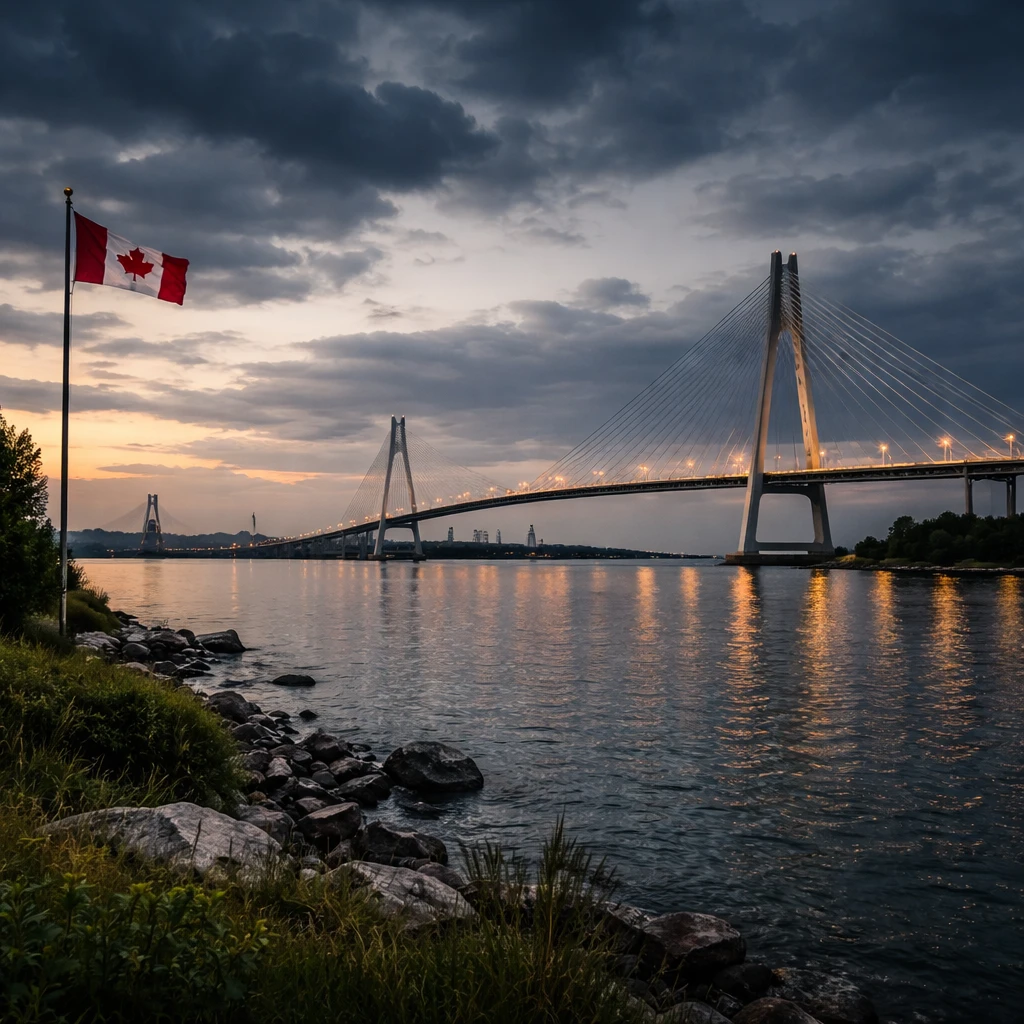
Canada will observe the official opening of the Gordie Howe International Bridge with a low-key event on Friday, foregoing a joint ceremony with U.S. officials as disagreements over toll-sharing and fresh threats of 50% tariffs from U.S. President Donald Trump have heightened tensions between the two neighbours.
The planned cross-border ribbon-cutting was cancelled, with Canadian authorities saying the milestone would be recognized only by Canadians ahead of the bridge opening to traffic on Monday. What would normally be a shared celebration between long-standing allies has instead been overshadowed by fraught trade discussions and recent threats from the United States to impose additional tariffs on Canada, which directs roughly 70% of its exports to its southern neighbour.
In recent days, some American political figures, including the president, have also accused Canada of "poisoning" the U.S. with wildfire smoke emanating from fires burning in northern Ontario. Those comments have added to the strain accompanying the project.
The bridge, which cost $4.7 billion and bears the name of Canadian-born Detroit Red Wings hockey legend Gordie Howe, was fully funded by Canada. Construction began in 2018 and the facility had originally been slated to open in June. It is intended to provide a quicker alternative to the existing Ambassador Bridge spanning the Detroit River.
President Trump previously threatened in February to block completion of the project, citing a range of grievances including provinces' refusal to sell U.S. alcohol, Canadian tariffs on American dairy products and Canada’s trade engagements with China. Disagreements between the two countries continue to surface over how toll revenues from the new crossing will be shared and the timing of any payments.
Earlier this month, the president said he had secured "a much better deal" and significant revenues for the United States that would permit the bridge to open. Canadian Prime Minister Mark Carney said his government would only agree to share toll revenues after its expenses had been repaid. However, a draft agreement released on Wednesday states that Canada will split net bridge- and crossing-related revenues with the U.S. for the first 15 years, and it does not explicitly include a clause requiring Canada to be reimbursed first.
Addressing the apparent inconsistency at a press briefing on Thursday, Carney said that a prior accord signed between Canada and Michigan remains in effect and that "there’s no splitting of tolls under that agreement until all of the debt is repaid." Neither country has produced a public estimate of potential toll revenues.
White House spokesman Kush Desai commented on Thursday that President Trump had "renegotiated an incredible deal for America on the Gordie Howe Bridge," without specifying when the U.S. would start receiving toll revenues from the crossing.
Legal and trade experts noted the competing interpretations. Nicolas Lamp, an associate professor and lawyer at Queen’s University’s Institute on Trade Policy, said the new draft agreement appears to contradict a 2012 pact referenced by Carney. "The U.S. can point to the new agreement that says they will get half of the net revenue, while Canada can say that contradicts the original agreement," Lamp said. He added that the document is sufficiently vague that both parties can present it as a victory.
Lamp also pointed out that the draft agreement is not legally binding, leaving open the possibility that Canada could press for more favourable terms in further negotiations.
Domestically, opposition Conservatives have criticized Carney’s handling of the situation, accusing him of having "caved" to U.S. demands. Lamp disputed that characterization. Don Abelson, who chairs the political science program in Canada-U.S. relations at McMaster University, warned that a major concern with the proposed terms is the absence of a dispute resolution mechanism, a gap he said "leaves Canada extremely vulnerable if President Trump does something unpredictable."
Abelson suggested Carney’s government may have prioritized getting the bridge operational as the primary objective, even if reimbursement for the billions invested remains a crucial issue. "Being reimbursed for the billions of dollars spent on the bridge is critically important, but there’s nothing more important than the trade relationship between Canada and the U.S.," he said.
Context and next steps
The bridge will open to traffic on Monday. In the meantime, officials on both sides continue to interpret and negotiate around the language of competing agreements. With no public revenue projections and contrasting statements from leaders and spokespeople, the financial implications and the timing of any revenue-sharing remain unresolved.