
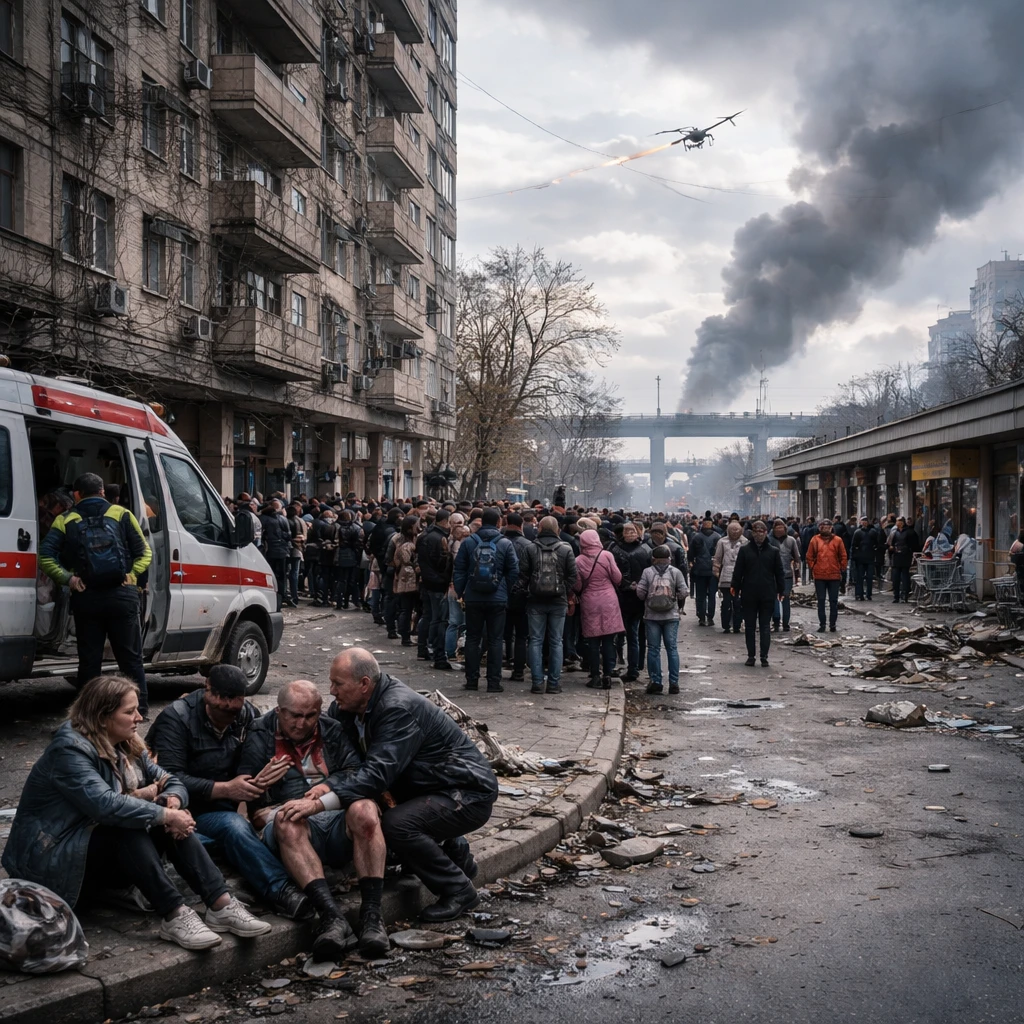
Kyiv is confronting a new and more relentless pattern of attacks that is eroding the fragile normality residents had rebuilt since February 2022. Over the summer, Moscow shifted to using swarms of high-speed, jet-propelled drones that are more destructive and harder to intercept than earlier propeller-driven models. In the last 10 days, those air attacks have moved from largely night-time strikes to a near-continuous, round-the-clock threat, with significant consequences for life across the city.
Immediate human impacts
Personal accounts across Kyiv underscore the suddenness and danger of the new strikes. Vitaliia Poliakova, 35, and her partner were driving near a bridge on the eastern bank of the Dnipro when a jet-propelled drone hit the road close to their car, leaving both of them injured. Poliakova spoke while being treated in an ambulance, describing how the strike interrupted an ordinary drive: "We were driving, talking about our own things. Then there was a sudden hit." She sustained cuts to her right hand; her partner suffered facial injuries and a wounded right leg.
For many of Kyiv’s roughly 3 million residents, the prospect of another winter under constant threat is a pressing worry. Residents have already endured intermittent power and water outages throughout the conflict, but officials and citizens say the recent uptick in intensity suggests even greater disruption is likely as the cold months approach.
Housing and displacement
Repeated strikes on residential areas have prompted people to reassess whether they can remain in the city. Bohdan, 29, surveyed damage to his apartment block after a recent attack and described the toll: "The last year has been really difficult for us. After this (attack), as you can see, it will probably be even harder, so we’re moving away." Such statements reflect a pattern of displacement driven by the erosion of safety in formerly protected urban neighborhoods.
Commuting, transport and retail disruptions
Daily mobility and commercial activity in Kyiv have been significantly affected. On a recent Monday, repeated air raid alerts forced the temporary suspension of metro services that link the two sides of the Dnipro river, stranding commuters and halting a key transit artery. At Osokorky station, near the far bank, nurse and psychologist Yulianna Oliynyk waited on an overcrowded platform with her two sons for alerts to clear. She said she is contemplating sleeping in the metro station near her children’s school as a precaution: "I’m already thinking maybe we should just take sleeping bags and sleep in the metro at the station near the school. Last year it was difficult at school and now I honestly don’t even know what to do. I just don’t know."
Roads into central Kyiv are heavily congested. Bus stops are crowded and many residents are walking long distances to get to and from work. Supermarkets and other large stores pause operations when air raid sirens sound, leaving customers to abandon shopping mid-visit. The food retail sector is feeling pressure: some dairy products are becoming scarce as supply chains are disrupted and warehouses are struck. Natalia Petrivska, executive director at the Ukrainian Food Retail Alliance, has appeared on television to tell consumers there is no reason to panic buy, while acknowledging supply challenges.
Education under strain
Schools have reopened, but the security environment has altered the rhythm of the school day. On the first day of the new academic year, pupils at one Kyiv school completed their first lesson when air raid sirens forced them to move into underground shelters to continue classes. The headmaster, Roman Feshchuk, said: "It’s stressful for them, but the children are becoming better able to adapt." That school, which had been damaged in a Russian attack in May, enrolled about 400 children this year, though fewer first-graders have signed up than in previous years. A young girl named Oleksandra, dressed in a traditional Ukrainian outfit and carrying flowers for the new academic year, said simply: "That the war will end."
Scale of the air campaign and military interception
Ukrainian air force figures indicate Moscow’s use of jet-propelled drones increased sharply over the summer. An air force spokesperson reported that Russia fired more than 2,800 jet-powered drones at Ukraine in August, and that their use had risen fivefold in July compared with June. Interception rates for the faster drones are lower than for the slower, conventional models; the spokesperson said interception was around 60% for the jet-propelled drones, compared with interception rates of more than 90% for slower drones.
Kyiv and Moscow provide differing interpretations of the intent behind these strikes. Russia says the attacks have military objectives; Ukrainian authorities say they are intended to break civilian morale and pressure the government. At the same time, polling by a Kyiv-based institute in August found public attitudes to Russia hardening: the proportion of respondents opposed to ceding the unoccupied part of the Donbas region rose to 69% from 62% in April.
Civilian toll and wider implications
The United Nations has verified more than 16,000 civilian deaths in the conflict to date, with the vast majority occurring in Ukraine. Both sides say they do not target civilians, yet dozens of civilians in Kyiv and the surrounding region have been killed since August 27. With intense frontline fighting causing large numbers of casualties each week but little change in territorial control, the conflict has increasingly shifted toward an escalated air campaign aimed at energy and logistics infrastructure on both sides. Officials report attacks in recent months have targeted energy and logistics facilities, contributing to repeated power and water outages.
What residents say and what remains uncertain
For residents of Kyiv, the combination of near-constant air alerts, disruptions to transport and retail, and damage to housing and schools has made everyday life more precarious. Some families are considering leaving the city. Others are adapting by changing commuting patterns, preparing to shelter underground during school hours, and coping with intermittent shortages of basic food items.
How the situation will evolve as winter approaches is uncertain. The recent escalation in drone strikes, the shift to around-the-clock attacks, and lower interception rates for the new jet-propelled drones together point to a higher likelihood of continued disruption to energy supplies, logistics networks, and civilian services, but precise outcomes remain unclear.
Summary of key developments:
- High-speed, jet-propelled drone attacks have increased in frequency and destructiveness, becoming around-the-clock in the last 10 days.
- Commuting, shopping and schooling have been repeatedly interrupted, with metro services suspended during air raid alerts and supermarkets closing mid-shopping.
- Energy and logistics facilities have been targeted, contributing to recurring power and water outages; civilian casualties continue to mount.