
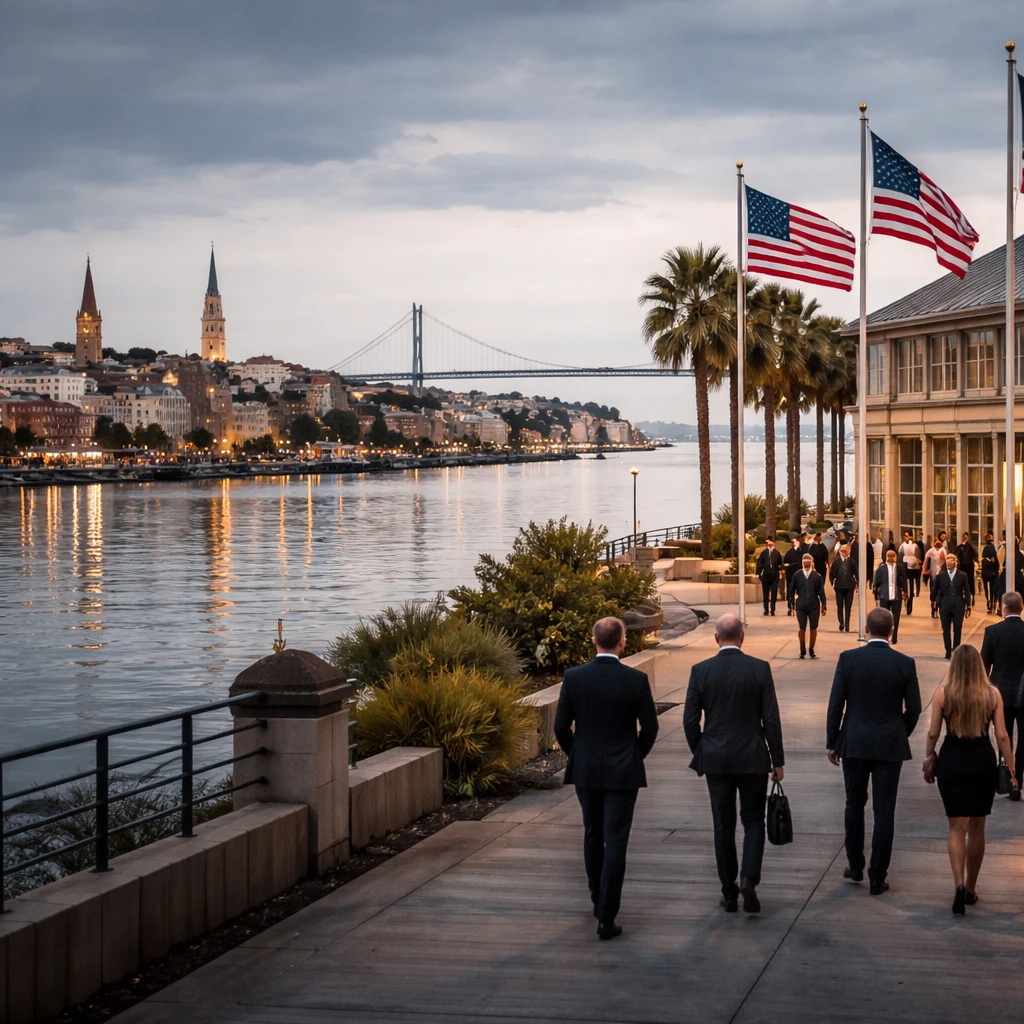
A bipartisan contingent of U.S. legislators is promoting a congressional resolution that would shift next year's meeting of up to 57 OSCE member states from Belgrade, Serbia, to Charleston, South Carolina. Representative Joe Wilson, a Republican, plans to introduce the joint resolution on Friday with 40 co-sponsors asking that the 2027 annual session of the Organization for Security and Co-operation in Europe be held in Charleston rather than Serbia's capital.
The annual OSCE gathering brings together European, Central Asian and North American member states. In recent years the organization has been preoccupied with managing the aftermath of Russia's invasion of Ukraine, and the location of the 2027 session has become a focal point of broader policy discussions in Washington about how to deal with Serbia.
A copy of the resolution was reviewed in advance of its publication. Charleston and Belgrade are both candidates to host the event, and U.S. lawmakers on both sides of the aisle have advanced a range of practical and logistical arguments for their preferred venue. Some of those arguments address facilities, delegate reception and the availability of congressional funding, while others reflect deeper geopolitical views about Serbia's international orientation.
At the center of the debate is Serbia's relationship with Russia and its refusal to join Western sanctions against Moscow. Several lawmakers have expressed concern about Belgrade's extensive economic ties with Russia, pointing to its role as a significant buyer of Russian energy. Those members favor a tougher posture toward Serbia in response to those ties.
Conversely, other U.S. legislators argue for continued engagement with Belgrade. They contend that keeping Serbia involved with Western institutions and diplomacy could help the country, which aspires to join the European Union, move into closer alignment with the West.
Representative Wilson, who co-chairs the Helsinki Commission - a congressional body focused on Europe - said a U.S.-hosted OSCE session would demonstrate America's commitment to the alliance of member states. He also criticized Serbia for what he described as a hostile stance toward Kosovo, a U.S. ally that Belgrade considers an illegitimate breakaway region.
Among the resolution's co-sponsors is Representative William Keating, the top Democrat on the House Foreign Affairs Committee's Europe subcommittee, who has publicly criticized the Serbian government on several fronts. In a statement Keating said the annual session should be in the U.S. "to highlight the important role the United States needs to play in multilateral institutions." The Serbian embassy in Washington did not immediately respond to a request for comment.
GEOPOLITICS, LOCAL POLITICS AND FUNDING QUESTIONS
Wilson said Republican Senator Roger Wicker, who chairs the Senate Armed Services Committee, is among those who oppose holding the meeting in Charleston. According to Wilson, Wicker told him that the congressional funds required to host the meeting in Charleston might not be secured - a concern Wilson dismissed. The comments were not independently confirmed, and Wicker's office did not respond to a request for comment.
Wilson also noted a local political consideration in favor of Charleston: his son, the Republican nominee for governor in South Carolina, could help ensure visiting delegates were well received. Several of the resolution's co-sponsors are members of Congress from South Carolina.
It remains uncertain whether Wilson's resolution will advance. Although the measure has attracted a number of relatively high-ranking signatories from both parties, Congress is approaching a recess that will last until September, which could affect the resolution's momentum.
IMPLICATIONS FOR MULTILATERAL ENGAGEMENT
The dispute over venue for the OSCE session underscores a broader tension in Washington policy circles: whether to press Serbia through a more confrontational approach because of its ties with Russia, or to prioritize engagement aimed at drawing Serbia closer to Euro-Atlantic institutions. The outcome of the resolution, and whether funding and Senate support materialize, will shape how the United States signals its posture toward both the OSCE and Serbia ahead of the 2027 session.