
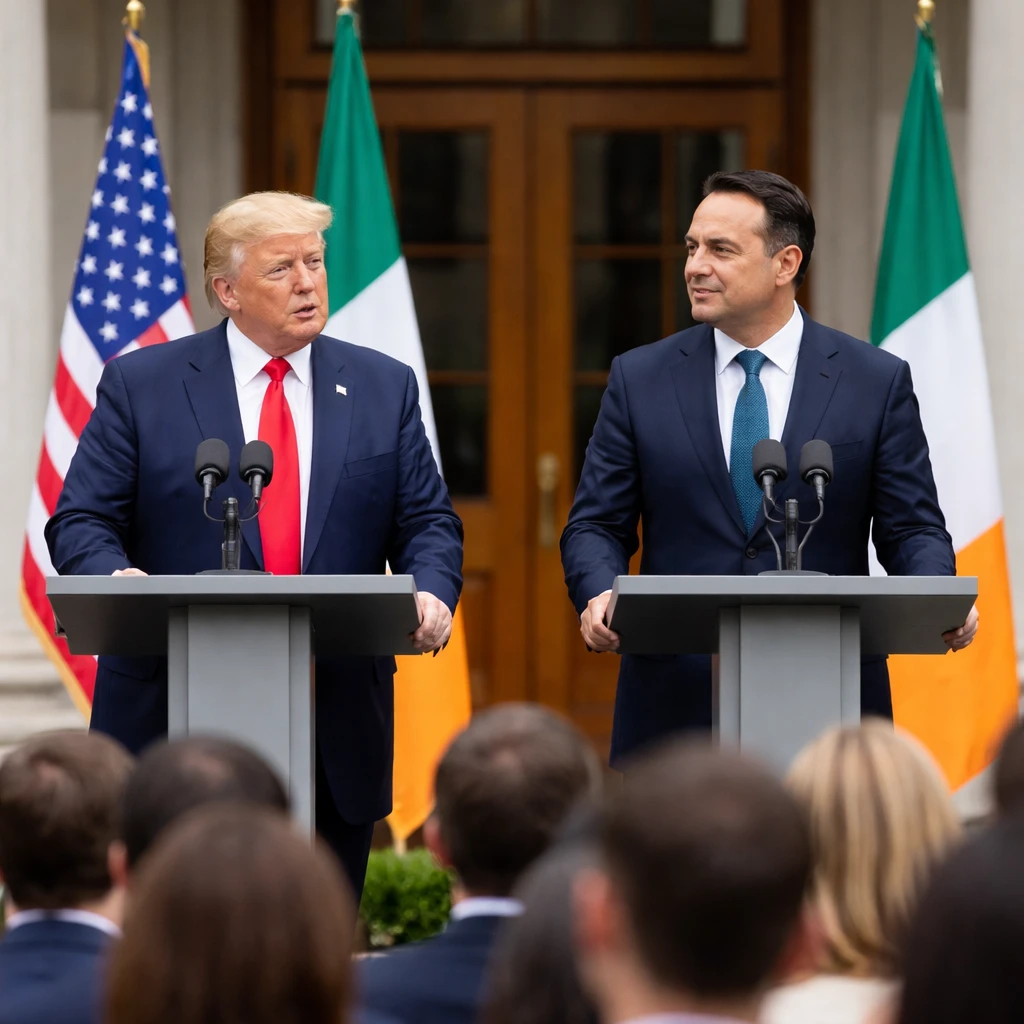
U.S. President Donald Trump said on Saturday in Dublin that he would "love" to see Northern Ireland - currently part of the United Kingdom - become unified with the Republic of Ireland. The remarks, delivered after a meeting with Irish Prime Minister Micheal Martin, drew immediate criticism from pro-British unionists in Northern Ireland and prompted reminders of the legal framework governing any change in the region's status.
Speaking alongside Prime Minister Martin, Trump told reporters, "Well, I don’t want to cause any problems, but I will tell you, I’d love to see it unified. It’s going to happen eventually ... I think it would be a fantastic thing." He added: "Now the UK will have something to say about it ... but I think it would be a great thing." Later, he reiterated that there "was no good answer" to the question on Irish unity while restating his view that it would be "a very cool thing."
Political and legal context
Observers note that any move toward Irish reunification is governed by the terms of the 1998 Good Friday Agreement. Under that accord, a referendum on Northern Ireland’s constitutional future can be held only at the discretion of the British government. The agreement brought an end to three decades of violence by providing mechanisms for power sharing and for addressing the constitutional claims of both Irish nationalists seeking a united Ireland and unionists who wish Northern Ireland to remain part of the United Kingdom.
Downing Street, responding to the remarks, said on Saturday that the position that a referendum is "off the table" - a stance recently reiterated by British prime minister Andy Burnham - had not changed.
Responses from unionist and nationalist communities
Leaders in Northern Ireland who advocate maintaining the union with Britain sharply challenged Trump’s prediction. Gavin Robinson, leader of the Democratic Unionist Party, described the prospect of unification as leading to "the destruction of our country," and emphasized that "Northern Ireland’s constitutional future will be decided by the people of Northern Ireland, not by commentary in London, Dublin or Washington." Robinson has publicly supported Trump in the past.
In Belfast, reactions among those who support a united Ireland were more guarded. Eamon Hanna, a supporter of the nationalist Social Democratic and Labour Party (SDLP), which has been critical of Trump’s policies, described the remarks as "just headline grabbing" and said, "I don’t think he gives a toss whether there is a United Ireland or not."
Diplomatic notes and earlier U.S. positions
Previous U.S. presidents, including those with strong Irish heritage, such as Joe Biden, have typically maintained a neutral stance on the question of Irish unity. The United States government previously played a notable role in facilitating the 1998 peace deal.
Meeting with Ireland's president and protests
Trump also met with Irish President Catherine Connolly during his visit. Connolly, who had taken part in a protest against his 2019 visit to Ireland prior to her election to the largely ceremonial presidency last year, issued a statement after their meeting. She said she had conveyed to Trump "the strong view of the Irish people that the normalisation of war and genocide can never be accepted." Her published statement did not single out any particular conflict, but she has in the past been critical of the U.S. war with Iran and of Israel’s assault on Gaza. Ireland, in common with a U.N. inquiry and several human rights groups, has described Israel’s actions in Gaza as a genocide; Israel rejects that characterisation, saying it is targeting militants who attacked it from the Palestinian enclave in 2023.
Shortly after the Dublin visit, thousands of protesters marched through the city centre. Some held posters calling Trump a warmonger and chanted "Free free Palestine" as they passed; the demonstration occurred as Trump travelled to one of his golf resorts in western Ireland to watch a tournament. The march was described as one of the country’s largest anti-war protests in recent years.
Economic ties highlighted
During his time in Dublin, Prime Minister Micheal Martin emphasised the close economic links between Ireland and the United States. Successive Irish governments have prioritised attracting and retaining U.S.-owned companies, particularly in the technology and pharmaceutical sectors. Those companies now employ about 10% of Ireland’s workforce, reflecting decades of policy choices focused on jobs and tax revenues.
Addressing those commercial ties in a lighter tone, Trump told reporters, "You took all our medical companies, we’ve got to get a couple of them back. You fleeced us but that’s okay ... There’s a lot of room to go around and our relationship with you is fantastic."
What remains unclear
The comments by President Trump have drawn immediate political reactions across the island and highlighted longstanding sensitivities about external commentary on Northern Ireland’s constitutional future. While the British government has publicly maintained that a referendum is not currently on the agenda, the political debate around identity and sovereignty in Northern Ireland remains active, and public opinion has shown shifts in recent years, with some polling indicating that while a majority still favour remaining in the UK, the gap has narrowed since Britain’s departure from the European Union.
For now, the question of if or when any referendum might be held remains a matter for the British government and for the people of Northern Ireland, as stipulated under the Good Friday Agreement.