
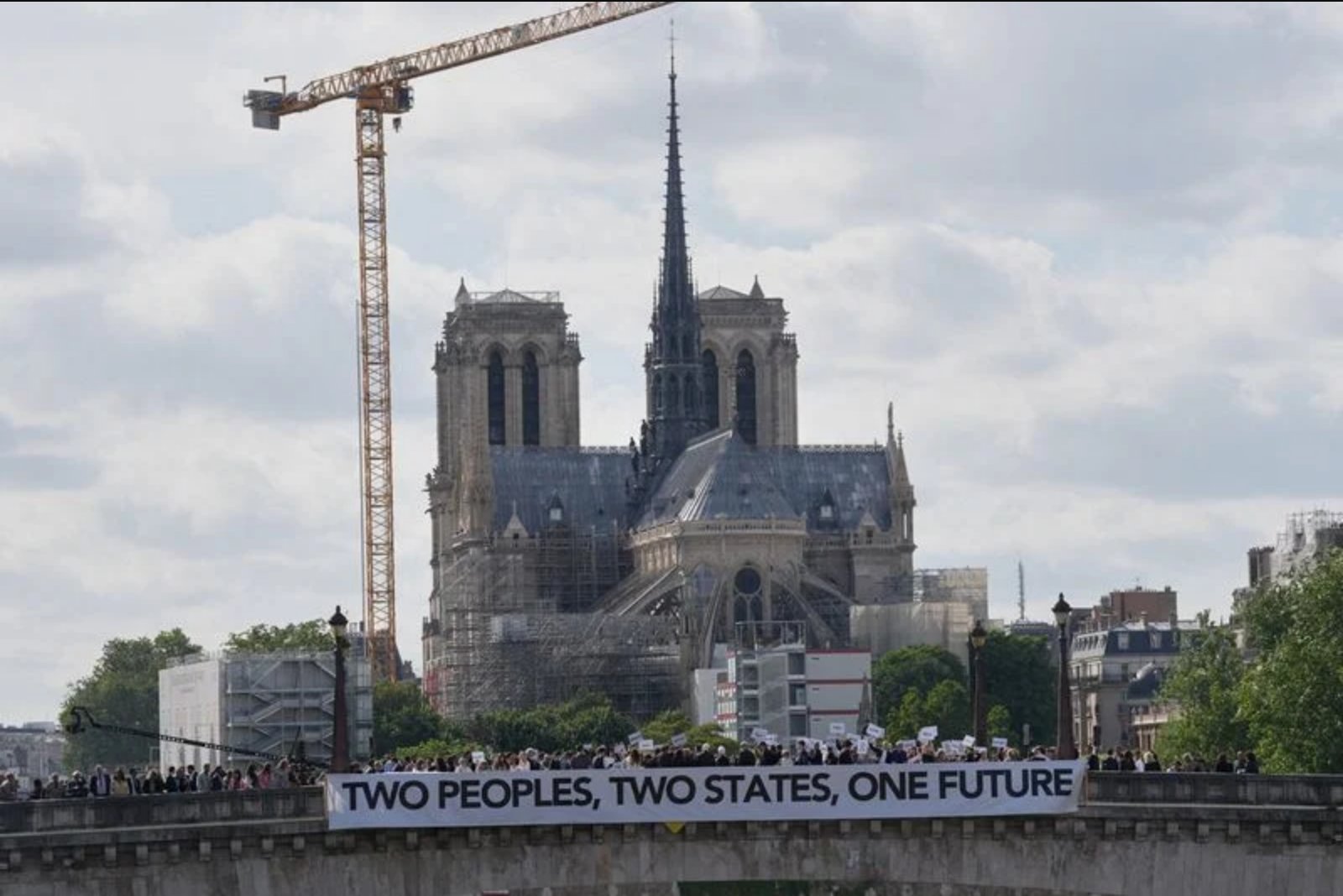
PARIS, June 12 - Israeli and Palestinian civil society representatives convened in France on Friday to press the international community to sustain efforts toward a two-state solution, even as the prospect of such an outcome faces growing strain amid the wider Middle East war.
The meeting assembled foreign ministers and senior officials from dozens of countries alongside activists and community leaders. Organizers framed the session as an effort by Paris to keep dialogue on statehood alive at a moment when momentum appears to be slipping.
Participants noted that the gathering coincided with the first anniversary of the U.N.-backed New York Declaration, a document that laid out a roadmap toward Palestinian statehood and prompted roughly a dozen countries - including France, Britain and Canada - to formally recognise a Palestinian state.
France's foreign minister addressed the approximately 250 civil society delegates from both sides, emphasizing the persistence of hope and the need for action.
Jean-Noel Barrot: "We could find every reason in the world to give up. But you are here! Your testimonies alone are grounds for hope and action."
Barrot added: "France refuses to let the side of war prevail over the side of peace."
The conference concluded with an eight-point "Call for Action" that the convenors said seeks a permanent ceasefire, a halt to settlement expansion, reconstruction of Gaza, governance reforms and strengthened international support for civil society. The plan is scheduled to be handed to G7 leaders as they gather in the French Alps early next week.
The action plan itself warned that the region is fragmenting and cautioned that both Gaza and Israel remain in precarious states. It said that settler terrorism, settlement expansion, de facto annexation and threats to the Palestinian Authority are eroding the prospects for an independent Palestinian state. The plan also portrayed Israelis and Palestinians as trapped by fear, insecurity and trauma, and warned that while a solution remains possible, the window of opportunity is narrowing.
"The region continues to fracture. Gaza is devastated, Israel remains under threat. Settler terrorism, settlement expansion, and de facto annexation and threats to the Palestinian Authority continue to undermine the viability of a future Palestinian state," the action plan said. "Israelis and Palestinians alike remain trapped in fear, insecurity, and trauma. We return because, as the G7 convenes in Evian, this conflict risks once again being set aside. The window for a solution remains open; but it is narrowing."
The gathering took place against a backdrop of increasing violence by Israeli settlers in the occupied West Bank, a dynamic that has fuelled frustration across many Western capitals toward the government of Prime Minister Benjamin Netanyahu, which has advanced settlement activity. Diplomats at the meeting expressed concern that settlement expansion is being used to undermine the viability of a Palestinian state.
A particular point of alarm highlighted by attendees is Israel's proposed E1 settlement project east of Jerusalem. Delegates argued that the E1 development would bisect the West Bank and sever its territorial contiguity with East Jerusalem, fragmenting land Palestinians seek as part of an independent state.
European Union foreign policy chief Kaja Kallas reiterated support for a two-state blueprint and voiced concern over recent developments in the West Bank.
Kaja Kallas: "The two-state solution remains the only viable path to bringing lasting peace to the Middle East. The situation in the West Bank is equally alarming. Illegal Israeli settlements continue to expand at an unprecedented pace, and settler violence is increasing without sufficient accountability."
On Tuesday prior to the Paris meeting, Britain, Canada, France and Norway announced coordinated sanctions targeting Israeli networks alleged to be involved in financing, enabling and carrying out violence in the Israeli-occupied West Bank.
Neither Israel nor the United States attended the Paris gathering. In a statement, the Israeli embassy said the ambassador had been invited but would not attend because, in its view, the conference did not promote peace. The embassy also stated that France cannot serve as mediator between Israel and the Palestinians and noted that, in the ambassador's view, Palestinians had rejected proposals to establish a state on five occasions.
The Paris meeting sought to maintain international focus on a negotiated two-state outcome while warning that opportunities to advance that aim are diminishing amid ongoing violence and political tensions.