
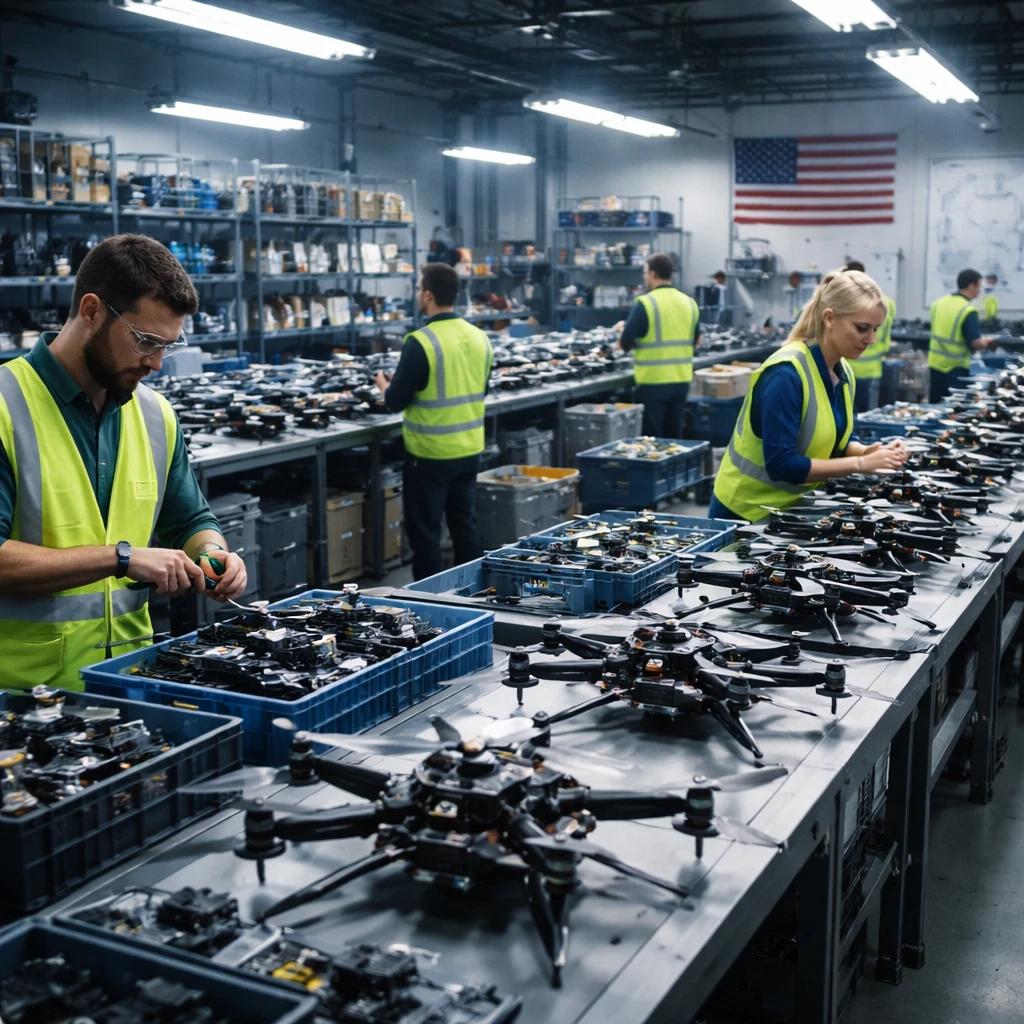
Summary: The Pentagon is racing to expand domestic small drone production but remains far behind Ukraine’s wartime output. Military rules now push for U.S.-made components and a "wholly domestic" supply chain, a move Pentagon officials say will make immediate scaling more difficult even as partnerships with Ukrainian firms are being structured to localize manufacturing in the United States.
Travis Metz, deputy director and chief operating officer of the Defense Innovation Unit and head of the Pentagon’s Drone Dominance Program since last fall, described the U.S. effort as being in "the earliest, hardest phase" of construction for a domestic drone industry. In an interview, Metz contrasted U.S. procurement figures with the scale of Ukrainian production this year.
He said Ukraine will produce between 6 and 7 million small first-person-view attack drones this year, which equates to roughly 500,000 units per month. By comparison, the Pentagon’s $1.1 billion Drone Dominance Program had placed orders totaling just under 200,000 drones cumulatively by February.
"It’s much harder to get from zero to 200,000" than it will be to scale up further once a domestic capacity to build many more drones exists, Metz said. That framing underlines how early the U.S. industrial effort remains despite growing investment and procurement.
At the same time, the Pentagon has raised the bar for components used in U.S. military drones. A revised supply chain framework released July 23 adds language stating the government’s long-term objective is "a wholly domestic" small unmanned aircraft system supply chain. Metz said the new rules prohibit drones entered in an upcoming August test event from using banned components such as Chinese-made brushless motors or battery packs.
Metz acknowledged this tightening of sourcing requirements will complicate attempts to rapidly increase U.S. production. He estimated that "the vast majority" of drones purchased in an earlier phase likely contained Chinese motors, and noted that harder-to-source components, including semiconductors, remain a far bigger problem for the United States beyond the drone program.
Despite those constraints, Metz expressed confidence the U.S. could eventually match or exceed Ukraine’s production capabilities. "I see no reason why we shouldn’t ... be the world champions of this as well," he said.
Part of the Pentagon’s approach to translate battlefield-tested Ukrainian expertise into U.S. manufacturing capacity is to require localization as a condition for future orders. Metz said all six Ukrainian companies invited to next month’s Gauntlet II test at Fort Carson, Colorado, have either entered or are moving toward joint ventures with U.S. manufacturers.
Examples cited include Ukrainian firm F-Drones, which has partnered with Ohio-based Ukrainian Defense Drones that opened a facility near Toledo, and Ukrainian drone maker General Cherry, which has agreed to a joint venture with New Hampshire’s Wilcox Industries, according to the companies. Under the conditions outlined by the Pentagon, Ukrainian competitors in Gauntlet II must localize production in the United States to be eligible for future procurement.
The structure is explicitly designed to convert Ukraine’s battlefield expertise into American manufacturing capacity rather than perpetuate reliance on imports. At the same time, the new sourcing standards and the difficulty of procuring critical components like semiconductors and certain motors create short-term obstacles to rapidly scaling U.S. drone production to match Ukraine’s output.