
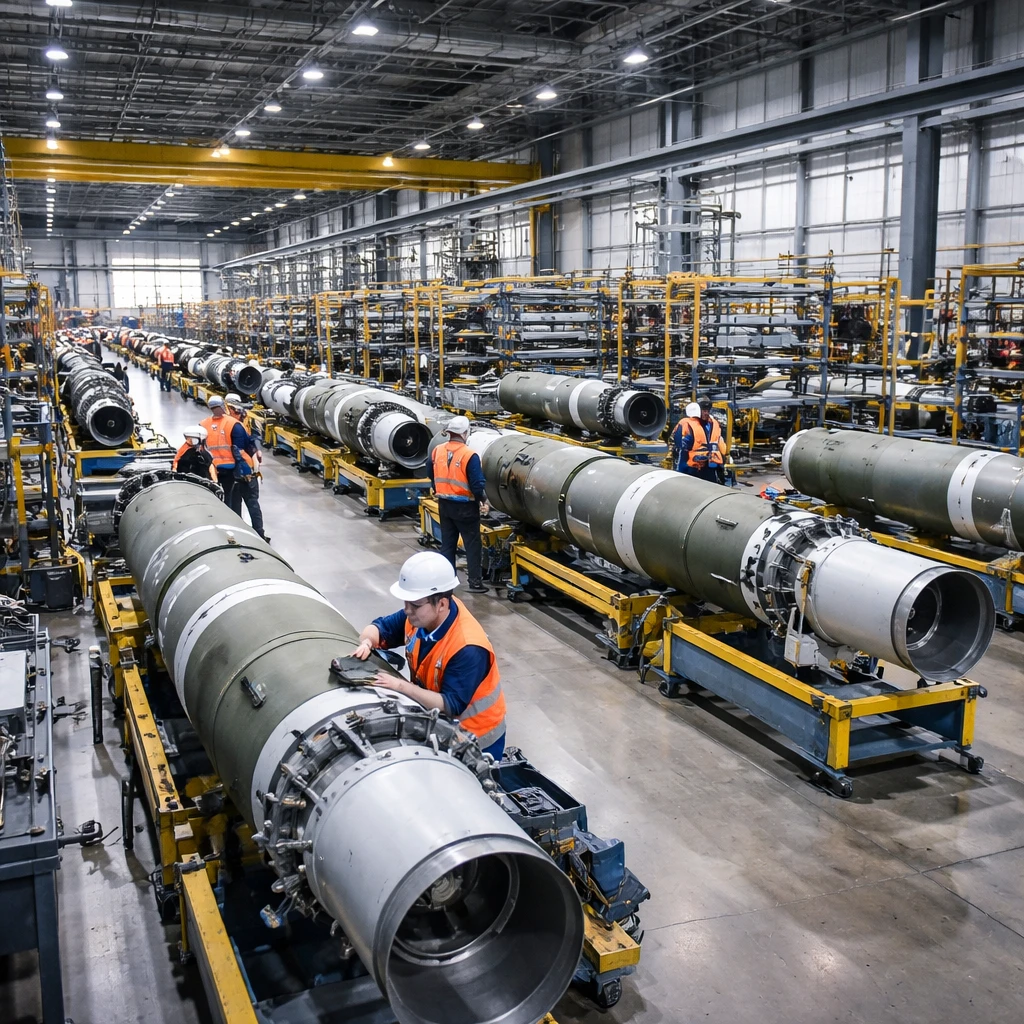
Shares of key defense contractors climbed after news surfaced of an expanded Patriot missile production effort and a multiyear propulsion agreement. RTX Corp led gains among large primes, while a new seven-year PAC-3 propulsion framework has put L3Harris in the spotlight as it plans to scale manufacturing capacity across multiple states.
Market moves at a glance:
- RTX Corp (RTX) - $220.31, up +3.53% on the day, +13.28% over one week, +17.17% over one month, market cap $297B.
- Lockheed Martin (LMT) - $584.54, up +0.33% on the day, +14.66% one week, +15.15% one month, market cap $135B.
- L3Harris (LHX) - $304.55, up +1.44% on the day, +8.52% one week, +4.53% one month, market cap $56.7B.
- Kratos Defense (KTOS) - $49.11, up +3.72% on the day, +6.90% one week, +4.02% one month, market cap $9.2B.
RTX stands out as the primary integrator of the Patriot system, responsible for components ranging from the AN/MPQ-65 radar to launchers and fire-control equipment. The stock has risen approximately +40.4% over the past 12 months, a reflection of heightened global demand and replenishment activity by U.S. partners and allies. At a $297 billion market capitalization, RTX represents the most direct and sizeable exposure among the names tied to Patriot work.
L3Harris has become the focal point of the latest supply-side shift. The company signed a seven-year PAC-3 propulsion framework with the Department of War and Lockheed Martin that covers two-pulse solid rocket motors, Attitude Control Motors, and Lethality Enhancers. To support the contract, L3Harris is investing in roughly 60 facilities and nearly 1 million square feet of new manufacturing space located in Alabama, Virginia, and Arkansas. Management indicates that production will nearly triple compared with current levels - a change that could lift revenue trajectories if sustained and fully executed.
Lockheed Martin manufactures the PAC-3 MSE interceptor itself, the component that intercepts and neutralizes incoming threats. Because operational Patriot batteries consume interceptors continuously, increases in propulsion and motor production help alleviate a bottleneck upstream and could allow a higher rate of interceptor output. The L3Harris propulsion agreement spans seven years and is intended to coordinate with Lockheed Martin's production needs.
Kratos Defense does not participate directly in Patriot manufacture but has secured related Department of Defense awards that have contributed to its order book. The company secured approximately $400 million in DoD hypersonic systems funding and a $36 million air defense missile contract. In Q1, Kratos reported record bookings of $605 million and a book-to-bill ratio of 1.6x, leaving a backlog exceeding $2 billion. That backlog underpins expectations for continued revenue growth, though the equity has experienced wide trading ranges - its 52-week high sits at $134 compared with the current quote of $49.11.
General Dynamics is also part of the broader defense landscape. Trading at $391.24 and up +1.16% on the day, the company is not a direct Patriot producer but stands to benefit indirectly from an overall lift in U.S. defense procurement budgets that support systems and platform orders across the sector.
Why this matters
The Patriot program touches several subsectors within aerospace and defense - from prime system integrators to propulsion and motor manufacturers, and specialist missile and hypersonics firms. A multi-year framework agreement for propulsion components, plus notable investments in manufacturing capacity, signal a shift from short-term replenishment toward longer-term production commitments. For investors, the development clarifies which firms have the most direct exposure to increased Patriot demand and which stand to gain indirectly from larger defense budget flows.
Key points
- RTX is the principal Patriot system contractor and has posted sizable share gains year-to-date and over 12 months, reflecting sustained demand for Patriot components.
- L3Harris inked a seven-year PAC-3 propulsion framework with the Department of War and Lockheed Martin and is expanding manufacturing capacity across multiple states to nearly triple motor production.
- Kratos has captured DoD funding and contracts that have driven record bookings and a backlog above $2 billion, though its share price shows heightened volatility relative to larger primes.
Risks and uncertainties
- Diplomatic developments - Ongoing Iran-U.S. talks could reduce near-term defense demand if they lead to de-escalation; such outcomes would affect procurement momentum across defense suppliers.
- Valuation and market positioning - Several names have already moved significantly higher; investors face the risk that market pricing may have factored in some or all of the potential production upside.
- Company-specific volatility - Smaller contractors such as Kratos have seen large past trading ranges, highlighting higher risk for investors seeking exposure to niche missile and hypersonic programs.
Investors assessing exposure to the Patriot replenishment should weigh direct manufacturer roles, manufacturing capacity plans, and backlog dynamics against geopolitical and valuation risks. The current developments provide clearer lines of sight on which companies hold the most direct operational linkage to elevated Patriot activity.