
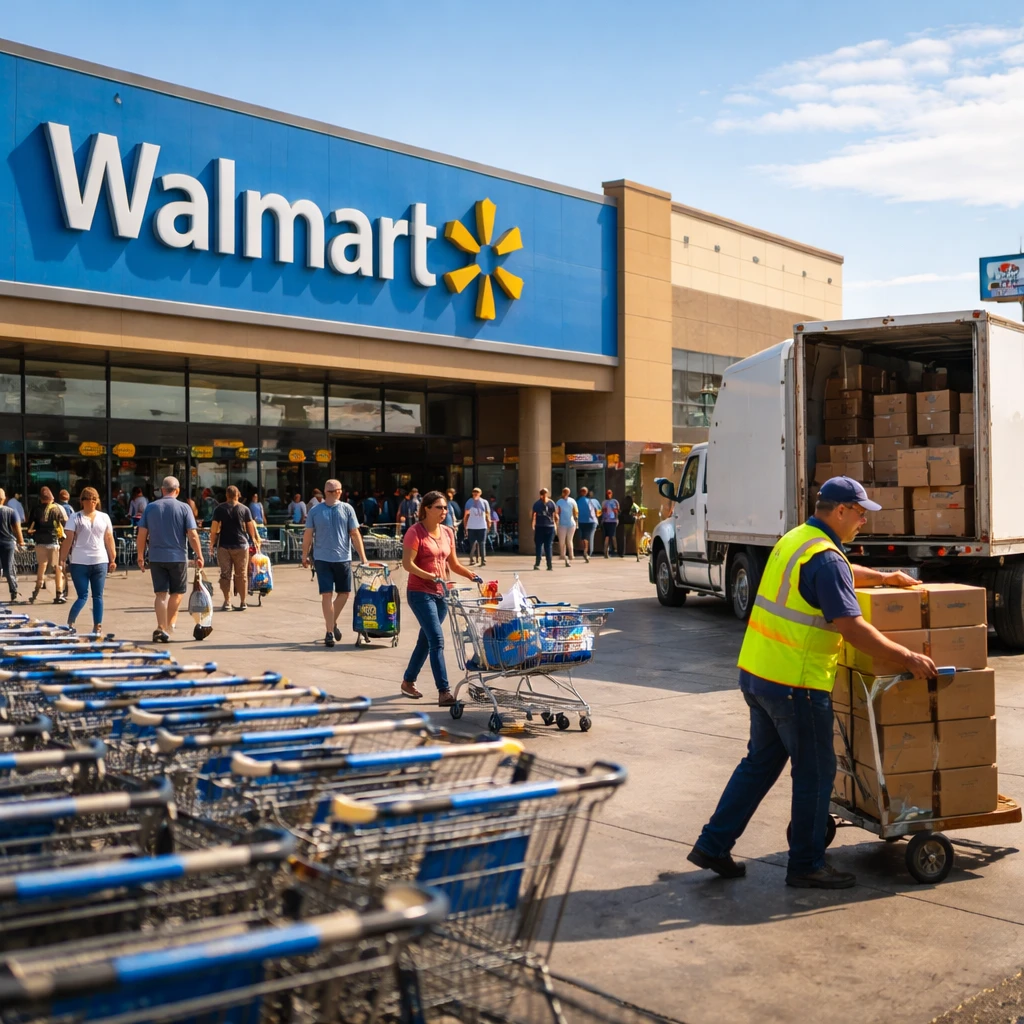
Walmart Inc. stock slipped 2.1% in pre-open trading following the retailer's first-quarter fiscal 2027 results, where a stronger-than-expected revenue print was overshadowed by guidance that fell short of analyst forecasts.
The company published its Q1 results at 6 a.m. CDT on May 21, 2026, and the subsequent earnings call featured remarks from CEO John Furner and CFO John David Rainey. Reported revenue for the quarter was $177.8 billion, exceeding the analyst consensus of $174.83 billion and marking a 7.3% increase from the prior year. Adjusted earnings per share of $0.66 came in line with expectations.
Despite the top-line beat and earnings in line with estimates, Walmart's forward-looking statements weighed on the stock. For Q2, management gave EPS guidance in a range of $0.72 to $0.74, below the Street estimate of $0.75. Full-year fiscal 2027 EPS guidance was set at $2.75 to $2.85, short of the consensus forecast of $2.92. Those guidance shortfalls drove the market reaction even as broader U.S. equity benchmarks were trading higher during the session.
Management cited higher fuel costs as an important factor pressuring operating income, noting that elevated fuel expenses reduced operating income by approximately 250 basis points. The company absorbed the additional fuel cost within its delivery operations in order to keep consumer prices low, a margin tradeoff that investors clearly considered significant.
Competitive dynamics also featured prominently in investor concerns. Kroger's new CEO, Greg Foran, announced plans to implement significant price reductions across thousands of products in an effort to recover market share from Walmart, Costco, Amazon, and other rivals. That planned pricing strategy from a major grocery competitor added another layer of pressure to Walmart's outlook.
Analysts had entered the report with heightened expectations, as several firms including Evercore ISI, TD Cowen, and BTIG raised their price targets ahead of the print. Those raised expectations set a higher bar for the quarter's results.
Market action around the report highlighted the earnings-driven nature of the stock move. At 6:00 a.m. ET in the pre-market, U.S. stock index futures were muted - Dow E-minis were up 0.2%, S&P 500 E-minis were up 0.1%, and Nasdaq 100 E-minis were roughly flat. By the time of later trading, the major indices had moved materially higher, with the S&P 500 gaining 1.1%, the Dow Jones up 1.3%, and the NASDAQ rising 1.5% - a broad market advance that contrasted with Walmart's decline.
Walmart shares traded at $128.10 during the session, near the lower end of the day's trading range and below the stock's 52-week high of $135.16. The combination of guidance shortfalls, margin headwinds from fuel, and renewed grocery price competition outweighed the firm's revenue beat in investors' assessments.
Key points
- Walmart beat revenue estimates with $177.8 billion in Q1 sales, a 7.3% year-over-year increase.
- Guidance disappointed: Q2 EPS of $0.72–$0.74 versus a $0.75 Street estimate, and FY2027 EPS guidance of $2.75–$2.85 versus a $2.92 consensus.
- Higher fuel costs and competitive price cuts in the grocery sector intensified investor concerns; sectors affected include retail, grocery, and logistics.
Risks and uncertainties
- Guidance risk - Near-term and full-year EPS guidance came in below consensus, creating earnings execution uncertainty for Walmart and the broader retail sector.
- Margin pressure - Elevated fuel costs reduced operating income by roughly 250 basis points, affecting Walmart's delivery operations and cost structure in logistics.
- Competitive pricing - Planned price cuts from Kroger to regain market share introduce uncertainty for pricing strategy and margins across grocery retailers and e-commerce competitors.