
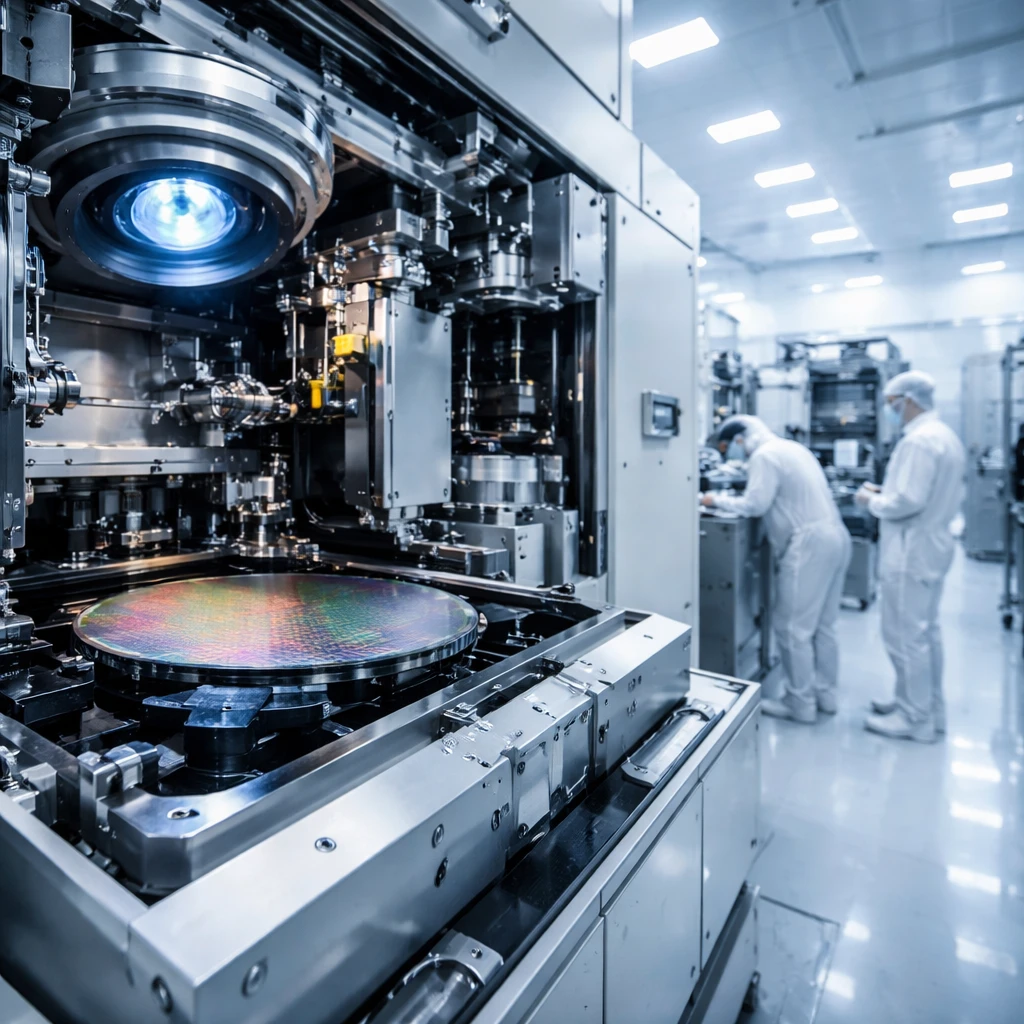
With broad semiconductor indices and ETFs trading sharply higher this year - the iShares Semiconductor ETF (SOXX) is up 65% year-to-date and the global SPIE average sits between 50% and 70% - UBS has singled out ASML Holding as the most compelling stock to own in the current, unusually elevated market environment.
UBSanalysts list three succinct reasons for their stance: "1) Capacity remains above demand; 2) Memory litho share keeps increasing and 3) High NA story is not over yet." The firm also says there is a visible catalyst path for the company and has assigned ASML a Buy rating with a raised price target of c1,900.
ASML occupies a central role in the semiconductor supply chain by producing the advanced lithography equipment that is essential to manufacturing cutting-edge chips. Its product set includes Extreme Ultraviolet (EUV) systems, High Numerical Aperture (High NA) EUV systems and various Deep Ultraviolet (DUV) machines. Major chipmakers that rely on ASML tools include TSMC, Samsung, Intel and memory manufacturers such as SK Hynix. The companyis also identified as a critical supplier for modern AI chipmakers like Nvidia, effectively taking a tollbooth-like position at the intersection of the AI demand surge, sovereign semiconductor investments and an expanding global fab footprint.
UBSnow expects stronger EUV revenue growth than previously forecast. The analysts forecast EUV revenues to increase 37% year-over-year in 2027 and 10% year-over-year in 2028E, versus their earlier estimates of 26% and -1%, respectively. The upgrade reflects the firm's view that revenue drivers from memory and advanced logic will lift EUV and DUV activity outside China.
On the memory side, UBS describes the outlook as constructive over the next two years, a backdrop that benefits the broader supply chain and especially vendors exposed to rising wafer fab equipment (WFE) intensity. The bank now projects memory-related revenues to grow 35% year-over-year in 2027 and 10% year-over-year in 2028E; previous forecasts were 35% and -10% for those years. UBS links this revision to an anticipation that the memory cycle will likely extend through 2028E under the prevailing constraints.
For foundry and advanced logic, which UBS expects to account for 62% of ASMLproduct sales in 2026E, the firm has also raised its growth expectations. It now forecasts foundry/logic growth of 34% year-over-year in 2027E and 18% year-over-year in 2028E, up from prior estimates of 16% and 17%. UBS attributes these changes to operational improvements at key foundry players including Intel and Samsung, and to anticipated incremental investment in 2028E driven by TSMC capacity constraints forecast for 2027.
UBS further argues the market has underestimated throughput improvements across lower numerical aperture (low NA) models and the potential for system upgrades and shorter cycle times enabled by rapid shipments. While ASML has publicly communicated a capacity of over 80 EUV units in 2027, the firm's internal analysis suggests theoretical maximum capacity could exceed 100 EUV units - a figure that excludes additional contributions from so-called fast shipments. By UBSestimates, demand growth is projected at 25-30% year-over-year in 2027, whereas producing 100 EUV units today would represent a 65% year-over-year increase in leading-edge capacity.
The High NA narrative is a core part of UBSs long-term case. The bank states adoption is likely within the next two to three years and cites two principal advantages: first, a 20-40% cost saving on critical layers compared with double or triple patterning plus simplification of process flows; second, a meaningful capacity unlock by replacing low-throughput multi-patterning steps - the analysts cite atomic layer deposition (ALD) as an example of a low-throughput step roughly equivalent to 30 wafers per hour. UBSs analysis suggests High NA can deliver more than 100% throughput gains compared with most alternative approaches (approximately 80% versus LELE), a metric the firm says reinforces the case for long-term adoption.
In sum, UBS presents a multi-faceted rationale for owning ASML at current market heights: upgraded revenue trajectories for EUV and DUV driven by memory and foundry/logic trends, potential upside to theoretical production capacity, and structural gains if High NA adoption accelerates. The bank highlights a set of catalysts and operational drivers that, in its view, justify a Buy rating and a c1,900 price target.
Context and implications
The UBS case hinges on a combination of cyclical and structural factors - expanding fab investment in memory and advanced logic, improvements in foundry operations, and a technology transition towards High NA systems that could materially improve throughput and lower cost per critical layer. Firms in the semiconductor equipment and capital goods ecosystem, as well as wafer fab operators, are directly implicated by these dynamics. ASMLs role as a near-monopoly provider of advanced lithography equipment places it at the center of those trends.
UBSs revised forecasts and capacity assumptions imply a more bullish operational path than its earlier models, but the firm frames these as contingent on the continuation of the memory cycle and on fabs moving forward with the anticipated investments and upgrades.