
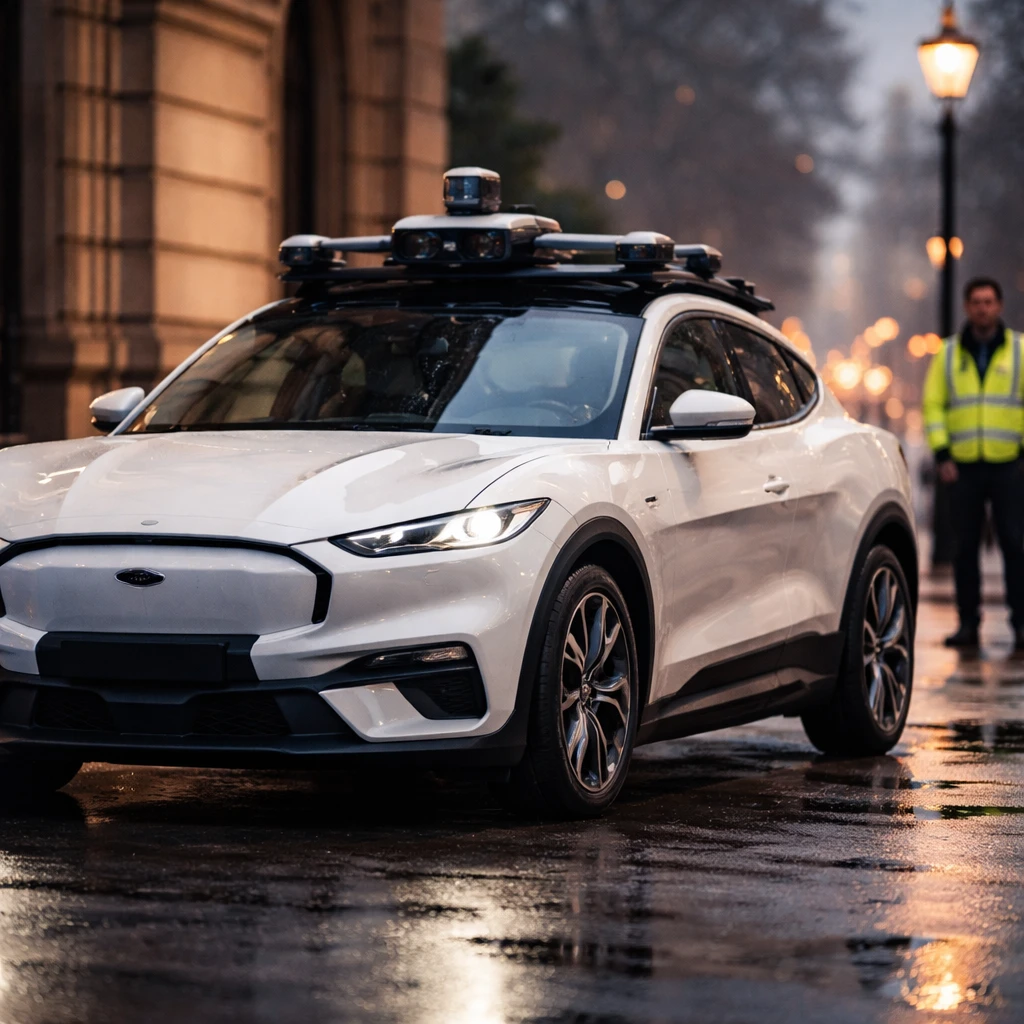
Uber Technologies Inc. this week opened an interest list for London customers who want early access to robotaxi rides before the company begins driverless operations in the UK later this year. Riders can join the waitlist through the Uber app to register their preference and to potentially improve their chances of being matched with a Wayve Technologies Ltd. robotaxi once the service launches.
Uber did not provide a specific date for when the London service will go live. The company said customers will have the option to accept a driverless vehicle when offered or to switch to a human-driven ride, mirroring the user choice available in Uber’s existing autonomous programs in Austin, Texas and Atlanta, Georgia, where Uber partners with Alphabet Inc.’s Waymo to provide driverless trips.
The vehicles that will serve customers in London are electric Ford Mustang Mach-E SUVs. They are equipped with camera arrays, radar sensors and the self-driving software developed by UK-based Wayve. According to a Wayve spokesperson, a licensed operator will initially be present behind the wheel to supervise the vehicle. That operator will not manually drive during normal operation and will only take control if an intervention is required.
Wayve has indicated it still needs additional regulatory approvals from the UK’s Department for Transport before it can offer fully unmanned passenger rides. The spokesperson noted that the same Department for Transport approvals will be required for other companies planning robotaxi services in London this year, including Waymo and China’s Baidu Inc.
Uber has expanded partnerships across a range of autonomous technology and vehicle providers, working with more than a dozen partners globally. Among those partners are China’s WeRide Inc. and Pony AI Inc., both of which are included in Uber’s broader program to offer driverless rides on its app in the Middle East and in parts of Europe.
The forthcoming London service will represent Wayve’s first passenger-facing operation following multi-market testing. The company has conducted trials in Europe, North America and Japan in recent years. In February, Wayve raised $1.5 billion in a financing round led by investors including Eclipse Ventures LLC, Balderton Capital, SoftBank Vision Fund 2 and Uber, with the round valuing Wayve at $8.6 billion.
What this means
The waitlist signals the next step toward commercial robotaxi deployments in London, while regulatory clearance remains a gating factor for fully unmanned service. Riders will initially see supervised, driver-supervised autonomous vehicles, with the option to request a human-driven ride as an alternative.