
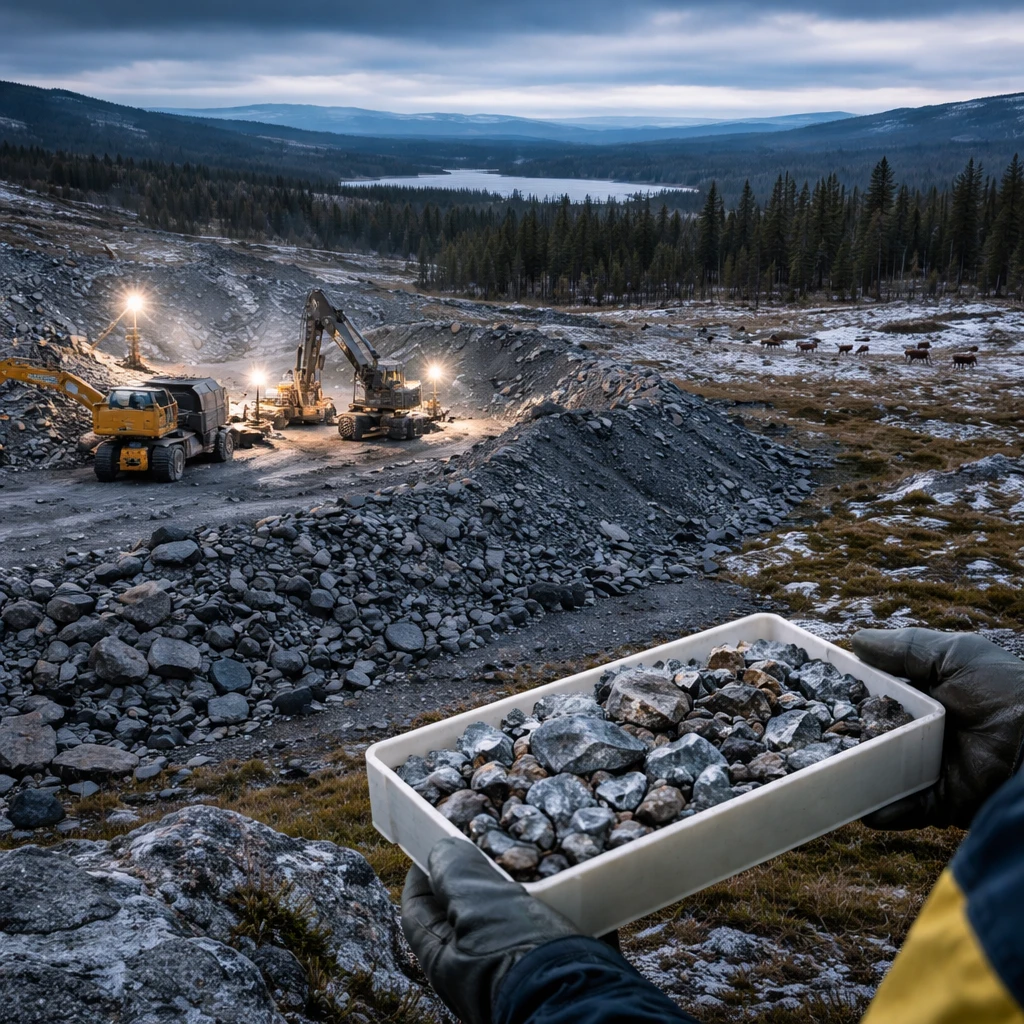
Sweden’s government on Thursday announced that mining operations for critical metals and rare earth elements will be treated as a national security interest, a policy change designed to hasten planning and permitting procedures and help lure investment into the sector.
Enterprise Minister and Deputy Prime Minister Ebba Busch said the new designation will shorten administrative processes that have previously delayed projects, with a primary aim of attracting private and public capital to mines and related infrastructure.
Chinese firms currently dominate both the mining and the refining stages for rare earth minerals, which are used in a range of applications cited by the government as critical - including clean energy generation, defense systems and electric vehicle manufacturing. The government statement noted that Beijing has previously deployed export controls as part of trade disputes with other governments.
Sweden holds substantial mineral reserves, among them the Per Geijer deposit located near LKAB’s Kiruna mine. The Per Geijer site is highlighted by the European Union as a flagship project aimed at reducing reliance on Chinese supplies. The deposit is estimated to contain 1.2 billion tons of total mineral resources, including 2.2 million tons of rare earth oxides.
"We believe that this can contribute significantly to both Sweden’s, EU’s and NATO’s defence capabilities," Busch said at a news conference, adding that the continent’s dependence on Chinese refining and mining capacity presents a "systemic risk."
Under the government’s strategy, it would become simpler for the state to assign land for mining projects, a change intended to expedite project starts. That measure touches on a longstanding area of conflict with the Sami, the indigenous reindeer-herding people, who warn that expanded mining could end their traditional livelihood.
Busch also said the government is exploring the possibility of establishing a state-owned investment company focused on the Swedish mining sector. She framed the move as a response to a perceived shortfall in the state’s existing toolkit for promoting and financing strategic extraction projects.
"Today, to put it plainly, the government lacks concrete tools to wisely contribute to accelerating and attracting investments in key projects in crucial strategic projects," she said.
The announcement signals an intention by Stockholm to more actively shape the domestic mining landscape and to provide stronger public support for projects that policymakers view as critical to national and allied defense, as well as to energy and transportation technology supply chains.
Summary
Sweden has classified mining of critical metals and rare earths as a national security interest to speed permitting, attract investment and reduce dependence on Chinese mining and refining. The Per Geijer deposit near Kiruna, with 1.2 billion tons of resources and 2.2 million tons of rare earth oxides, is cited as a strategic asset. The plan would ease state assignment of land for mines and consider a state-owned investment company, while raising concerns from the Sami reindeer-herding community about impacts on their way of life.