
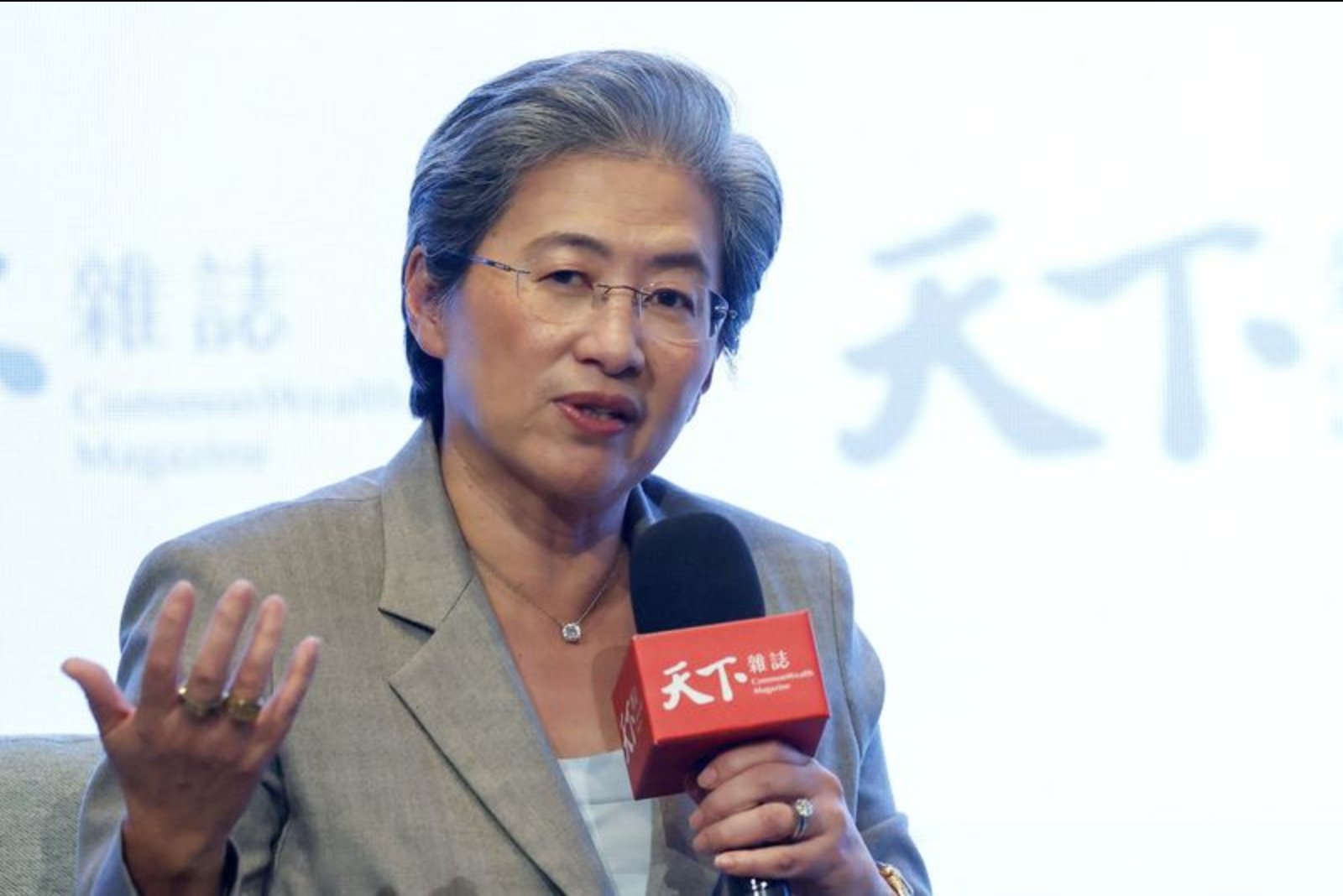
Lisa Su, AMD’s chief executive, kept a subdued public profile during a visit to China last week, arriving a few days after Nvidia’s Jensen Huang departed the country. Huang’s visit drew visible crowds in Beijing, where he posed for photographs and sampled local dishes such as Beijing-style soybean paste noodles. The contrast between Su’s restrained presence and Huang’s visible public engagement underscores two different corporate approaches to operating in what has become one of the most geopolitically sensitive markets for artificial intelligence chips.
Those divergent styles also mirror a divergence in market trajectories. Huang has said publicly that Nvidia’s market share in China fell steeply under U.S. export restrictions. Speaking at last year’s Computex trade fair in Taipei, he said Nvidia’s share in China had fallen to 50% from 95% because of those curbs. This year, he said that figure had effectively fallen to zero amid Beijing’s drive for self-reliance in advanced AI chips. Huang has also put a $50 billion figure on the potential size of China’s AI chip market for this year.
By contrast, AMD holds a much smaller slice of the Chinese AI accelerator market. Research firm IDC estimates AMD’s share at roughly 4% of China’s AI chip market. Analysts note, however, that AMD’s presence in China extends beyond AI accelerators. Lian Jye Su, chief analyst at Omdia, pointed out that AMD can supply a range of products - central processing units, consumer graphics processing units, AI chipsets and programmable integrated circuits known as FPGAs. That product diversity gives AMD access to multiple system architectures as AI workloads move beyond the narrow task of training large models toward broader enterprise deployment.
Both executives have roots in Taiwan and have publicly noted a distant familial connection, and both unveiled significant investment plans in Taiwan during the past week. The two CEOs are expected to be in Taiwan again for the upcoming Computex event. But their China playbooks diverged during the recent trips: Su pursued a series of meetings in China including a developer event and customer and partner sessions, while Huang’s Beijing itinerary did not include a comparable meeting with senior Chinese leaders.
Su’s schedule included a publicly announced meeting with Chinese Vice Premier He Lifeng. After that meeting, He said China welcomes firms such as AMD to "seize the opportunities presented by China’s development and deepen mutually beneficial cooperation." By contrast, Huang did not have a comparable senior-level engagement during his visit to Beijing, which took place around the summit between China’s president and the U.S. president on May 14 and 15. That absence of a senior-level meeting was noteworthy given Huang’s vocal warnings that U.S. chip controls risk ceding China’s AI market to domestic competitors such as Huawei.
An unnamed adviser to multinational chief executives with business in China said Su’s lower-profile approach is better aligned with the current geopolitical climate. The adviser, speaking on condition of anonymity to discuss specific executive behaviour, noted that the politicization of U.S.-China commercial ties and swings in public sentiment increase reputational risks for global chip executives operating in China.
Su herself emphasized China’s continued importance to AMD, saying last week that the country accounts for about 20% of AMD’s revenue. She described China as materially important across PCs, gaming and certain data-centre segments. "Frankly, you look at the size of the market and the size of our portfolio, and we’ll continue to partner very closely with our Chinese customers," she said.
AMD’s outreach in China is not limited to senior meetings. The company held a Shanghai developer event on May 19 at which Su promoted ROCm, AMD’s open-source software stack. That outreach comes at a moment when many Chinese AI firms are seeking alternatives to Nvidia’s CUDA ecosystem, since the most advanced Nvidia hardware is difficult to obtain under U.S. export controls.
Nevertheless, signs suggest AMD’s opportunity in China is constrained for now. The firm’s software ecosystem is generally regarded as less mature than Nvidia’s CUDA environment, and U.S. export restrictions prevent AMD from selling its most advanced AI chips into China. A person familiar with AMD’s China operations, speaking without authorization to comment publicly, said the company sold a substantial number of AI chips to Alibaba last year. The source added that Alibaba had to allocate considerable engineering resources to adapt and debug those chips because AMD’s software environment was weaker than Nvidia’s. AMD and Alibaba did not respond to requests for comment for this article.
In this evolving landscape, Nvidia and AMD are pursuing different combinations of public engagement, product strategy and regional investment. Nvidia’s high-profile visits and vocal warnings about the impact of export controls stand in contrast to AMD’s lower-key diplomacy, broader product portfolio in China and efforts to promote alternative software stacks. How those approaches play out will depend on factors detailed in recent visits and statements, including export-control constraints, the state of each company’s software ecosystem and China’s policy drive toward self-reliance in advanced AI chips.