
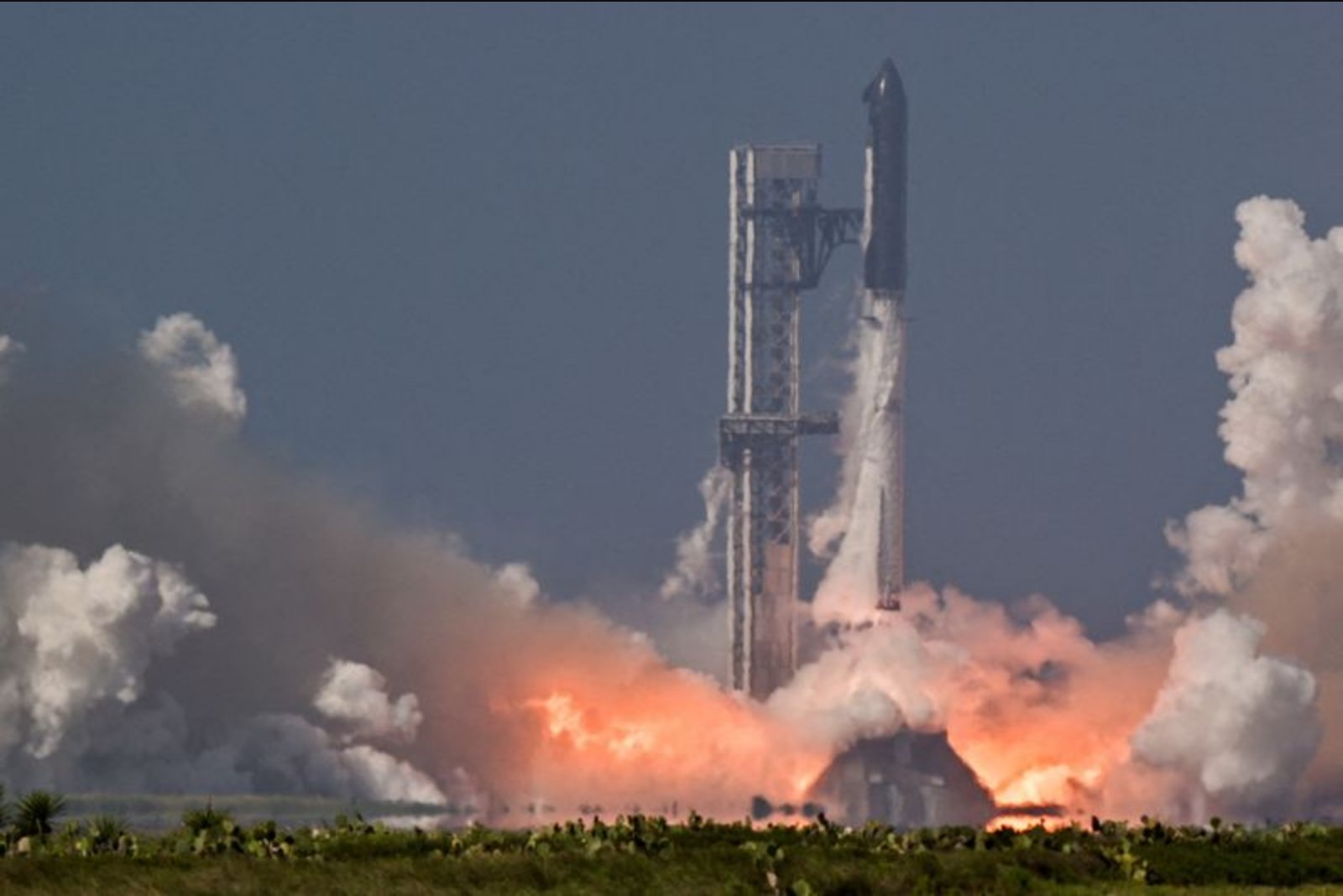
SpaceX's upgraded Starship demonstration on Friday provided the type of forward motion investors needed to see as the company approaches an IPO aimed at a valuation of $1.75 trillion. The flight advanced several technical milestones while also exposing that achieving full reusability of the system continues to be a work in progress.
The firm has invested in excess of $15 billion to develop Starship, which it envisions as a fully reusable rocket able to carry substantially larger payloads than existing launch platforms. Company leaders and market observers contend that such reusability is central to materially lowering launch costs, supporting expansion of SpaceX's Starlink satellite business - a primary cash generator - and enabling future projects that include space-based computing, orbital AI data-center satellites and crewed missions to the moon and potentially Mars.
Friday's flight was the 12th Starship prototype test since 2023 and the inaugural launch of the V3 configuration. In many respects the mission was a success: the vehicle released a set of mock satellites and the spacecraft itself achieved a controlled splashdown in the Indian Ocean. Those outcomes supplied tangible evidence of progress toward the goals cited in the company's IPO filing.
However, the mission did not achieve a controlled recovery of the Super Heavy booster, which tumbled into the Gulf of Mexico. The incomplete booster landing underlines that some critical elements of end-to-end reusability have yet to be proven reliably in series.
Investors and analysts applauded the demonstration as sufficient to keep confidence intact ahead of the public offering. "SpaceX did not need perfection from this Starship flight. It needed proof that the upgraded vehicle is moving in the right direction, and that is largely what investors saw," said Mark Vena, CEO at SmartTech Research.
Market participants have placed heavy bets on the IPO, reflecting a broader faith that Elon Musk can convert high-risk engineering ventures into significant commercial platforms. Even with the booster landing failure, a number of investors judged the test as lowering the probability that Starship is caught in a repeating cycle of failures that would undermine the ability to scale the system.
"Full reusability is the key to unlocking dramatically lower launch costs," said James Bruegger, chief investment officer at British investment firm Seraphim Space. "That’s where the real value lies."
At the same time, SpaceX has itself cautioned that delays in reaching development or cost goals could impede deployment of next-generation satellites and AI infrastructure by increasing program costs. A small set of investors has voiced concern that Starship could end up trapped in ongoing rounds of fixes and subsequent failures without ever validating an end-to-end, working system.
Jesse Nacht, a research associate at MarketVector Indexes, framed the result as a reduction in downside risk rather than a full removal of execution uncertainty. "What we saw with the Starship launch is that it reduced the bear case risk that the Starship is stuck in a failure loop. So it doesn’t completely eliminate the execution risk," he said. "Unless something were seriously catastrophic, I don’t think it would change expectations all too much."
Analysts described a partial triumph as a preferable result for the company at this stage. Antoine Grenier, partner and head of space consulting at Analysys Mason, called a "lukewarm success" potentially the optimal outcome. "Total failure would have been problematic, total success would have triggered enormous IPO excitement," he said. Grenier also noted that a seven-month hiatus since the previous flight meant SpaceX likely needed to fly before the IPO roadshow to avoid raising additional investor questions about execution pace.
A roadshow for the anticipated IPO is scheduled to begin on June 4. If the offering proceeds successfully, it could raise as much as $80 billion, which would make it the largest public offering to date.
Investor attention has broadened beyond traditional launch and satellite services, with many market participants evaluating SpaceX as a potential future provider of AI infrastructure. Musk defended the path of xAI earlier in the week, saying the three-year-old company is still in its infancy compared with rivals OpenAI and Anthropic, and asserting that its models "will be great."
Despite Friday's technical steps forward, analysts stress that significant proof points remain outstanding before Starship can be regarded as a reliable, economical platform at scale. "Obviously, SpaceX will need to demonstrate a successful launch, payload deployment, orbits and touchdown of the booster and the vehicle in order to enable deployment of the system at scale to construct a megaconstellation of orbital data centers," said Austin Moeller, managing director of equity research at Canaccord Genuity.
Context for markets
- Space launch and aerospace sectors are central to the Starship program's commercial promise.
- Satellite communications and emerging AI infrastructure markets could be materially affected if full reusability and cost targets are met.
- Capital markets attention is concentrated on the pending IPO and the valuation implications of Starship's technical trajectory.