
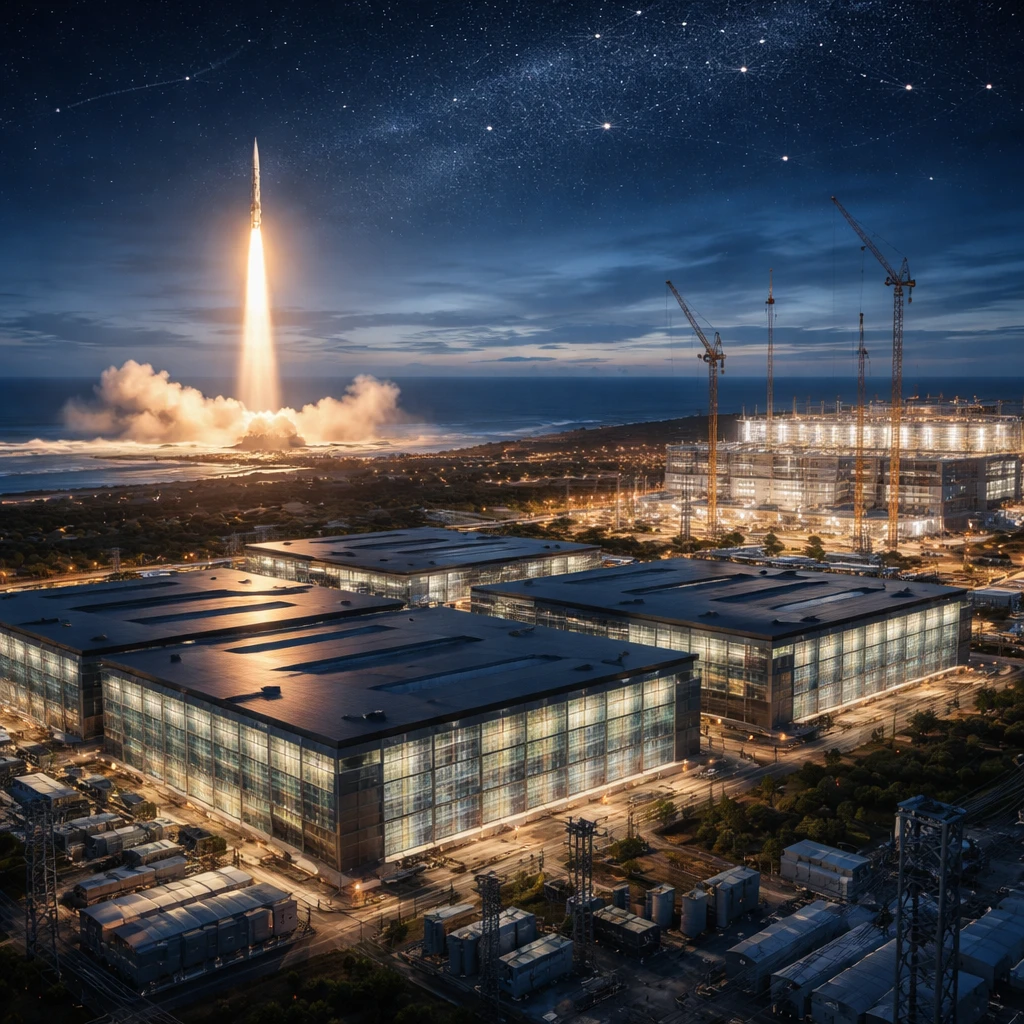
SpaceX's S-1 filing contains several detailed figures and program descriptions that are directly relevant to investors in chips, data-center hardware and launch services. Wolfe Research analyst Liz Pate summarized the key points, identifying Nvidia as the dominant provider of accelerators in SpaceX's ground-based clusters and naming Intel as a partner in a major planned fabrication initiative.
The filing shows SpaceX currently operates two distinct AI compute clusters. Colossus 1 is described as a site of roughly 130 megawatts hosting about 100,000 H100 GPUs. Colossus II is presented as a larger facility currently at 430 megawatts, populated with roughly 110,000 GB200 and 110,000 GB300 accelerators.
SpaceX's disclosed plans indicate further expansion for Colossus II. Total planned capacity for that site includes an additional 400 megawatts of compute and approximately 220,000 more GB300 processors. Taken together, the two Colossus sites point to total planned compute capacity across both facilities reaching 1 gigawatt.
On capital spending, Wolfe Research highlighted the filing's near-term spending profile. SpaceX reported $7.7 billion in AI-related spending for the first quarter of 2026, a run rate that annualizes to more than $30 billion. That pace marks a sharp increase from the $12.7 billion of AI spending recorded in fiscal 2025, and the filing suggests further acceleration could follow.
The S-1 also introduces Terafab, a large-scale chip fabrication project announced in the first half of 2026. Wolfe's note calls out Intel as a named partner, citing the company's expertise across design, fabrication and packaging. The facility is described as targeting annual output on the order of 1 terawatt of compute hardware. The filing, however, does not include specific disclosures on the Terafab timeline or the capital expenditure required to reach that production target.
Perhaps the most forward-looking element in the filing is SpaceX's stated ambition to deploy AI compute via satellites. The company is aiming to begin launching AI compute satellites as early as 2028, with a target of 100 gigawatts in satellite constellation-driven compute capacity per year. Wolfe Research noted that achieving that scale would require thousands of launches annually.
These items together map to potentially large demand for accelerators, packaging and fabrication capacity, and they imply a substantial lift in launch activity if the satellite compute plans proceed. The filing provides specific hardware counts and spending figures while leaving some timeline and investment details, particularly around Terafab, unspecified.