
Stock Markets May 18, 2026 03:43 PM

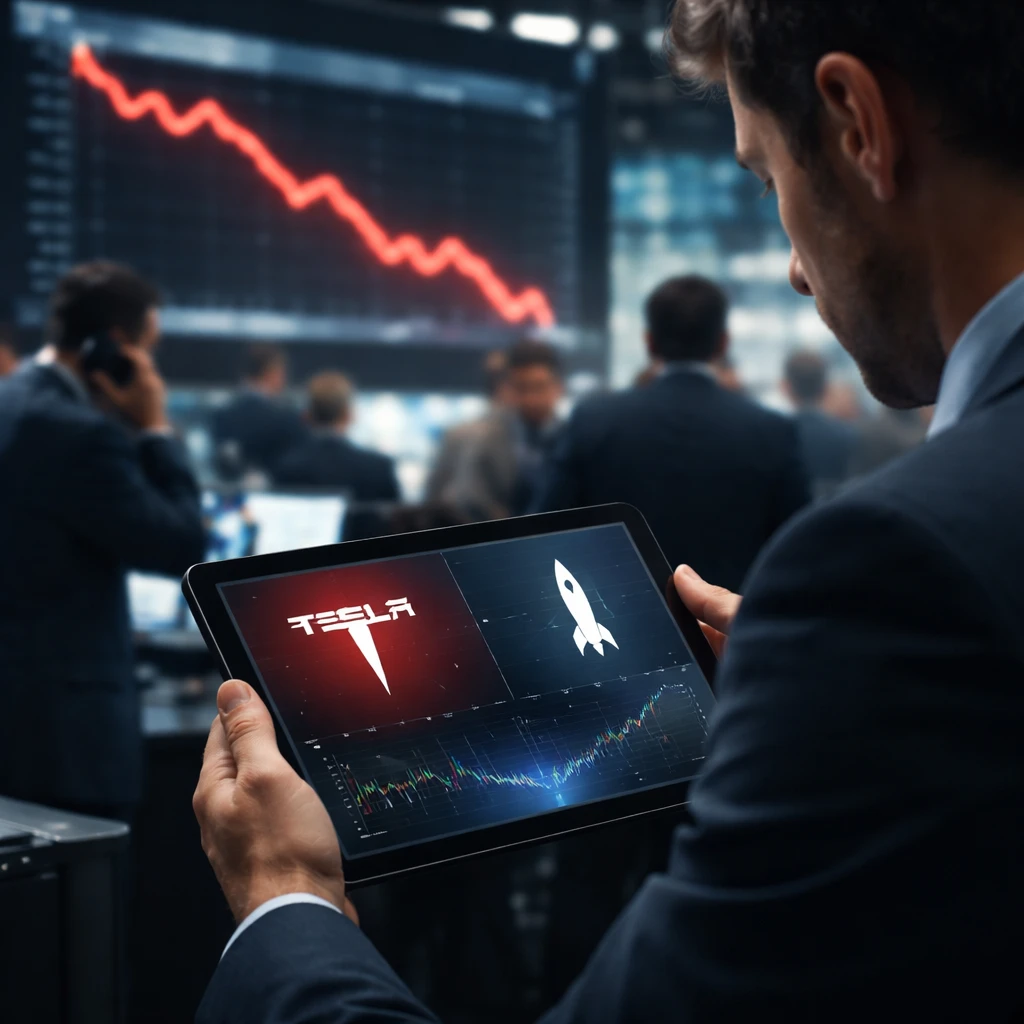
SpaceX IPO Draws Capital Away, Pressures Tesla Share Price

Investors weigh a new public option in the 'Musk economy' as Tesla slips amid concerns over capital and management focus

By Avery Klein TSLA

Tesla shares fell after SpaceX announced plans for an initial public offering, prompting analysts to warn that Wall Street capital and executive attention may shift toward the space company. The move has interrupted Tesla's role as the primary publicly traded way for retail investors to gain exposure to Elon Musk-led enterprises and coincides with concerns over slowing sales growth and a lofty valuation tied to future autonomous and robotics ambitions.

SpaceX IPO Draws Capital Away, Pressures Tesla Share Price
TSLA

Key Points

  • Tesla shares fell 3% on Monday and about 8% over the prior five trading days after SpaceX announced an IPO - impacts equity markets and investor allocation decisions.
  • Analysts warn that Tesla’s role as the primary public vehicle for exposure to Elon Musk-led companies is disrupted, creating direct competition for investor capital - affecting capital markets and the automotive and aerospace sectors.
  • Tesla’s valuation stands near 195 times forward earnings, with its premium dependent on future autonomous vehicle and robotics progress amid competition from Alphabet’s Waymo and Chinese EV makers - relevant to technology and automotive investors.

Tesla Inc (NASDAQ:TSLA) saw its stock decline 3% on Monday after the announcement that SpaceX would pursue an initial public offering. The company’s shares have moved lower over the week, registering an 8% drop across the last five trading days.

Market commentators noted a structural change: for years Tesla functioned as the only listed option for many retail investors looking to participate in businesses run by Elon Musk. SpaceX going public alters that dynamic and introduces a fresh choice for capital allocation within what some analysts call the "Muskonomy."

Wall Street analysts raised two related concerns. First is the possibility that Musk’s attention could increasingly be directed toward SpaceX at a time when Tesla is experiencing a slowdown in sales growth. Second is that SpaceX’s public debut may attract investment flows away from Tesla because analysts view the space company as a leader in its sector with substantial growth prospects and comparatively little direct competition.

Those analyst observations sit against Tesla’s current valuation metrics: the stock trades at roughly 195 times forward earnings, placing it among the highest-valued names in the S&P 500 as the second most expensive stock by this measure. That valuation premium is linked heavily to expectations for Tesla’s future developments in autonomous vehicles and robotics, areas in which the company faces competition from Alphabet’s Waymo unit and several Chinese electric-vehicle manufacturers.

Analysts describe SpaceX’s emergence as a publicly listed alternative as creating direct competition for investor capital within the broader Musk ecosystem. The presence of another high-profile Musk-led company on public markets has also been connected in reports to Musk’s reported consideration of a potential merger between Tesla and SpaceX.

Overall, recent stock moves appear to reflect investor unease on two fronts: the potential division of senior management focus across multiple large enterprises and the availability of a newly listed vehicle for those seeking exposure to ventures controlled by Musk. Both concerns are cited by analysts as contributing factors to Tesla’s recent share weakness.

Risks

  • Management attention risk - analysts cite concern that Musk may shift focus toward SpaceX while Tesla faces slowing sales growth, which could affect operational execution in the automotive and robotics businesses.
  • Capital allocation risk - SpaceX as a new public option may draw investor funds away from Tesla, increasing pressure on Tesla’s stock and influencing valuations across related technology and transportation sectors.
  • Valuation dependence risk - Tesla’s rich forward multiple relies heavily on anticipated autonomous-vehicle and robotics outcomes; competition from Waymo and Chinese EV manufacturers presents uncertainty for those growth assumptions.

More from Stock Markets

Boeing Examining Faster 737 Output, Evaluating Supplier Capacity to Approach Airbus Levels Jun 4, 2026 MOEX slips as mining, oil & gas and power names weigh on market Jun 4, 2026 Walmart rolls Subway into its 30-minute express delivery program as e-commerce competition intensifies Jun 4, 2026 Merlin Shares Rally After C-130J Program Clears Critical Design Review Jun 4, 2026 S&P Lowers Wabash National Credit Rating, Cites Weak Cash Flow and Tightening Liquidity Jun 4, 2026