
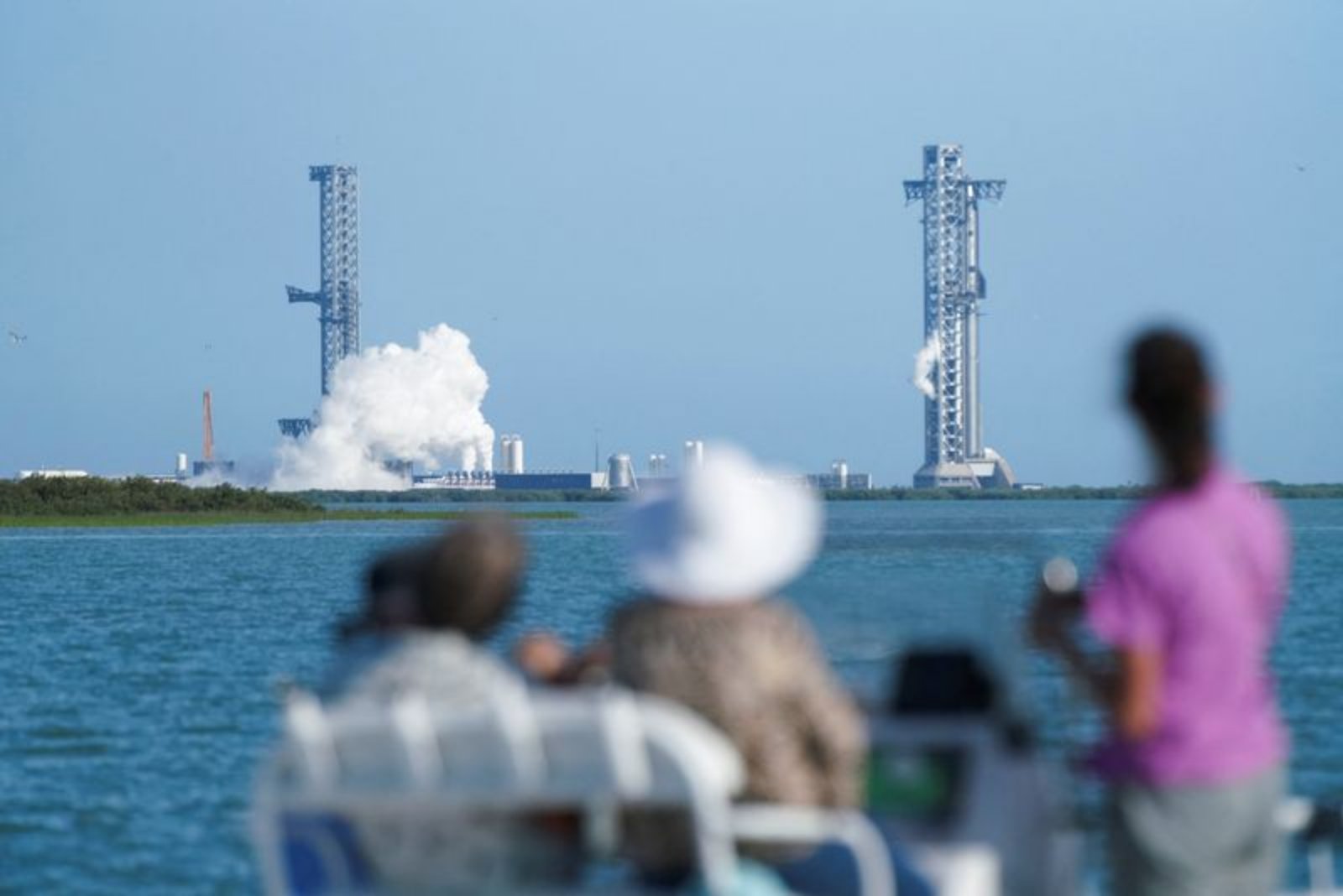
SpaceX launched the 12th Starship vehicle on May 22 from its Starbase complex in Texas, initiating the first flight of an upgraded V3 configuration in an uncrewed demonstration that blends propulsion, thermal protection and payload-release experiments. The mission, which lifted off from a new pad on the Gulf coast near Brownsville, tested revisions to both the upper-stage Starship and its Super Heavy booster - including the company’s new Raptor 3 engines - and was conducted without any plan to attempt a recovery of either stage.
The V3 flight is a consequential milestone for the program. The iteration is intended to support more frequent Starlink satellite launches and future crewed and cargo missions beyond low-Earth orbit, including NASA lunar missions. The debut also arrives as SpaceX prepares for an initial public offering next month that is expected to be the largest in history, placing the test under intense investor scrutiny.
Flight profile and objectives
The composite vehicle - the upper-stage Starship mounted on top of its Super Heavy booster - lifted off in the evening from Starbase. SpaceX framed the outing as a test flight rather than an operational launch, and stated there would be no recovery attempts at the conclusion of the mission even if other objectives were met. Instead, the company planned for both stages to perform controlled descent maneuvers and make splashdowns in planned ocean zones.
Under the published timeline, the Super Heavy booster aimed to reach a targeted splashdown area in the Gulf of Mexico roughly seven minutes after liftoff. The upper-stage Starship was expected to continue on a suborbital profile and perform its own controlled ocean impact in the Indian Ocean about an hour after liftoff, an endpoint SpaceX described as an "exciting landing."
While in flight, the Starship payload dispenser was set to release 20 mock Starlink satellites individually and to deploy two real satellites placed along the flight path to gather data. Those two functional payloads were tasked with scanning Starship’s heat shield and relaying descent telemetry to ground controllers. Approximately 20 minutes after the mock- and real-satellite deployment, a planned restart of Starship’s Raptor engine was scheduled to exercise the upper stage’s in-space ignition capability.
Heat-shield and imaging experiments
To probe aerodynamic and thermal performance during re-entry, engineers intentionally removed a single heat shield tile to compare the loading on neighboring tiles. Several other tiles were painted white to serve as visual targets for imaging systems during descent. The rocket’s thermal protection system is widely acknowledged within the program to be one of the most challenging technical elements, as it must provide exceptional durability while requiring little or no refurbishment between flights to meet SpaceX’s goal of rapid turnaround.
Key hardware upgrades
The V3 configuration features several hardware changes designed to ready Starship for missions beyond low-Earth orbit. The Super Heavy booster has been retooled so that its complement of 33 Raptor engines produces greater thrust while reducing overall booster mass. The upper-stage Starship propulsion suite has been refined to support longer-duration missions, enable ship-to-ship docking, permit on-orbit refueling and to improve maneuverability.
These operational capabilities are central to SpaceX’s plan for ambitious missions, including in-orbit refueling carried out by multiple tanker Starships - a complex and unproven sequence the company would rely upon for its first planned lunar landing mission in 2028. The in-space refueling architecture and long-duration upper-stage work were part of the capability set that underpinned a $3 billion-plus contract SpaceX received in 2021 under NASA’s Artemis program.
Investor scrutiny and program context
The outcome of the V3 test carries financial as well as technical significance. SpaceX has invested more than $15 billion in developing Starship as a fully reusable spacecraft, a centerpiece in Chief Executive Elon Musk’s plans to lower launch costs, expand Starlink and pursue projects such as deep-space exploration and orbital data centers. Those businesses and ambitions are woven into management’s stated target of a $1.75 trillion valuation for the planned IPO.
A successful demonstration would bolster the argument that Starship - the largest and most powerful rocket ever flown - is approaching commercial readiness after years of intermittent failures and development delays. The test is being observed closely by investors roughly three weeks ahead of the scheduled offering, which could become the first U.S. market debut to exceed $1 trillion and immediately place SpaceX among the world’s most valuable public companies.
SpaceX’s engineering approach has emphasized frequent, aggressive flight testing that deliberately pushes prototypes toward failure modes so teams can iterate quickly. While that tolerance for risk has delivered rapid learning in some cases, it also produced high-profile setbacks during Starship’s development. Public pronouncements about timelines have shifted; for example, a previous projection that Starship would attempt an uncrewed Mars voyage at the end of 2026 is now beyond reach.
Competitive and programmatic implications
Starship sits at the heart of several strategic ambitions. If it reaches routine operational status, the vehicle could cut per-launch costs and allow SpaceX to scale Starlink deployments and pursue long-duration missions. The vehicle is a central element in the U.S. Artemis lunar strategy and is explicitly tied to NASA’s plans for returning astronauts to the lunar surface. The program’s timeline and technical success also figure into broader comparisons with other nations’ lunar plans.
What remains uncertain
Despite the detailed test profile, the flight did not include recovery attempts and thus does not demonstrate turnaround or reusability. The durability of the heat shield in regular operations, the operationalization of in-orbit refueling using multiple tanker Starships and the mature performance of the reworked Raptor engine family remain to be proven through repeated flights and further demonstrations.
As SpaceX advances toward a public listing, investors will continue to weigh the company’s demonstrated engineering progress against persistent technical uncertainties and the company’s tolerance for high-risk testing approaches.