
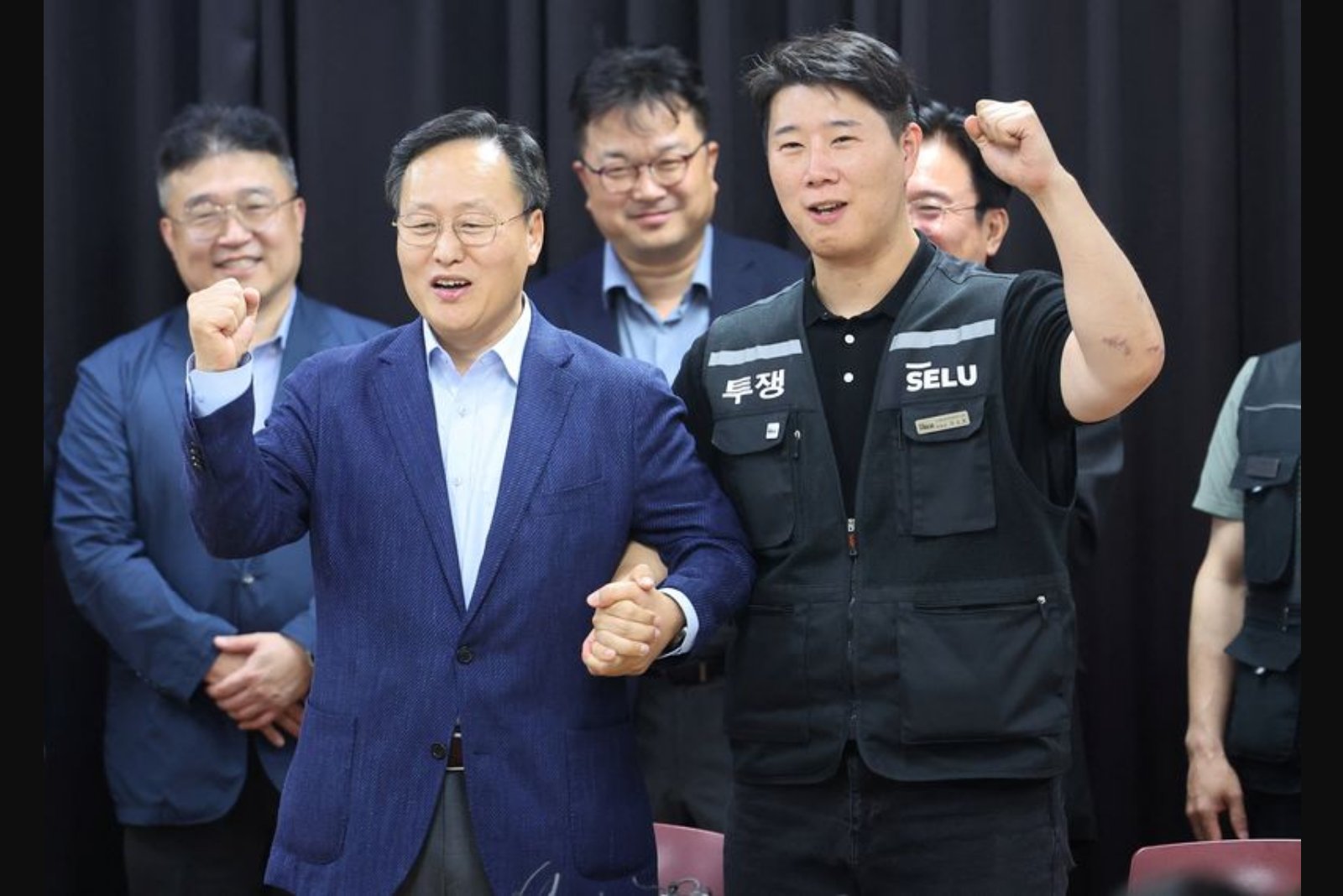
Samsung Electronics saw its share price jump strongly on Thursday after management and the company’s union reached a negotiated settlement that paused a planned 18-day walkout involving about 48,000 union members. The accord, brokered with government involvement, will be subject to a ratification vote set to take place between May 22 and May 27, and the union’s leader has said he expects members to approve it.
Markets responded immediately. Samsung stock and the benchmark KOSPI moved nearly 8% higher in morning trading as investors digested the avoided disruption. The suspension of industrial action came amid broad relief in South Korea, where Samsung represents roughly one quarter of the nation’s exports and where the proposed strike was widely expected to have serious economic consequences and to threaten global chip supply if it had proceeded.
Under the terms agreed with the union, the company is expected to allocate about 10.5% of operating profit from its chip division to special bonuses, the union said. Those awards are structured to be paid largely in company stock rather than cash for at least 10 years and are conditional on the chip division meeting specified operating profit targets.
The profit hurdles are specified as more than 200 trillion won in annual operating profit from 2026 through 2028, and 100 trillion won from 2029 through 2035. The union also trimmed a prior demand to dedicate 15% of operating profit toward bonuses. A union source who declined to be identified provided an example of the payout scale: a memory chip worker with an 80 million won base salary would be expected to receive a bonus of around 626 million won this year, mostly in stock, equivalent to about $416,000 using an exchange rate of $1 = 1,500.8000 won.
Analysts noted a mixed set of implications from the arrangement. Ryu Young-ho, a senior analyst at NH Investment & Securities, said investors were relieved that the strike had been averted but cautioned that the deal raises labour costs substantially. He also pointed to the company’s choice to deliver performance-related pay in stock as a feature that could lessen the immediate cash impact on Samsung’s finances.
Company management sought to move the conversation toward unity and competitiveness. Jun Young-hyun, the head of Samsung’s chip division, wrote to staff urging them to put the dispute behind them and to join forces to bolster the company’s global competitiveness and long-term growth.
The agreement will now be presented to union members for ratification in the voting window announced by union leaders. If approved, it will halt the planned industrial action and implement the multi-year, stock-centric bonus framework for the chip division. The full financial and operational consequences will depend on both ratification and future performance against the set profit conditions.
Market and sector context
The near-term market reaction was materially positive, reflecting investor relief that operations and global chip supply chain disruptions tied to an 18-day strike were avoided. At the same time, the settlement introduces elevated labour-related obligations for Samsung’s chip operations and links a significant portion of bonus payments to long-term profit performance.