
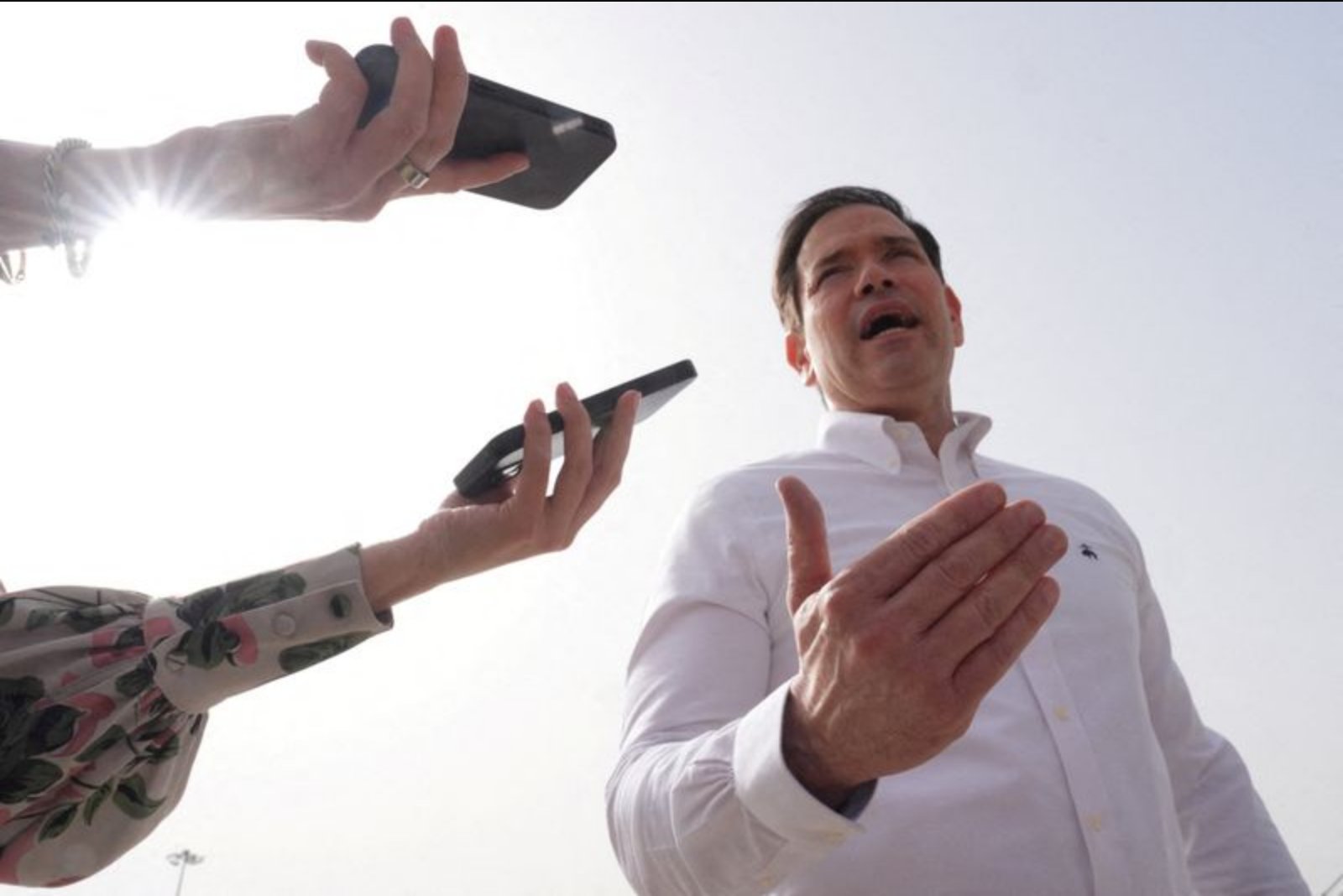
WASHINGTON/ISLAMABAD - U.S. Secretary of State Marco Rubio said on Monday that Washington will either reach a substantive agreement with Iran or handle the situation "another way," signaling that diplomacy will be given priority before the United States considers alternatives. Rubio spoke with reporters in New Delhi, reiterating that the administration intends to pursue diplomatic channels fully before exploring other options, after President Donald Trump advised his team not to rush into any Iran deal.
Rubio said there was "a pretty solid thing on the table" that would allow Iran to reopen the Strait of Hormuz and lead into a "very real, significant, time-limited negotiation on the nuclear matter," adding that officials hope they can "pull it off." The secretary's comments came as U.S. officials cautioned that an imminent breakthrough was not guaranteed in the three-month-old conflict.
On Sunday President Trump wrote on Truth Social that the U.S. naval blockade on Iranian ships transiting the Strait of Hormuz "would remain in full force and effect until an agreement is reached, certified, and signed." He also urged patience, stating that "Both sides must take their time and get it right." There was no immediate response from Iran's government to the president's post. The Tasnim news agency, which is linked to Iran's Revolutionary Guards, said the United States was still blocking parts of a possible agreement, including Tehran's demand for the release of frozen funds.
Markets reacted to signs of progress: oil prices dropped 6% to two-week lows on Monday amid growing optimism that the United States and Iran might be edging closer to a peace arrangement. President Trump had raised expectations of a near-term deal on Saturday by saying Washington and Tehran had "largely negotiated" a memorandum of understanding that would reopen the Strait of Hormuz - the critical waterway that had carried a fifth of global shipments of oil and liquefied natural gas before the conflict.
Sticking points and negotiating contours
U.S. officials outlined what they described as the latest contours of the issues under negotiation, but they did so without independent confirmation from Tehran. One senior administration official, speaking on condition of anonymity, said Iran had agreed "in principle" to open the Strait of Hormuz in return for the United States lifting its naval blockade, and to dispose of Tehran's highly enriched uranium. The same official said the administration believed Iran's Supreme Leader Ayatollah Mojtaba Khamenei had endorsed the broad template of the proposed deal.
There was no immediate confirmation from Iranian authorities about the scope of any "in principle" agreement, nor an elaboration on what that phrase meant in practical terms. The U.S. official said Washington envisioned first re-opening the strait and lifting the U.S. naval blockade, while negotiating the precise nuclear measures would take additional time. On the question of disposing of enriched uranium, the official pushed back on suggestions that Iran had not accepted the idea, saying "It's a question about how."
A second senior administration official said the proposed framework would give negotiators 60 days to reach a final deal. Iranian sources had told Reuters that in later phases, "feasible formulas" might be found to address the dispute over Iran's highly enriched uranium stockpile, such as diluting the material under the supervision of the U.N. nuclear watchdog.
Iran has repeatedly denied U.S. and Israeli accusations that it is seeking nuclear weapons and maintains that it has a right to enrich uranium for civilian purposes. The purity Iran has reached, officials say, exceeds that needed for power generation.
Domestic and diplomatic context
President Trump, whose approval ratings have been affected by the war's impact on U.S. energy prices and who has faced congressional measures to constrain his war powers, has emphasized the prospect of a deal to end the conflict that began on February 28 in actions involving the U.S. and Israel. A fragile ceasefire has been in place since early April.
The president responded to critics of his negotiating approach and his willingness to make concessions with a social media post: "If I make a deal with Iran, it will be a good and proper one ... So don't listen to the losers, who are critical about something they know nothing about."
Officials and analysts note that any agreement that strengthens the current fragile ceasefire could ease market pressures, even if it would not instantly resolve the broader global energy crisis that has pushed up prices for fuel, fertilizer and food.
Human cost and regional violence
Fighting between the U.S.-Israeli forces and Iran resulted in a large number of casualties in Iran before those strikes were suspended in early April. Israel's military campaign in Lebanon, carried out in pursuit of the Hezbollah militia, has similarly caused thousands of deaths and displaced hundreds of thousands of people. Iranian retaliatory strikes against Israel and neighboring Gulf states have killed dozens, according to the accounts contained in reporting from the conflict.
Advertisement-style material included in reporting
The original reporting also included an investment-oriented passage that framed the question "What should you actually own right now?" and argued that the best investments begin with improved data. It described a service that combines institutional-grade data with artificial intelligence-powered insights to help identify potential investment ideas, while noting that such tools do not guarantee winners but may help investors find more opportunities. The passage invited readers to consider those tools when assessing top investments of 2026 to date.
Conclusion
U.S. officials portrayed a potential pathway that would begin with reopening the Strait of Hormuz and lifting the U.S. naval blockade, followed by a time-limited negotiation over nuclear issues. Despite those contours, key elements - including the mechanics of disposing of enriched uranium, the lifting of sanctions, and the transfer of frozen Iranian funds - remain unresolved and contested. Tehran has not immediately confirmed the U.S. account of progress, and domestic political considerations in Washington continue to shape how negotiators proceed.
The outcome of the talks remains uncertain. For now, U.S. leaders say diplomacy will be attempted fully before other measures are pursued, while markets and regional actors watch for whether that diplomatic effort produces an enforceable and signed agreement or requires alternative action.