
Market reaction and contract overview
Rocket Lab USA, Inc. shares rose 3.3% in premarket trading Friday following confirmation that the company was awarded a $90 million contract by the U.S. Space Force’s Space Systems Command. Under the agreement, Rocket Lab will serve as prime contractor and end-to-end mission provider for two geostationary satellites that will host the Heimdall space domain awareness optical payload.
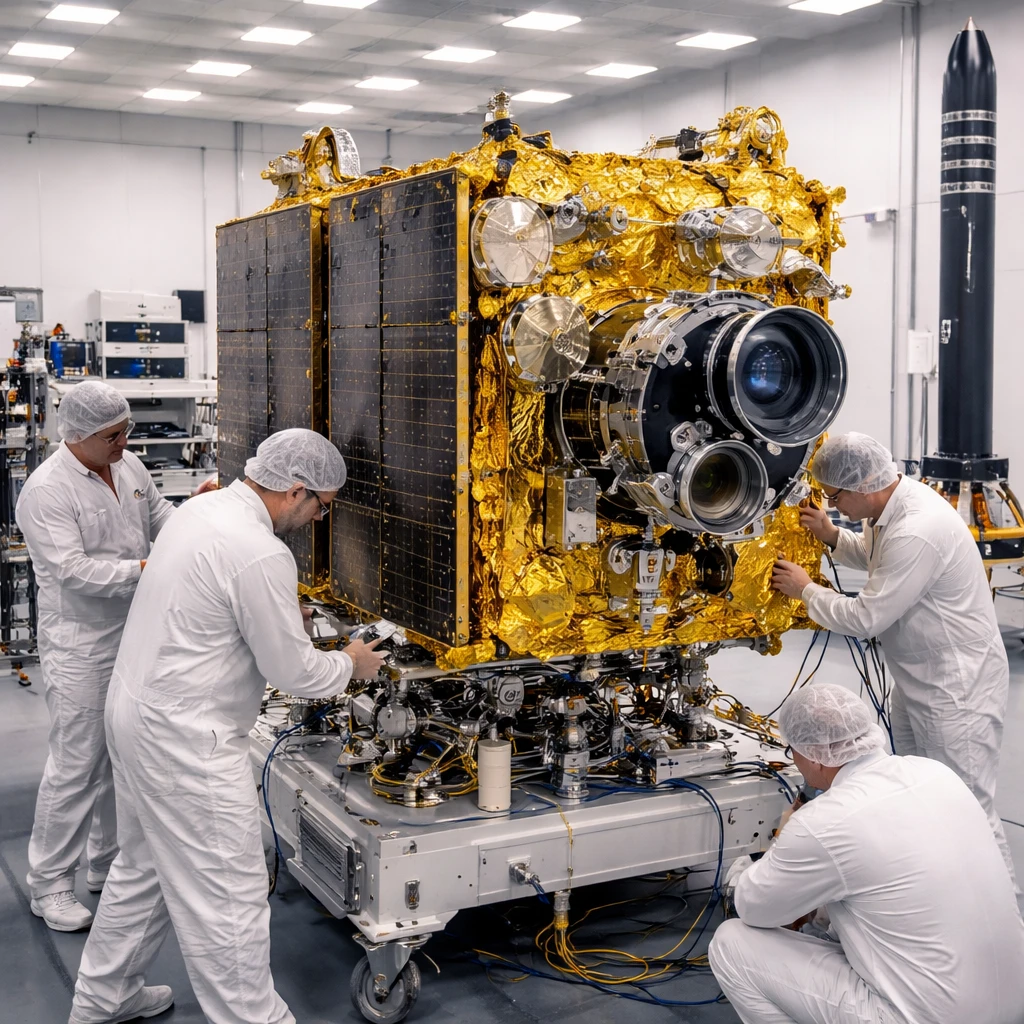
As prime contractor, Rocket Lab is responsible for spacecraft design and manufacture, integration of the in-house Heimdall optical payload, launch integration onto a government-furnished launch vehicle, and on-orbit operations for up to five years after commissioning. The award is identified by the company as its first satellite production program for geostationary orbit and extends its vertically integrated mission model into a new orbital regime.
Platform and program lineage
The two satellites will be built on Rocket Lab’s Lightning bus, which will be adapted to meet the thermal, radiation, propulsion, and station-keeping requirements specific to geostationary orbit. Lightning is already in production across several national security programs, including the Space Development Agency’s Tranche 2 Transport Layer-Beta and Tranche 3 Tracking Layer, as well as for commercial constellations.
The contract builds on a Space Systems Command program that began with prototype development of two Heimdall space-based payloads originally awarded to GEOST. Rocket Lab acquired GEOST in 2025 and integrated that business as Rocket Lab Optical Systems, incorporating the Heimdall payloads into its vertically integrated capability set.
Operational scope and timeline elements
Rocket Lab’s scope under the contract covers the full mission lifecycle from spacecraft design and manufacture through integration of the Heimdall optical payload, launch integration with a government-furnished launch vehicle, and on-orbit operations extending up to five years following commissioning. The firm’s role as prime contractor places responsibility for coordinating those activities and delivering operational satellites in geostationary orbit.
Concurrent launch activity
Separately, Rocket Lab announced the successful deployment of the ninth satellite for Synspective on Thursday. The Viva La StriX mission launched on Electron from Launch Complex 1 in New Zealand to a 572 km low Earth orbit. That mission brings Rocket Lab’s total launch count to 88, and the company has an additional 18 Electron launches for Synspective on the manifest.
Implications for capabilities
The Space Systems Command award formalizes Rocket Lab’s movement into geostationary satellite production and extends its vertically integrated model - spacecraft bus, payload integration, launch integration, and operations - into an orbital regime with distinct thermal, radiation, propulsion, and station-keeping demands. The company will rely on its Lightning bus adapted for those requirements while leveraging the Heimdall optical payload developed through the program started under GEOST and transitioned after Rocket Lab’s 2025 acquisition.
Note: This article reports company disclosures and mission counts as provided. It does not include investment advice.