
Overview
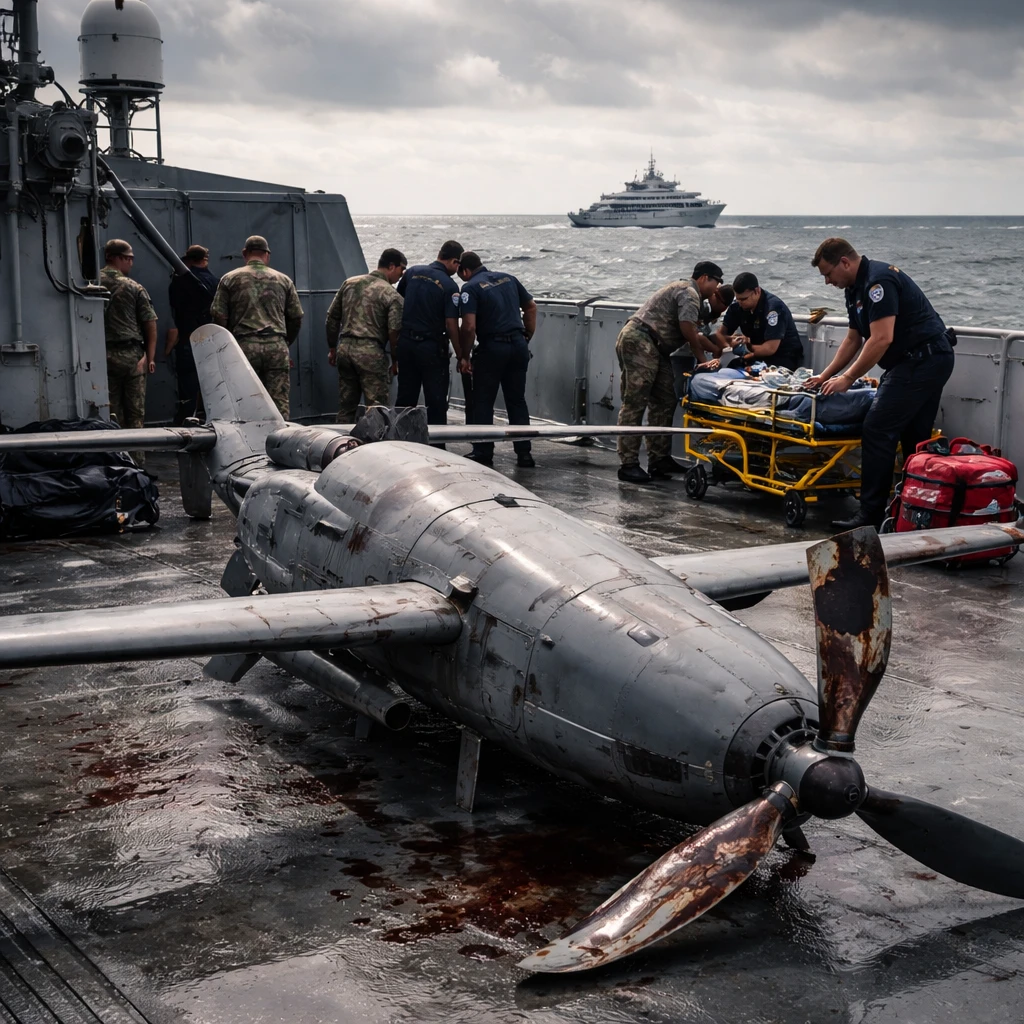
A severe injury sustained during a Shield AI training exercise has renewed scrutiny of the company's V-BAT unmanned aircraft. On May 12, a Romanian Navy official had two fingers severed and a third fractured after her hand was caught in a V-BAT propeller while the drone was operating from a boat off the Texas coast, Romania's Ministry of National Defence told Reuters. The incident, which had not been publicly reported until recently, follows a prior episode in which a U.S. Navy official suffered partial finger severing during a V-BAT test.
Shield AI acquired the V-BAT platform when it bought Martin UAV in 2021. The company has sought to position the aircraft as a military-grade VTOL drone for a broad set of customers, but the vehicle's operational record and internal handling of safety issues have drawn criticism from former employees, industry executives, investors and regulators. The company says the V-BAT remains among the most operationally proven VTOL aircraft in service and that it has accumulated 18,000 flight hours since 2019.
Details of the May 12 Incident
Romania's defence ministry reported the May 12 incident and said the injured official underwent operations to reattach her fingers on May 12 and again on May 16 at the University Medical Center New Orleans. Her condition worsened thereafter, and she was transferred to the Walter Reed National Military Medical Center in Maryland, where she remained as of May 25, the ministry said. The ministry also said it would investigate the event and cautioned that it was premature to ascribe blame or determine preventability.
Shield AI told Reuters the May 12 incident resulted from a violation of established safety procedures rather than a product defect, but it did not disclose the specific breach it cited. The Romanian Naval Forces, which last year entered a $30 million agreement with Shield AI for the V-BAT, said that the contract remains in effect.
Crash Record and Internal Fleet Losses
Interviews and documentary materials reviewed by Reuters portray steady technical difficulties with the V-BAT. According to two people with knowledge of Shield AI's internal fleet, more than 50 of about 200 upgraded V-BATs that the company manages internally have been destroyed in crashes during testing or training over the past 18 months. That level of loss, if accurate, represents a high failure rate within Shield AI's controlled operating environment.
In September, during a NATO-led event in Portugal that showcased unmanned military systems, a V-BAT reportedly crash-landed on a runway. In another episode earlier in the year, a series of crashes prompted the company to pause flights for several weeks in February to determine root causes. One crash in Texas ignited a grass fire that burned more than 40 acres, according to fire records and interviews with emergency responders.
Shield AI disputed that its internal fleet had experienced the level of trouble described in those interviews and materials, saying instead that its customers have experienced 10 operational mishaps since early 2025 following an upgrade to the V-BAT. The company characterized operational mishaps as common for a drone of the V-BAT's design and defended the platform's performance and safety record overall.
Whistleblower and Employee Allegations
Jacob Miller, a former Shield AI product manager, filed a whistleblower complaint in May with the Department of Labor's Office of Administrative Law Judges that alleges the company took steps to conceal technical shortcomings from military customers. The complaint, reviewed by Reuters, alleges that Shield AI reported a drone test as autonomous to the Greek military while the aircraft was in fact manually piloted, and that the firm scrubbed or falsified data in mishap reports to present a more favorable view of V-BAT performance to potential customers and U.S. military buyers. Miller said he was terminated after raising safety concerns and subsequently filed a lawsuit in May alleging wrongful termination tied to those disclosures.
Miller and other former employees described a company culture they say incorporated a Silicon Valley-style willingness to press forward with demonstration and sales efforts even where unresolved technical issues existed. One former product manager characterized the approach as "fake it until you make it," and said that approach was being applied to equipment capable of causing immediate physical harm.
According to people with knowledge of internal events, at least three employees who raised safety concerns in the past 18 months were either dismissed or left the company. Shield AI has declined to comment on ongoing litigation and said it would vigorously defend itself.
Near-Misses and Testing Anomalies
Allegations include several operational near-misses. In one testing scenario, employees were evaluating a new detect-and-avoid capability. Two company employees flew in a Cessna near a V-BAT as part of the test, but had to maneuver the airplane to avoid a possible collision when they realized the drone had failed to detect the small aircraft. A child - the young son of one of the employees - was reportedly in the Cessna during that flight. In another allegation, a Cessna containing a Shield AI employee and his child had to take evasive action to avoid a mid-air collision with a V-BAT.
These examples stand in contrast with Shield AI assertions that it maintains a strong safety record, and they form part of the material reviewed by Reuters alongside interviews and official documents.
Contracting, Valuation and Market Position
Shield AI has emerged as one of Silicon Valley's most high-profile defense startups. The company was valued at $12.7 billion in a March funding round co-led by JPMorgan. Its growth strategy has centered on selling drones and autonomy software to the Pentagon and to allied militaries amid heightened global demand for unmanned systems.
Shield AI's founders built the company from a combination of commercial tech and military experience. Ryan Tseng founded the company in 2015 along with his brother Brandon, a former Navy SEAL. The firm has pushed to displace traditional prime defense contractors in certain niches by drawing on venture capital and rapid product development cycles.
As part of its commercial expansion, Shield AI has sold V-BAT systems to more than half a dozen foreign militaries and has been featured at high-profile demonstrations. In February, U.S. Vice President JD Vance toured Armenia and was shown a V-BAT model that had recently been sold to the country under Washington's first arms sales to that nation. Video of his reaction, in which he praised the aircraft, circulated publicly.
Products Under Development - X-BAT
Shield AI is now marketing a larger aircraft called X-BAT, designed for a different set of missions and expected to cost about $30 million. The company has been awarded a contract by the Pentagon's Defense Innovation Unit for the X-BAT, an award that had not previously been reported publicly. In an internal pitch deck from April, Shield AI requested $500 million from the Pentagon to help develop four X-BAT prototypes by 2029 and outlined a total program cost of $1.3 billion, with the company expecting to invest alongside government support.
Materials reviewed by Reuters indicate that Shield AI plans for the X-BAT to use the same flight control architecture as the V-BAT. A presentation to the Indian government in April of the prior year described that reliance on common flight controls. A Pentagon spokesperson, when asked about the risk of basing the X-BAT partly on V-BAT technology, said that the Department of Defense recognizes that risk is inherent to technology development and innovation and views it as part of a learning process essential to delivering capabilities quickly at scale.
Litigation, Investigations and Personnel Matters
Beyond Miller's whistleblower complaint and lawsuit, Shield AI last year retained Littler Mendelson, a law firm, to investigate claims of a hostile work environment and concerns about air safety. Sources familiar with that engagement declined to disclose the firm's findings. Shield AI has not publicly released the results of any internal reviews tied to its recent operational disturbances.
Shield AI declined requests to make its current and former chief executives available for interviews. The company did respond to Reuters with statements defending its approach and performance, noting, for example, that the V-BAT had logged significant flight hours and that operational mishaps can be expected with aircraft of this type. Company representatives also said they believed the allegations against the company lacked merit and that legal claims would be vigorously contested.
Operational and Market Implications
The incidents documented and alleged - from catastrophic injuries to multiple crashes, near-misses during detect-and-avoid trials, and claims of data manipulation in mishap reporting - raise clear operational questions for Shield AI's V-BAT fleet and for programs that intend to scale from that platform, including the X-BAT effort. Customers and contracting authorities must weigh a platform's flight hours and public safety record against the internal accounts of failures and the legal disputes now in progress.
Romania's decision to keep its V-BAT contract in force despite the May 12 injury shows that purchasers may judge the program's overall utility differently than outside critics. At the same time, military buyers commonly require detailed incident reporting and acceptance tests. Allegations that mishap reports were altered, if substantiated through formal inquiry, could affect procurement relationships and regulatory scrutiny.
What Remains Unclear
There are limits to what is publicly known. Shield AI has not disclosed the specific safety procedure it says was violated in the May 12 incident. The company has also not provided a public accounting that reconciles its statement about only 10 customer mishaps since early 2025 with accounts that more than 50 internal aircraft were destroyed over the past 18 months. The findings of independent or internal probes commissioned by Shield AI have not been released publicly, and the outcomes of ongoing litigation and regulatory reviews remain to be determined.
Conclusion
The May 12 injury and the broader pattern of crashes, employee departures and allegations of obfuscation form a complex set of operational and reputational challenges for Shield AI. The company sits at the intersection of venture capital-fueled rapid product rollout and the safety-critical demands of military hardware. How Shield AI navigates investigations, litigation, and customer confidence in the months ahead will shape both its commercial prospects and broader perceptions about rapidly scaled defense technologies that move from prototype to battlefield use.