
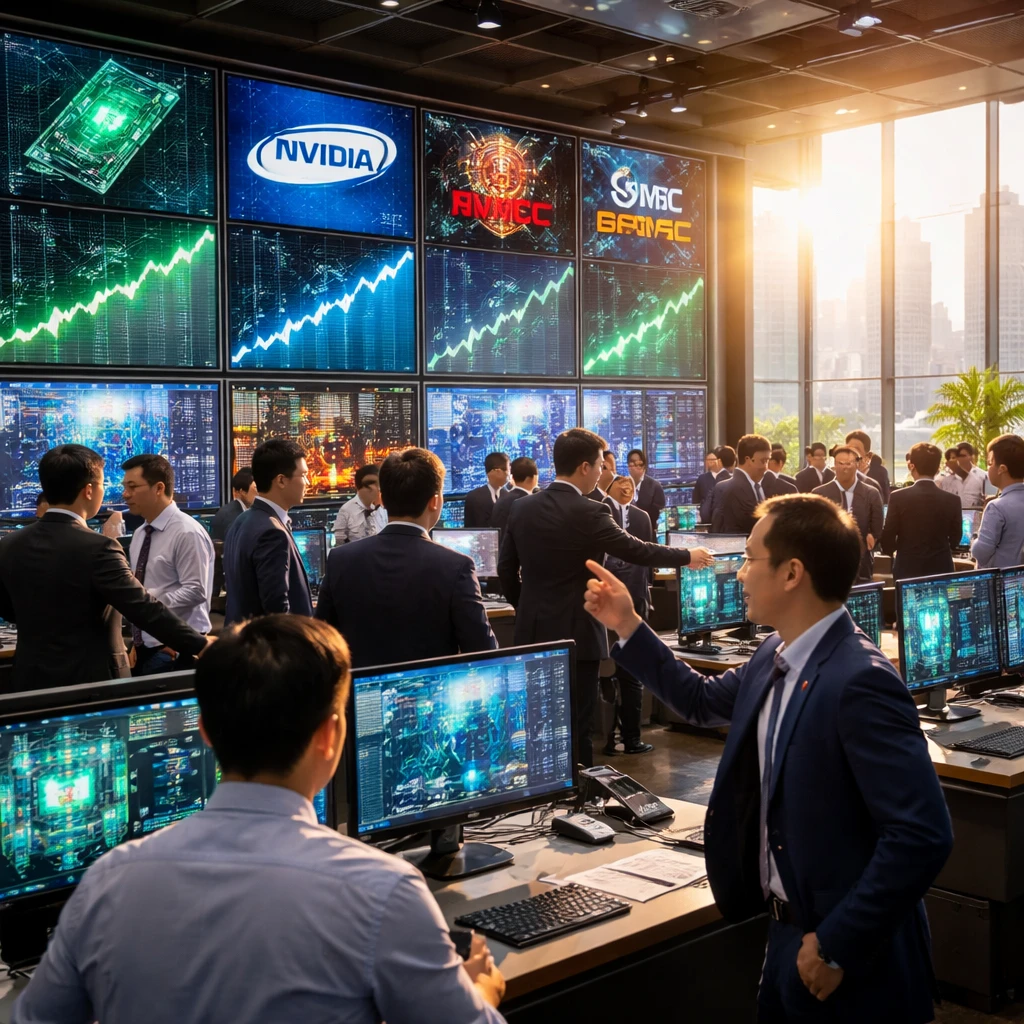
Shares of companies supplying Nvidia rose across Asian markets on Thursday as investors digested a robust first-quarter report from the chipmaker that highlighted persistent, AI-driven demand.
Sentiment toward the semiconductor sector received an additional boost when Samsung Electronics reached an eleventh-hour agreement with a key union to avert a potential strike, removing a near-term operational risk for one of the region's largest memory suppliers.
Among the most notable moves, Samsung and SK Hynix - both important memory suppliers to Nvidia - climbed 8% and 10.9%, respectively, with both stocks approaching recent record highs. Taiwan Semiconductor Manufacturing Co (TSMC), the world's largest contract chipmaker and another significant Nvidia vendor, gained 3.2% in Taiwan trading. Hon Hai Precision Industry, which handles server assembly for Nvidia, rose 3.1%.
Several Japanese suppliers also benefited from the positive sentiment. Advantest, a maker of chip testing equipment used by Nvidia, rose 4.8%. Ibiden, a supplier of key chip components, surged nearly 15%. SUMCO and Murata Manufacturing increased 2.1% and 8.9%, respectively.
The market reaction followed Nvidia's announcement of first-quarter results on Wednesday evening that beat expectations and underscored continued growth driven by artificial intelligence workloads. Despite the stronger-than-expected figures, Nvidia's shares drifted slightly lower in aftermarket trading after management's outlook for the current quarter failed to meet some high investor expectations.
Investors also registered concern over intensifying competitive dynamics, as several of Nvidia's customers are investing heavily to develop custom AI chips. That development has prompted caution even as companies tied to Nvidia's supply chain see immediate demand benefits.
Nvidia is widely viewed as a bellwether for AI demand given its position as a leading producer of advanced processors. That standing has contributed materially to the company's valuation over recent years, making it one of the most highly valued listed firms globally.
Overall, Nvidia's earnings and guidance suggest the strong AI-driven revenue tailwind is likely to persist in the near term, a factor that has supported a positive outlook for its Asian suppliers across memory, contract manufacturing, assembly, testing equipment and component sectors.