
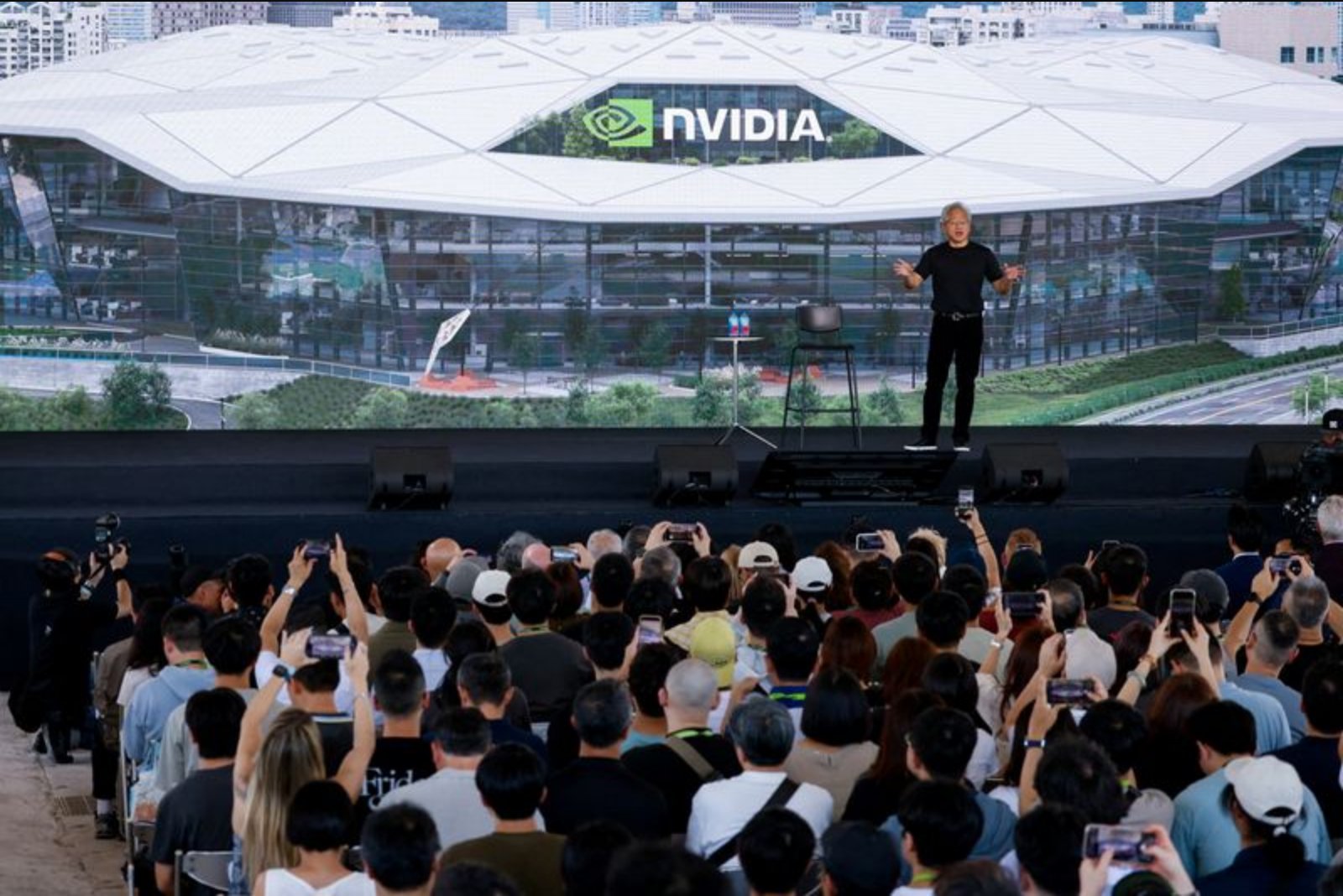
Taipei will again serve as a focal point for the global technology industry when Computex convenes next week, but this year the show’s emphasis appears to be shifting from consumer gadgets to the systems and services that underpin artificial intelligence. Nvidia’s CEO Jensen Huang, who arrived in Taipei more than a week before the event, has underscored that pivot with a bold investment projection that highlights Taiwan’s growing importance to AI deployment.
Huang said on Wednesday that Nvidia could spend up to $150 billion a year in Taiwan, calling the island the epicentre of the AI revolution. He also charted the company’s expanding partner network as evidence of the island’s centrality: "Many years ago, we had 10 partners. Five years ago, maybe 50 partners. Now we have 150 partners," Huang said.
AMD has also signalled a heavy commitment to Taiwan’s AI ecosystem. CEO Lisa Su said last week that AMD intends to invest more than $10 billion in the island’s AI sector, and that the company is co-investing with Taiwanese partners to secure sufficient capacity for expansion in 2026 and beyond. Those commitments reflect a broader pattern: Taiwan’s technology cluster now includes not only chip foundries but AI server manufacturers, advanced packaging houses and an array of component suppliers that together support the data-centre build-out.
"Taiwan’s AI role is moving from a semiconductor story to an infrastructure story," said Ryan Fletcher, a partner at McKinsey & Company. "The question is no longer only who makes the chip, but who can turn it into a powered, cooled, networked and serviceable AI system." That formulation draws attention to integration work - system assembly, power and cooling engineering, networking and serviceability - that sits beyond pure chip design but is essential to deploy large-scale AI workloads.
Nvidia will dominate the public-facing narrative at Computex. The trade show runs June 2-5 and will open with a keynote by Huang on Monday. Over the course of his time in Taiwan he has maintained an intensive schedule of meetings and dinners with supply-chain executives, including TSMC CEO C.C. Wei, Foxconn Chairman Young Liu and Quanta Computer Chairman Barry Lam. Nvidia’s recent strategy has increasingly skewed toward business and data-centre applications; at Computex the company is expected to showcase data-centre offerings such as its Vera Rubin AI computing platform and its Vera CPU, as well as developments in robotics and AI for manufacturing.
Executives from other global chip companies are also due to attend what organisers say will be the largest Computex yet, with 1,500 exhibitors. Confirmed attendees include Intel CEO Lip-Bu Tan, Qualcomm CEO Cristiano Amon and Arm CEO Rene Haas. Additional senior industry representatives scheduled to be present include Marvell CEO Matt Murphy and NXP Semiconductors CEO Rafael Sotomayor.
Intel’s presence is drawing particular attention. A keynote by Intel’s Tan will be watched for signals about the company’s strategic direction following his efforts to stabilise the firm. Bryan Ma, vice president for client devices research at IDC, said the speech will be a barometer for where Tan wants to take Intel next. Analysts will also be looking for product-level developments: long-rumoured Nvidia PC platform announcements, Intel’s Arc G-series processors for handheld gaming devices, and broader sentiment in the gaming market amid elevated memory prices.
Ian Cutress, chief analyst at More than Moore, expects Intel to emphasise partnerships and its renewed commitment to high-performance CPUs for AI inference. Those product and partnership narratives underscore how vendors are positioning to supply complete AI solutions, not just discrete silicon.
The backdrop to this technology-focused activity includes heightened geopolitical tensions. The article notes that China’s President Xi Jinping told U.S. President Donald Trump during their summit this month that mishandling Taiwan could lead to conflict between the two powers, and that China has increased its military presence around the island. Despite these tensions, commercial activity in Taiwan has continued to expand: exports of servers from Taiwan rose to $60 billion last year from $571 million in 2017, illustrating the rapid growth of a hardware ecosystem serving data centres and AI workloads.
With major chipmakers publicly expanding investment commitments and deepening local partnerships, Computex looks set to spotlight the practical infrastructure required to scale AI. The show will therefore serve not only as a product launch platform but also as a stage for the commercial arrangements and manufacturing capacity that underpin next-generation AI deployments.