
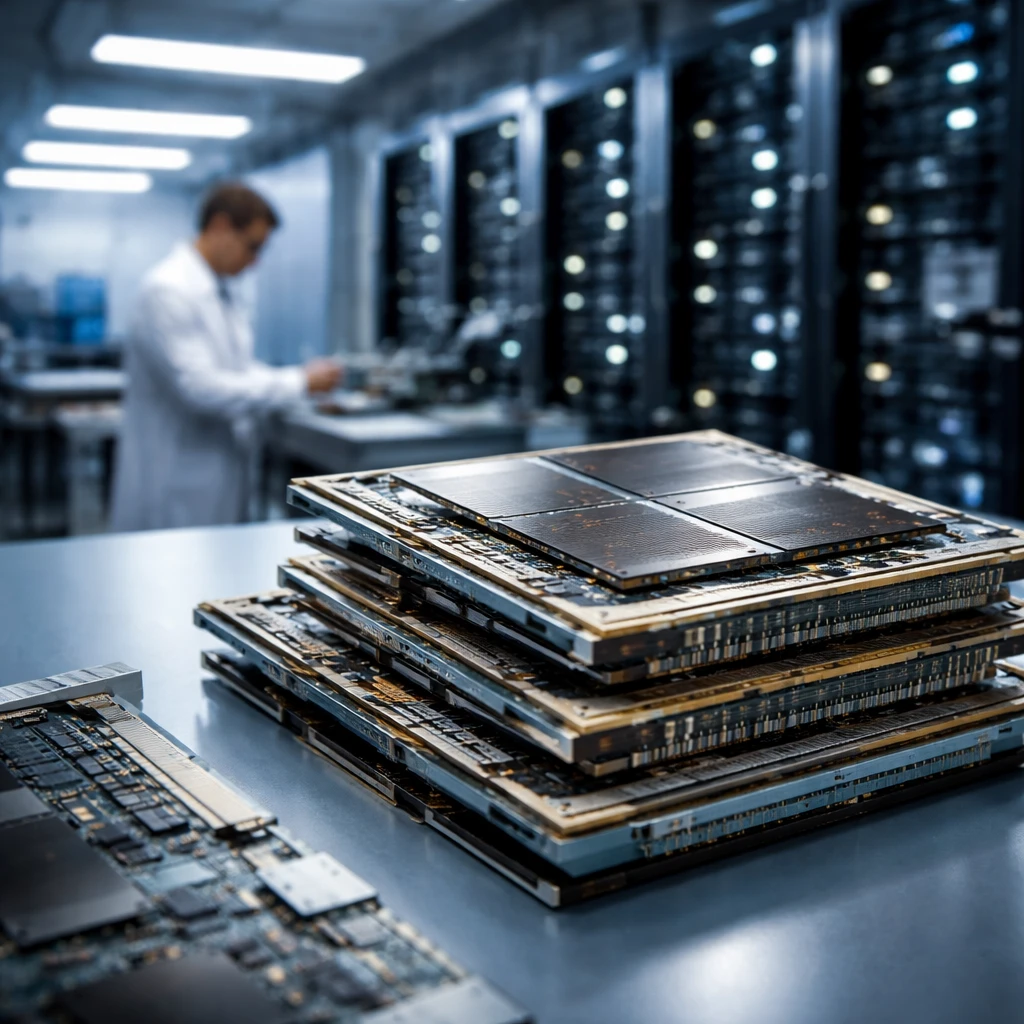
Nvidia has publicly confirmed that three major memory manufacturers have passed certification to supply HBM4 memory for its next-generation Vera Rubin AI accelerator platform. CEO Jensen Huang made the confirmation on June 5, 2026, naming Samsung Electronics (LON:0593xq), SK Hynix Inc (KS:000660), and Micron Technology Inc (NASDAQ:MU) as approved vendors.
The certification disclosure, reported by Bloomberg, resolves months of speculation about which memory suppliers would qualify for Vera Rubin - the successor to Nvidia's Grace Blackwell GPU architecture. Vera Rubin moved into full production after its announcement at the GTC Taipei keynote on June 1, 2026. Nvidia states the new platform delivers 10x agent throughput at scale compared with the Grace Blackwell platform.
Huang’s description of the platform emphasized a new workload profile. In remarks tied to the production launch, he said: "Agentic AI is a new kind of workload. One prompt can launch a thousand-step journey of reasoning, retrieval, tool use and response generation." Huang added: "Vera Rubin was built for this moment - an AI factory engine that delivers intelligence at scale, with the performance, efficiency and security needed to power the next industrial revolution."
While Nvidia has not released official allocations of HBM4 volume among the certified suppliers, supply-chain analysts cited by TechTimes provided an indicative split. Their estimates put SK Hynix in the largest position, holding roughly 60-70% of Vera Rubin HBM4 volume, with Samsung capturing around 25-30% and Micron supplying the remainder. The analysts also noted that SK Hynix entered the qualification process earlier than its rivals, and that Samsung began mass-producing HBM4 in February 2026.
Huang's certification announcement coincided with a trip to South Korea. During the visit he is expected to meet with the chairs of major conglomerates - including SK Group, Samsung, LG Group, Hyundai Motor Group, and Naver - to discuss supply ramp commitments and potential physical AI partnerships. Earlier in the trip, on June 2, he publicly urged SK Hynix to increase production of HBM chips, telling reporters that global semiconductor supply remains tight - a comment that highlights the demand pressure Nvidia faces as it scales Vera Rubin deployments.
Market reaction to the certification has been mixed. The article noted intraday price movements across several tickers: Nvidia (NVDA) was up 1.82%, while Micron (MU) and the listed codes for Samsung and SK Hynix showed declines in the referenced price snapshots. Despite the supply approval news, Micron shares were reported as declining 4.4% ahead of the market open on June 5, 2026. The article attributes part of that weakness to broader technology sector pressure following a hot jobs report and to an "AI-stock hangover" after Broadcom's results the prior evening; Micron had also slid 7.7% on Thursday.
Beyond the certification and market moves, the original coverage included a description of an AI-driven stock selection tool. It stated that ProPicks AI evaluates NVDA alongside thousands of other companies each month using more than 100 financial metrics to assess fundamentals, momentum and valuation, and that the tool highlights stocks it considers to offer the best risk-reward based on current data. The piece noted examples of previous winners identified by that tool.
Key points
- Samsung, SK Hynix and Micron have all been certified to supply HBM4 for Nvidia's Vera Rubin platform, according to CEO Jensen Huang on June 5, 2026.
- Vera Rubin has entered full production after its June 1, 2026 unveiling and is described by Nvidia as delivering 10x agent throughput at scale versus its Grace Blackwell predecessor.
- Estimated HBM4 volume splits cited by supply-chain analysts place SK Hynix at roughly 60-70%, Samsung at about 25-30%, and Micron supplying the remainder - a distribution that affects semiconductor, AI hardware and data-center supply chains.
Risks and uncertainties
- Supply constraint risk - Global semiconductor availability remains tight, and Nvidia's scale-up of Vera Rubin places additional demand pressure on HBM4 production, affecting memory suppliers and data-center buildouts.
- Market volatility - Despite certification news, memory and broader tech stocks experienced notable price swings tied to macroeconomic data and quarterly results from other AI-related companies, which can impact supplier valuations and financing conditions.
- Allocation opacity - Nvidia has not disclosed official volume allocations, so estimates of vendor share are based on third-party analyst projections rather than company confirmation, leaving uncertainty about exact supplier commitments.