
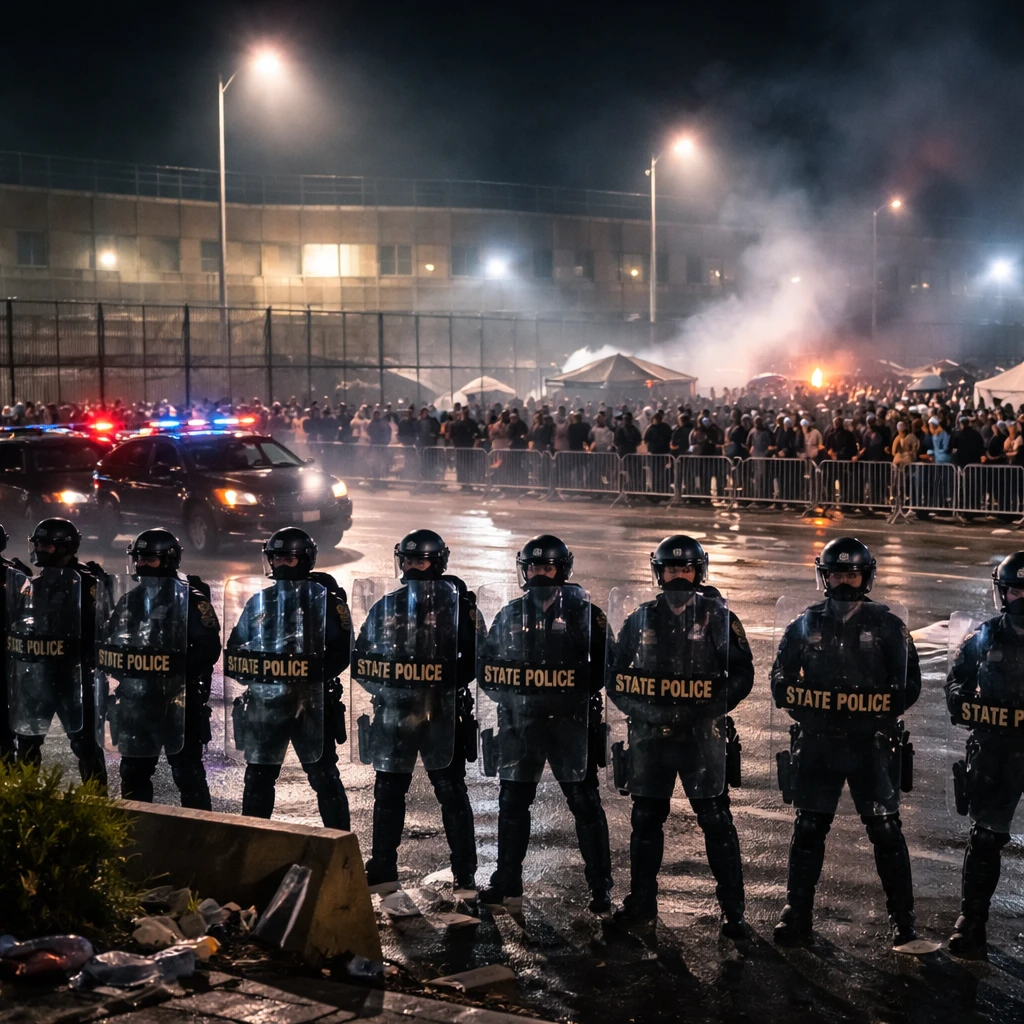
New Jersey Governor Mikie Sherrill said on Saturday that people traveling from outside the state and members of "national extremist groups" have elevated tensions at demonstrations outside Delaney Hall, an immigration detention facility in Newark, prompting city authorities to impose an overnight curfew in the immediate area.
Sherrill, who deployed state police to manage the perimeter of Delaney Hall, said that five of the six people arrested on Friday were from out of state. She said those who came to the protests seeking to provoke confrontations were not helping detainees or their families and were undermining public safety.
"You should not be here," she said of those who joined to create disorder. "You are not helping the people detained at Delaney Hall. You’re not helping detainee families and you’re certainly not keeping New Jersey safe."
Mayor Ras Baraka announced a targeted curfew covering roughly a half-mile radius around Delaney Hall. In a post on X, he said Doremus Avenue would be closed to pedestrians beginning at 12 a.m., with vehicle access limited to those with verified official business. The curfew will run nightly from 9 p.m. to 6 a.m. until further notice, he said.
State police said they established "protected protest zones" after several days of confrontations between demonstrators and federal agents outside the 1,000-bed detention center, where detainees had launched a labor and hunger strike, citing what they described as inhumane conditions and demanding release.
Sherrill said authorities should focus on advocating for better conditions inside Delaney Hall rather than allowing disruptions outside the facility to derail that effort. "That’s exactly where our focus needs to be right now, advocating for better conditions for those inside the facility," she said. "We can’t let what’s happening outside Delaney Hall take us away from that mission."
The GEO Group operates Delaney Hall for Immigration and Customs Enforcement. Homeland Security Secretary Markwayne Mullin rejected the complaints about the facility and called the involvement of state police a victory for law and order.
Sherrill, a Democrat, said federal agents' tactics, including the reported use of batons, had contributed to heightened tensions. She said ICE's actions in crowd-control situations had not helped public safety and that the state was working to ensure there was no pretext for federal officials to escalate their response.
"What we have been working towards now is ensuring that ICE has no pretextual reason whatsoever to exacerbate this situation," she said at a news conference, reiterating her call for Delaney Hall to be closed.
New Jersey state police described efforts to provide spaces where protesters could assemble while maintaining order. Lieutenant Colonel David Sierotowicz said demonstrators who were ordered to disperse on Friday night encircled a law enforcement vehicle and directed threats at personnel. He added that some activists retrieved items such as face coverings, gas masks, fireworks, rocks and other projectiles from a tent area nearby.
Video from Friday showed law enforcement advancing with riot shields and deploying tear gas. Sierotowicz characterized the police response as standard tactics to push the crowd back and said there were no significant injuries reported among the public or law enforcement. "We were not striking anybody last night," he said.
Officials reiterated that protests are permitted so long as they remain peaceful. At mid-afternoon on Saturday dozens of demonstrators chanted slogans while staying behind barriers set up by police.
Sherrill expressed gratitude to the majority of protesters who she said had assembled peacefully to raise concerns about conditions inside Delaney Hall. She urged those gathering outside the facility to "bring the temperature down," so attention could remain on detainees and their families.
Officials cited concerns about possible further escalation and pointed to instances elsewhere where confrontations have turned deadly. They said avoiding an increase of federal agents on site and discouraging provocative behavior outside the detention center were key priorities in the near term.
The situation remains fluid as city and state officials balance the protection of peaceful protest activity with public safety measures, while detainees and their families continue to demand improvements within Delaney Hall.