
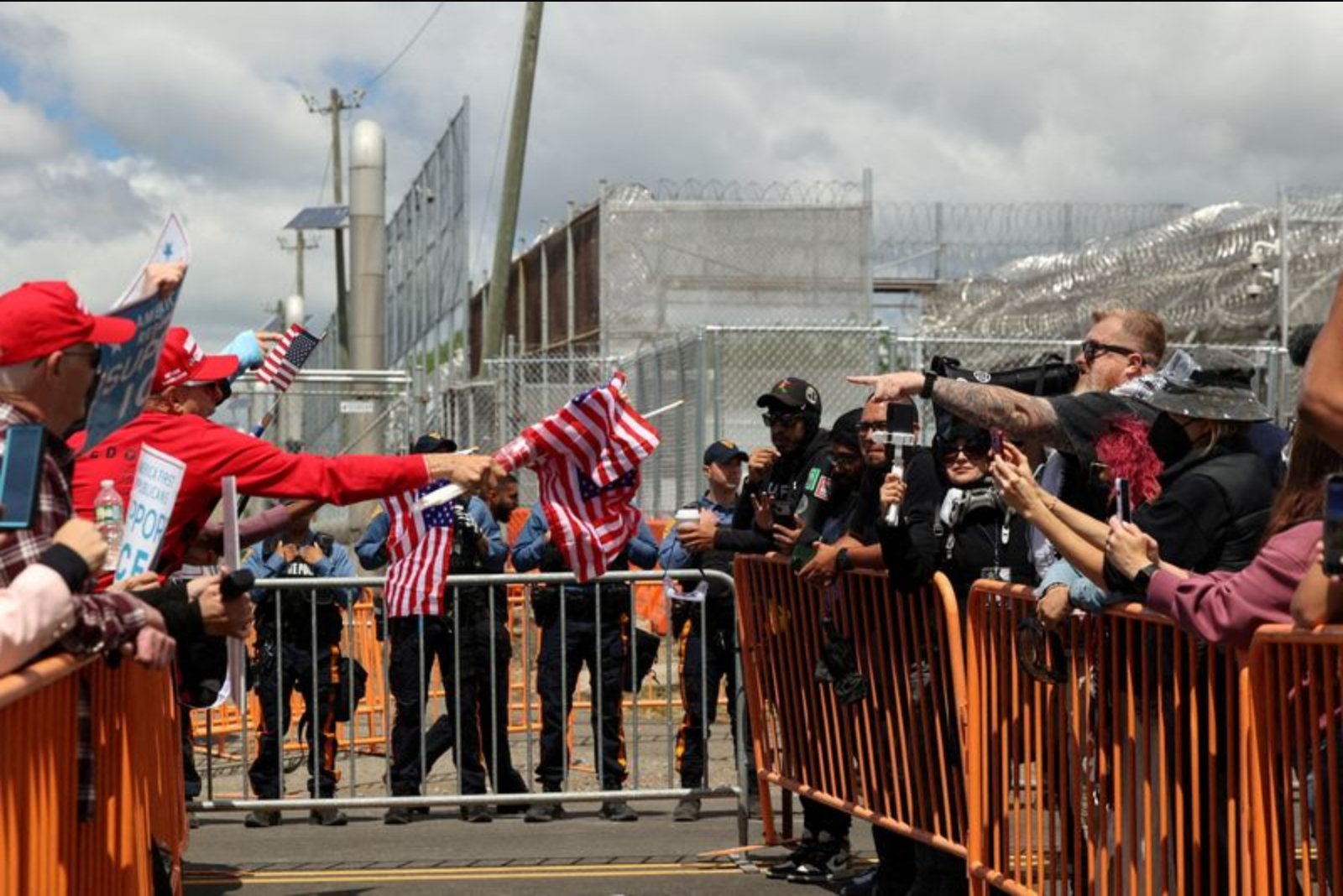
New Jersey's governor said state police who were deployed near a Newark immigrant detention facility identified out-of-state participants as key instigators of escalating unrest during protests this week. The governor made the comments after ordering state police to take charge of security outside Delaney Hall following a string of confrontations between demonstrators and federal officers.
At a news conference on Saturday, the governor said that five of six people arrested late Friday were not residents of New Jersey and warned those who traveled in to provoke unrest that they were doing no favors for the detainees or their families. "You should not be here," she said, addressing those she described as coming to create chaos. "You are not helping the people detained at Delaney Hall. You’re not helping detainee families and you’re certainly not keeping New Jersey safe."
State police established so-called "protected protest zones" after several days of escalating confrontations outside the 1,000-bed facility, where detainees had announced a labor and hunger strike aimed at drawing attention to what they characterized as inhumane conditions and to press for their release. The governor said the priority should remain on advocating for improved conditions inside Delaney Hall rather than allowing events outside the facility to divert attention from that mission.
"That’s exactly where our focus needs to be right now, advocating for better conditions for those inside the facility," she said. She also expressed appreciation for the large majority of demonstrators who have assembled peacefully to voice concerns about conditions at Delaney Hall.
The facility is operated by the Geo Group, identified by the ticker GEO.N, under a contract with federal immigration authorities. Homeland Security Secretary Markwayne Mullin has rejected allegations about conditions at the facility and described the involvement of state police as a "win for law and order." The governor, a Democrat, said federal actions at the site - including the use of batons and other crowd-control measures - had in some instances raised tensions and were not appropriate for the situation.
"They have been increasing tensions in a way that’s not helpful to public safety," she said, reiterating her call for the closure of Delaney Hall. The governor added that her objective in taking state control of the perimeter was to ensure protests remain peaceful, to protect public safety, and to avoid a further influx of federal personnel. "What we have been working towards now is ensuring that ICE has no pretextual reason whatsoever to exacerbate this situation," she said.
Officials noted that clashes between immigration officers and demonstrators have occasionally become violent in other states, pointing specifically to incidents in Minnesota where federal personnel fatally shot two people and injured others. That history helped shape New Jersey authorities' decision to try to maintain clear, protected areas for lawful, peaceful assembly while limiting escalatory interactions.
State police described events late Friday as tense. Lieutenant Colonel David Sierotowicz said protesters who were ordered to disperse surrounded a law enforcement vehicle and issued threats toward personnel. He reported that some activists were observed retrieving face coverings, gas masks, fireworks, rocks and other objects from a nearby tent area. Video from Friday showed officers advancing with riot shields and deploying tear gas, and Sierotowicz said officers used standard crowd-control tactics to move the crowd back. He added there were no significant injuries to members of the public or to law enforcement and stated, "We were not striking anybody last night."
Officials emphasized that protests are welcome so long as they remain peaceful. By mid-afternoon Saturday, authorities said dozens of demonstrators were chanting but staying behind barriers set up by police. The governor urged protesters to "bring the temperature down" in order to refocus attention on detainees and their families.
The sequence of events underscores tensions between state and federal approaches to crowd control and facility operations, and reflects the polarizing effect such detention facilities can have on local communities. State officials are balancing the First Amendment rights of demonstrators with concerns about public safety and the potential for conflict to spiral, while also attempting to limit circumstances that federal authorities might assert as justification to deploy additional forces.
For now, New Jersey's state police remain in control of the area surrounding Delaney Hall, and state leaders say their priority is to preserve a safe space for lawful protest while keeping the focus on the conditions inside the detention center and the welfare of those held there.