
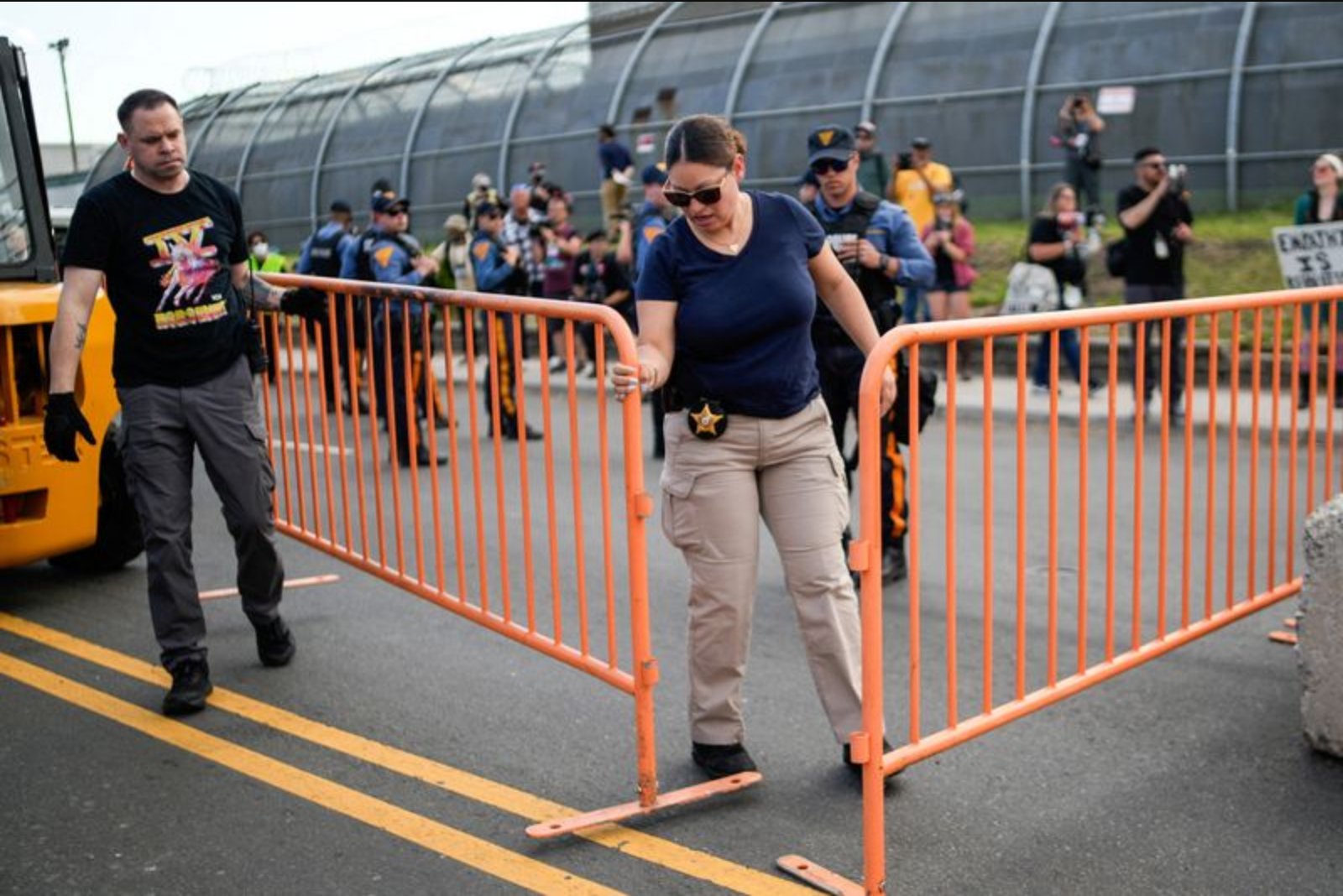
New Jersey's governor ordered state police to assume operational control of the perimeter around Delaney Hall in Newark as tensions escalated between demonstrators and federal Immigration and Customs Enforcement officers. The facility, a 1,000-bed detention center run by the private firm Geo Group on behalf of ICE, has been the focal point of repeated confrontations over the past week.
Governor Mikie Sherrill, a Democrat who has publicly urged the closure of Delaney Hall, said the move was intended to calm rising violence and preserve both public safety and the right to assemble. She framed the action as a means to prevent expanded ICE operations in the state, telling reporters, "I will not give ICE the pretext to expand operations in our state." She made the announcement alongside state Attorney General Jennifer Davenport and acting state police Superintendent Jeanne Hengemuhle.
State police described operational changes they implemented on site. Lieutenant Colonel David Sierotowicz said forces had established "protected protest zones" beyond the facility gates to give demonstrators designated and safer locations to gather. Authorities also put in place vehicle checkpoints to manage traffic flow. "ICE agents and their partners have agreed to remove themselves from the immediate area," he said.
Officials added that anti- and pro-ICE demonstrators would be directed to separate assembly zones to keep opposing groups apart. The aim, as described by state officials, is to reduce incidents of physical confrontation that had marked several recent demonstrations.
Federal officials publicly welcomed the state actions. In a message posted on social media, U.S. Homeland Security Secretary Markwayne Mullin called the New Jersey moves a "win for law and order" and thanked the governor for "allowing New Jersey State Police to cooperate with us." Mullin said Sherrill had previously "refused to allow state police to assist @ICEgov law enforcement against violent anti-ICE rioters."
Daily gatherings of protesters outside Delaney Hall began late last week after detainees inside reportedly alerted relatives and supporters to launch a labor and hunger strike. Those inside described conditions they called inhumane, listing complaints such as "food containing worms in a state of decay," defective ventilation, unsanitary bathroom facilities and an unchecked spread of influenza-like illness within the center.
Mullin denied those allegations and characterized the facility's provisions differently, saying detainees receive adequate calories and sanitation while adding, "it isn’t a Holiday Inn."
The facility is reported to hold more than 850 immigration detainees, of whom roughly 100 had criminal convictions, according to figures cited by the Deportation Data Project, an organization that collects and analyzes U.S. government data on immigration detention.
The situation drew comment from national political figures as well. President Donald Trump, addressing the issue during a White House Cabinet meeting, described Delaney Hall as "a nice facility" that was performing well. He also dismissed the demonstrators as inauthentic, saying, "These aren’t protesters, these people are fake," and alleging without evidence that some participants were being paid to rally.
Confrontations between ICE agents and demonstrators have occurred intermittently, with federal officers deploying batons and pepper spray in some encounters. Mullin reported that six protesters were arrested on Wednesday during recent clashes. Among those affected was U.S. Senator Andy Kim of New Jersey, who went to the site in support of demonstrators and was reportedly pepper-sprayed earlier in the week.
Governor Sherrill engaged directly with the protest movement, joining demonstrators on Memorial Day and attempting to visit the detention center. ICE denied her entry; instead, she said she listened to a detainee by telephone from outside the facility. Mullin characterized her attempt as "nothing more than a political stunt."
Sherrill issued a statement emphasizing the human dimension of those detained: "The people inside Delaney Hall are fathers and mothers, sons and daughters, and members of our community," she said. "In New Jersey, we believe in the rule of law and that everyone deserves to be treated with basic dignity."
State health officials also engaged with the site. On Thursday, several representatives from the New Jersey Health Department inspected Delaney Hall, but officials were allowed to review only the food service area and the kitchen. As of Friday, the department had not released any findings from that inspection.
The immediate operational outcome of the state police assumption of control was described as an effort to create structured, separated areas for protesters and to limit the federal agents' presence at the facility perimeter. Officials said the measures should reduce direct contact between demonstrators and ICE personnel and give law enforcement tools to manage vehicular access through checkpoints.
How the arrangement will evolve was not detailed further by state or federal officials as of Friday. The public health concerns, detainee allegations and the political and law enforcement responses remain active elements of the situation around Delaney Hall.