
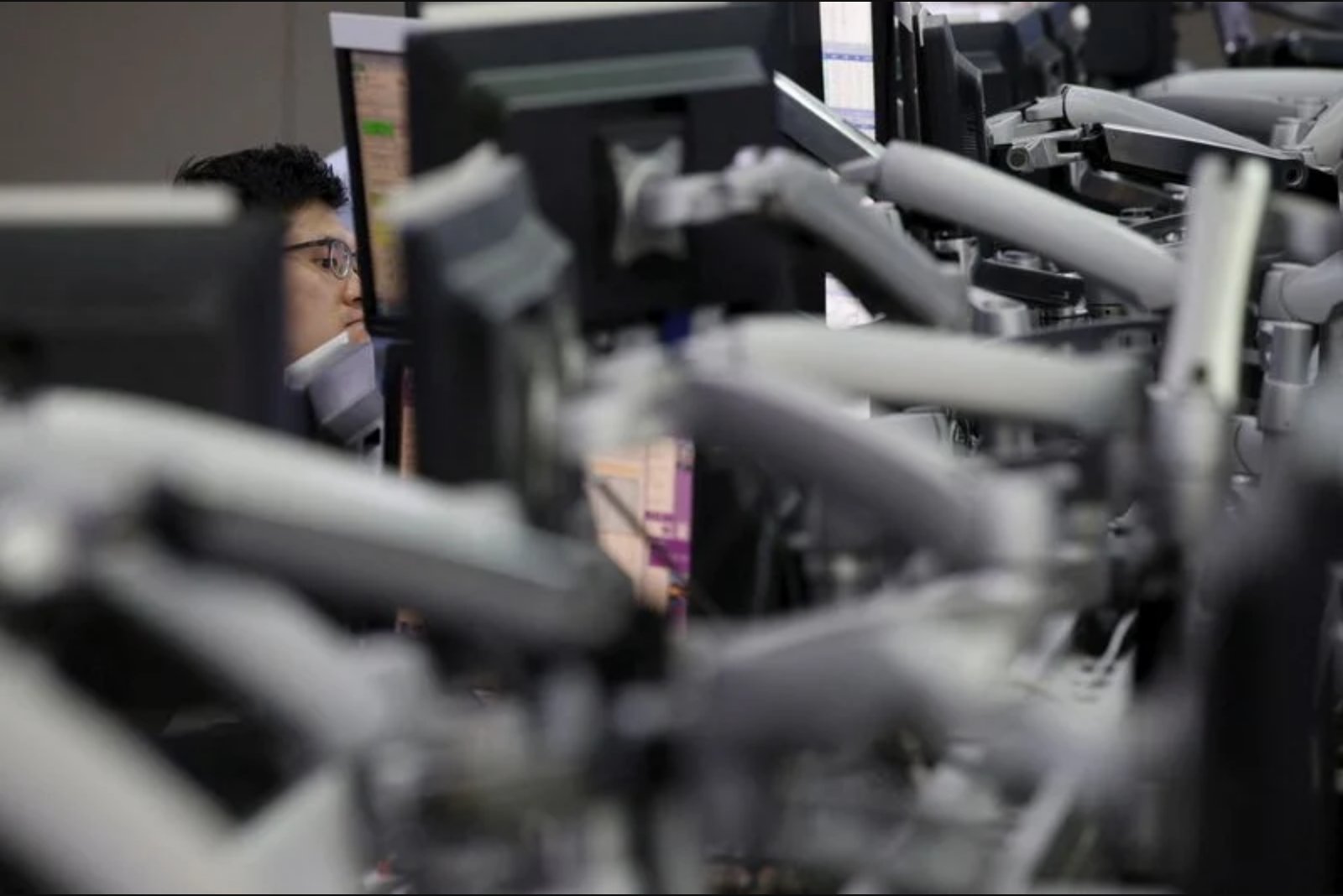
Asian stock markets retreated on Friday as profit-taking in technology shares combined with heightened geopolitical uncertainty to push investors toward safer assets ahead of the weekend. The pullback followed fresh signs that attempts to halt hostilities in the Middle East have stalled and a cooling of the recent AI-led market rally after a noted chipmaker delivered results that failed to meet lofty expectations.
MSCI's broadest index of Asia-Pacific shares outside Japan slipped 1.6% in early Asian trade. South Korea's tech-focused Kospi plunged by more than 6%, while Japan's Nikkei declined about 1.3%.
Market participants pointed to two primary drivers: a deterioration in the outlook for peace efforts involving the United States and Iran, and a pullback in AI-driven demand expectations after Broadcom reported results that disappointed investors. The Iran-backed Hezbollah militia rejected a proposed ceasefire in Lebanon, and Israel announced it would not withdraw troops from the country, developments that, according to the reporting, weakened hopes for progress in U.S. President Donald Trump's plan to curb fighting and reach a deal with Tehran.
"(It) seems like quite a risk-off today," said Charu Chanana, chief investment strategist at Saxo. She noted that Korea had been among the largest beneficiaries of the AI memory cycle, and when Broadcom disappointed on AI expectations, investors rapidly de-risked across the semiconductor supply chain. "The issue is not that AI demand has disappeared - it is that expectations had become extremely high, and even good numbers are no longer enough unless guidance keeps moving higher," she added.
U.S. equity futures reflected the softer tone from Asia and a mixed session on Wall Street overnight. Nasdaq futures were down roughly 1%, while S&P 500 futures eased about 0.5%. In Europe, EUROSTOXX 50 futures dipped 0.2%, DAX futures lost 0.5% and FTSE futures were broadly flat.
Oil and macro flows
Energy markets remained sensitive to the geopolitical backdrop. Brent crude futures were steady at around $95 a barrel and were positioned to rise by more than 3% on the week. U.S. crude slipped about 0.3% to $92.73 per barrel in intraday trade but was on track to gain more than 6% for the week.
Kristian Kerr, head of macro strategy at LPL Financial, warned that markets may be underestimating the complexity of restoring shipping through the Strait of Hormuz to pre-conflict norms, even if Washington and Tehran reach a memorandum of understanding. He suggested early increases in available barrels would likely come from oil already produced or held on floating vessels and in storage rather than from an immediate restart of production or exports. "In other words, this is more about clearing existing bottlenecks than reflating the supply base," Kerr said.
Currencies and safe-haven moves
The dollar was on track to finish the week about 0.5% stronger, supported in part by the Middle East tensions. The yen hovered near the 160-per-dollar mark, last quoted at 159.96, after Japanese authorities stepped up warnings about the weak currency and kept markets alert to the potential for intervention. Data released on Friday showed Japan's foreign reserves fell by $77 billion in May.
Other major currencies were relatively steady: the euro was last at $1.1611 and sterling near $1.3421. Investors' attention shifted to U.S. nonfarm payrolls due later in the day, with market consensus forecasting an increase of 85,000 in employment and an unchanged unemployment rate at 4.3%. Analysts note that a stronger-than-expected reading could reduce the probability of a Federal Reserve rate hike in the near term.
Spot gold eased 0.2% to $4,465.23 an ounce in intraday trade.
What this means for markets
With geopolitical risks elevated and AI-fueled enthusiasm tempered by corporate results, investors appeared to recalibrate exposures across technology and commodity-related sectors. Semiconductor-linked equities and broader tech baskets took much of the brunt of selling, while energy and safe-haven assets gained attention due to ongoing Middle East uncertainty and potential disruptions to shipping and supplies.
Market focus will remain on upcoming U.S. labor data for further direction on interest rate expectations and on how diplomatic developments in the Middle East evolve over the weekend.
Note: Quotes and data in this report reflect market conditions and statements as presented in the underlying market updates.